

The robot economy is no longer a distant concept reserved for science fiction. Autonomous machines are already performing logistics, monitoring infrastructure, assisting in healthcare, and supporting industrial automation. As artificial intelligence becomes more capable and robotics hardware becomes more affordable, the number of machines interacting with the real world will increase dramatically. The challenge is not simply building smarter robots. The real challenge is building trust between machines, developers, businesses, and users. This is where the idea of cryptographic proofs and universal staking becomes important, and why the ROBO ecosystem is attracting attention within the broader crypto and AI infrastructure narrative.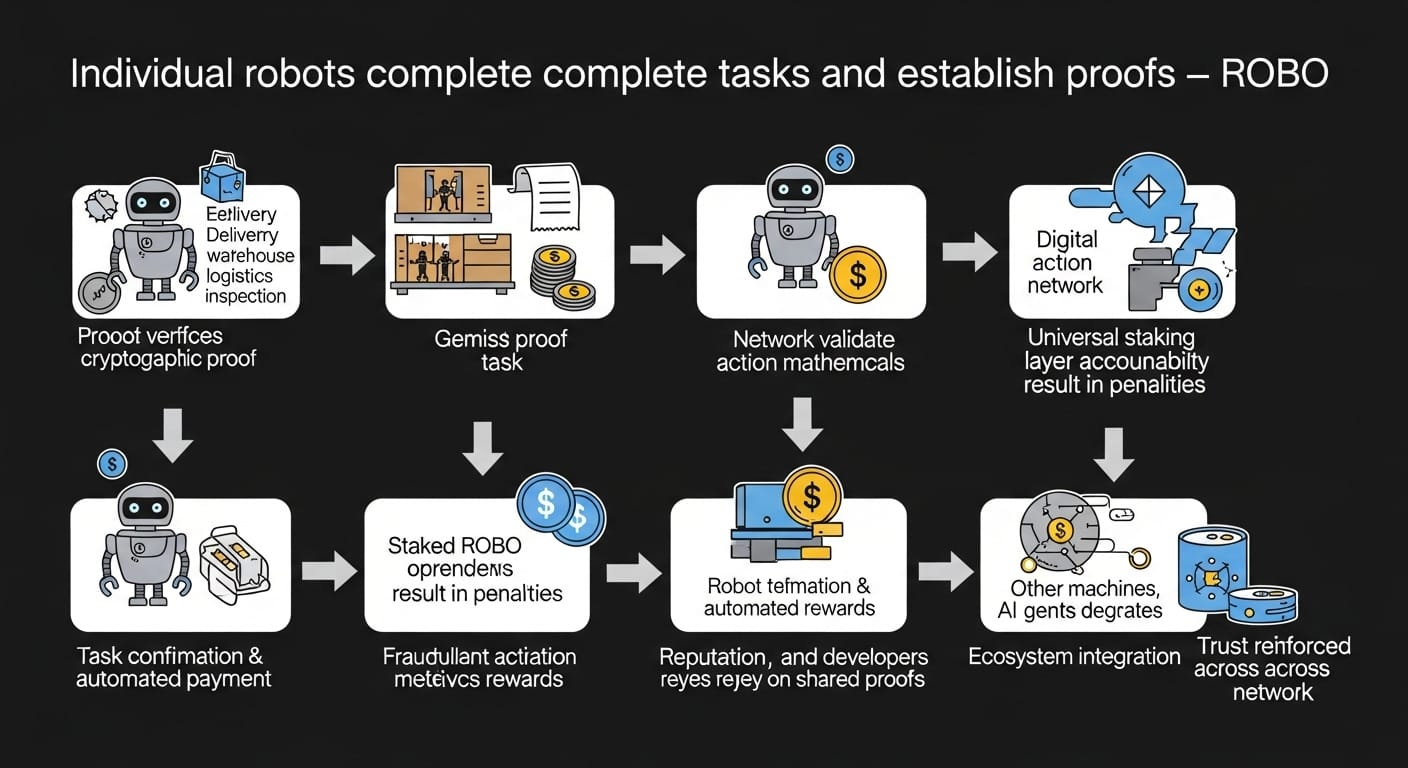
At the core of the robot economy lies a simple problem. Machines will eventually perform economic work. When a robot completes a delivery, processes a warehouse task, inspects a pipeline, or contributes computing power, the system must verify that the work actually happened. In traditional corporate environments this verification is handled by centralized platforms. A company owns the robot, controls the database, and confirms the result. In an open machine network the situation is very different. Robots may belong to different organizations and operate across multiple jurisdictions. Trust cannot depend on a single operator.
Cryptographic proofs offer a solution to this coordination challenge. Instead of asking participants to trust a central authority, machines can generate verifiable proofs of their actions. These proofs act like digital receipts that confirm specific events occurred according to the network rules. If a robot claims to have completed a delivery route or executed a computational task, the proof verifies that the work was performed correctly. Anyone interacting with the system can independently confirm the result without needing to trust the robot operator.
From my perspective, this shift is extremely important for the future of decentralized infrastructure. Crypto networks solved a similar trust problem for financial transactions. Blockchain allowed strangers on the internet to agree on ownership of digital assets without trusting each other. The robot economy introduces a new version of that problem. Instead of verifying financial transfers, the network must verify physical actions and machine contributions. Cryptographic proofs extend the same logic of trustless verification into the world of autonomous machines.
Within the ROBO ecosystem, cryptographic verification plays a central role in how work is recognized and rewarded. When robots or AI agents perform tasks, the network records verifiable evidence that the task occurred. These proofs become the foundation for automated payments, reputation systems, and network coordination. Without reliable verification, a decentralized robot economy would quickly collapse under false claims and inaccurate reporting.
Another important mechanism strengthening trust is universal staking. In many decentralized networks, staking functions as an economic security layer. Participants lock tokens as collateral to demonstrate commitment and align incentives with the health of the network. In the context of robotics, staking can serve a similar purpose but with a broader role. Robot operators, service providers, and developers may stake ROBO tokens to participate in the network and validate activity.
This approach introduces accountability. If a robot operator attempts to submit fraudulent task data or manipulate results, the staked assets can be penalized. The economic cost discourages malicious behavior and encourages honest participation. In a system where thousands of machines may operate simultaneously, this incentive structure becomes a powerful enforcement mechanism.
A useful chart could be placed here to illustrate the trust flow within the robot economy. The diagram could show a robot completing a task, generating a cryptographic proof, submitting it to the network, and receiving payment through the ROBO ecosystem after verification. This visual helps explain how machine work transforms into verifiable economic activity.
Universal staking also provides a shared security layer across different parts of the ecosystem. Rather than having isolated validation processes for each application, the staking mechanism creates a unified economic backbone for the network. Developers building robotic applications can rely on this foundation instead of designing custom trust models for every deployment.
For developers this simplification matters more than most people realize. Robotics stacks are already complicated. Hardware interfaces, control algorithms, sensor integration, and safety protocols demand enormous engineering effort. Adding custom verification and payment systems on top of that complexity can slow innovation significantly. A network that provides built in trust and economic coordination removes a major barrier to experimentation.
Another chart could visualize this infrastructure stack. The bottom layer would represent physical robots and sensors interacting with the real world. The next layer would represent computation and AI agents controlling the machines. Above that would sit cryptographic proof systems verifying actions. At the top would be the economic coordination layer powered by universal staking and ROBO based incentives.
The timing of these ideas also aligns with several broader trends in the crypto market. The rise of AI agents, decentralized physical infrastructure networks, and machine based service platforms is pushing blockchain technology beyond financial applications. Investors and builders are beginning to explore how decentralized coordination can manage real world systems.
Projects exploring the machine economy often face skepticism because the vision sounds ambitious. However, the core logic is surprisingly straightforward. If autonomous machines are performing valuable work, they need identity, verification, and payment rails. Without these elements the system remains fragmented and difficult to scale.
From a market perspective, this narrative creates both opportunities and risks. On the opportunity side, infrastructure supporting machine based economies could become a foundational layer for future automation networks. Developers may build applications that connect robotics fleets, industrial systems, and AI agents through shared verification and economic frameworks.
On the risk side, the technology remains early. Verifying real world actions through cryptographic systems is technically complex. Latency and scalability challenges still exist in many blockchain environments. Robotics itself is a demanding field where reliability and safety standards are extremely high. The adoption curve may therefore be slower than market enthusiasm suggests.
Another risk lies in token economics. Staking models rely on stable incentive structures. If the value of the token fluctuates dramatically, it can influence the behavior of participants in unpredictable ways. Developers and operators must carefully design incentive systems that remain sustainable under different market conditions.
Despite these challenges, the combination of cryptographic proofs and universal staking offers a compelling framework for building trust in machine based economies. The concept blends technical verification with economic incentives, creating a system where both mathematics and market dynamics reinforce honest behavior.
From my personal perspective, the most exciting aspect of this model is how it mirrors earlier stages of crypto innovation. In the early days of blockchain, many people questioned whether decentralized verification could support global financial activity. Over time, the technology proved capable of coordinating billions of dollars in value without centralized oversight. The robot economy could represent the next evolution of that idea.
If millions of autonomous machines eventually participate in economic activity, the systems coordinating them will need to be transparent, verifiable, and economically secure. Cryptographic proofs confirm what machines do. Universal staking aligns incentives between participants. Together they create a foundation where the robot economy can grow without relying on centralized control.
For investors evaluating the ROBO ecosystem, the key signals will not only come from market price movements but from ecosystem development. Developer activity, real world integrations, and partnerships with robotics platforms will provide insight into whether the infrastructure is gaining traction.
For builders, the opportunity lies in creating applications that treat robots as economic agents capable of earning and transacting value. The sooner developers experiment with these ideas, the faster the infrastructure can evolve.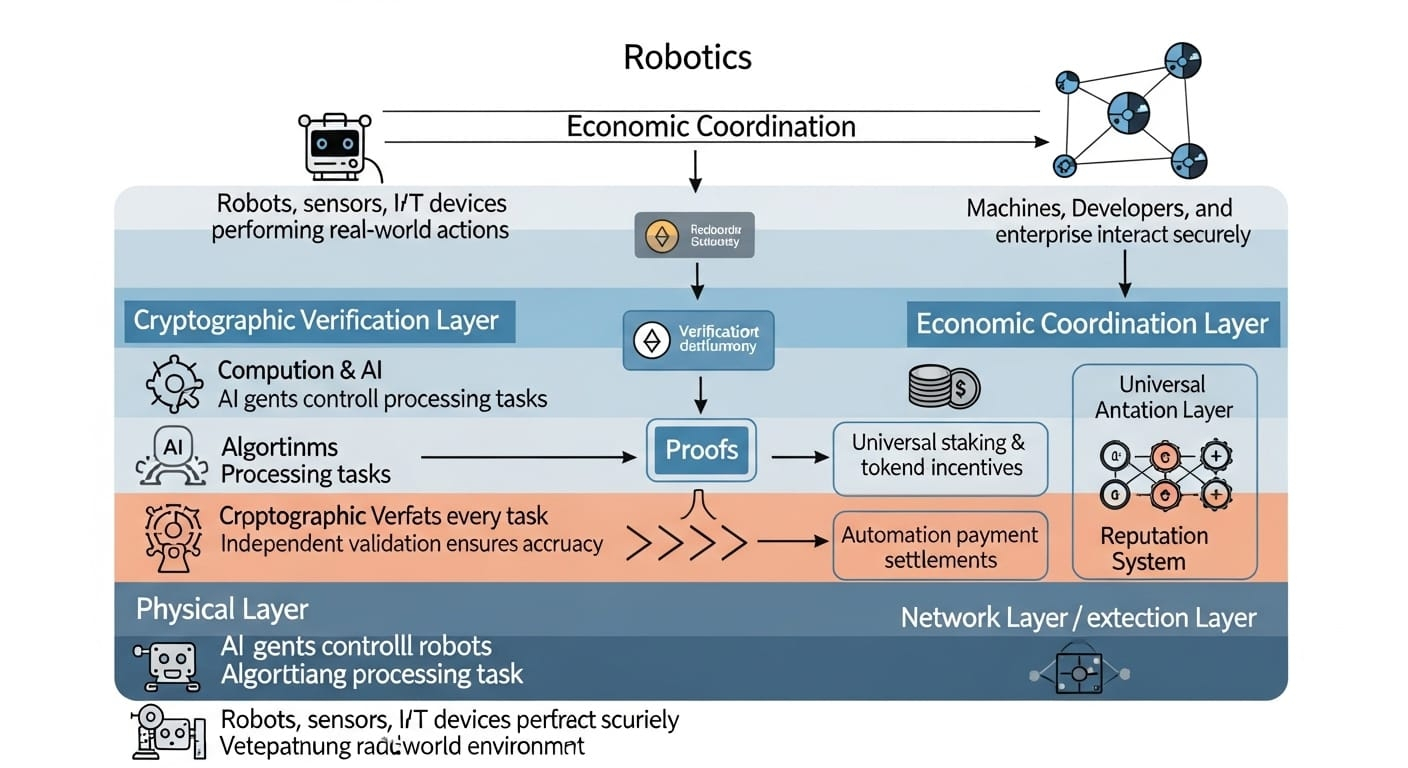
The broader takeaway is that trust remains the central challenge of decentralized systems. Whether the network coordinates financial transactions, digital assets, or autonomous machines, participants must believe the rules are enforced fairly. By combining cryptographic verification with universal staking incentives, the ROBO ecosystem is attempting to create that trust layer for the emerging robot economy.
@Fabric Foundation #ROBO $ROBO
