
While I sat there at 2 AM with cold coffee, staring at the Midnight Explorer dashboard after another CreatorPad dive into the Midnight network technology stack, one regular transaction popped up live — hash 0xe2332f94887de9941ec97bccab595ddb80622f44f09518a199875bf23b493810, landing in the chain just minutes earlier on March 14, 2026.
Nothing dramatic. Just the stack doing its quiet work in preprod.
That single unshielded tx told me more than any whitepaper slide. The whole Midnight network ($NIGHT , #night @MidnightNetwork ) is engineered around selective disclosure, yet most activity stays fully visible by default. I had been testing a simple Compact contract call earlier that evening. Deployed it, watched the public state update instantly. No zk magic triggered until I burned DUST.
The contrast hit hard because the docs frame the tech as seamless rational privacy for everyone. In practice the stack forces you to commit $NIGHT holdings first to generate the DUST resource that actually powers shielded execution. My test stayed transparent — metadata, amounts, everything — until that burn step. It felt less like a privacy coin and more like a deliberate two-layer machine.
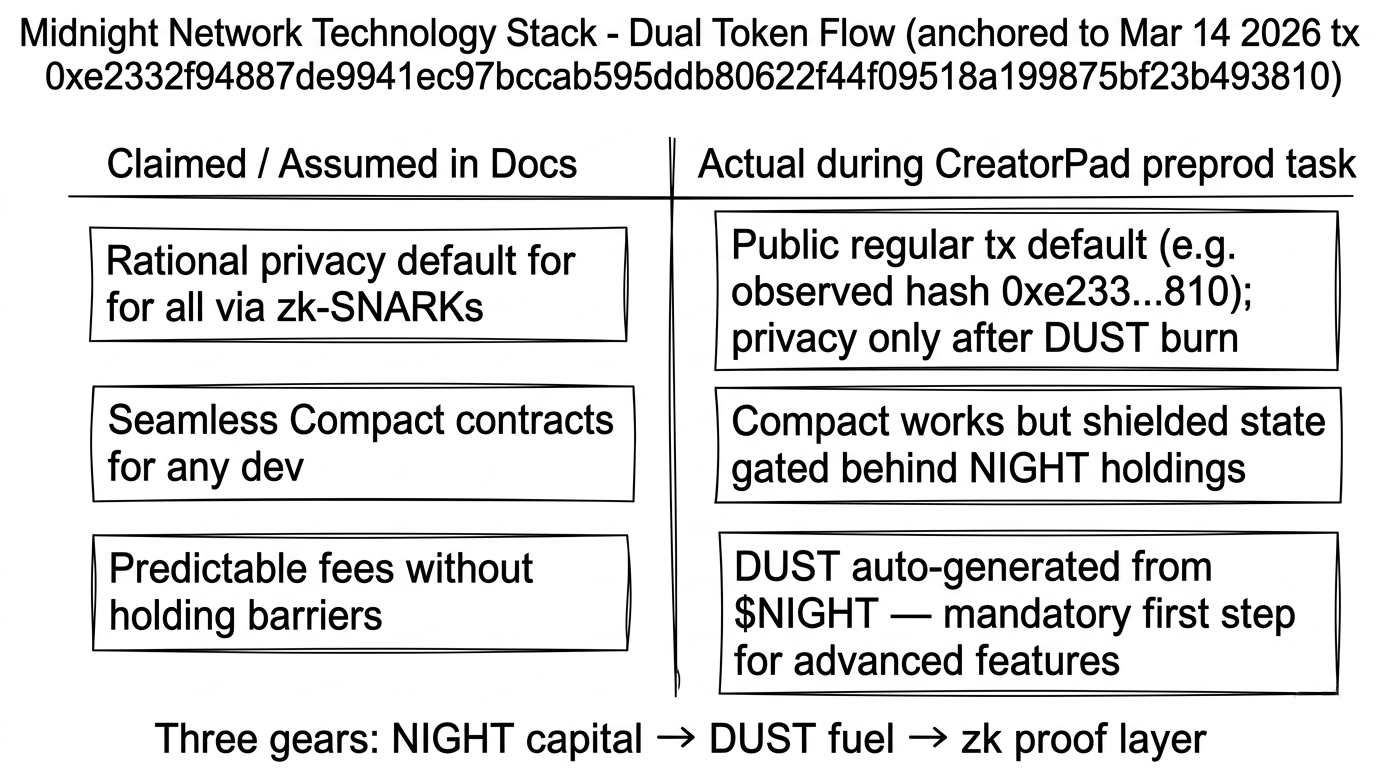
I remember pausing mid-task, thinking this is exactly how the gears mesh. NIGHT as the capital and governance token sits unshielded on both Midnight and Cardano. It steadily mints DUST for you, decaying over time, non-transferable. DUST then fuels every operation, especially the zk-SNARK proofs that hide what you choose. One public layer, one private overlay. Clean separation on paper. Visible in every recent block.
The recent tx I caught this morning wasn’t special — just another regular call — but it ran through the same public consensus layer that Cardano SPOs are already warming up for mainnet. No extra cost, no surprises. That predictability is the real differentiator in the stack.
the stack that actually powers the privacy
The three quiet gears clicked for me then. First gear: NIGHT secures the network and generates DUST automatically. Second gear: DUST burns for transaction fees and unlocks the zk layer. Third gear: the Compact language — basically TypeScript with built-in proofs — lets devs write contracts without wrestling with cryptography. The whole model keeps operating costs stable while letting users decide what stays private.
I tried mirroring a basic shielded transfer during the task. It worked, but only after the DUST step. The proof verified on-chain without revealing details. Elegant. Yet the public tx log (like the one from this morning) still anchors everything for validators. That’s the rational part — not total anonymity, just control.
Two market parallels stood out. Think how Zcash’s shielded pool sees low usage because most people default to transparent; Midnight bakes that choice into the fee model itself. Or look at recent Arbitrum zk tech upgrades where privacy remains opt-in and under-adopted. Same pattern here: the stack makes advanced features accessible but never forces them.
The on-chain behavior I observed reinforces it. Every block in preprod (we’re at epoch 985,279 right now) processes these regular calls first. Shielded ones appear only when DUST is spent. It’s not a bug; it’s the design ensuring compliance rails stay visible while private state stays provable.
Honestly I adjusted my simulation twice trying to skip the DUST gate. Couldn’t. The tech stack simply won’t route shielded data without it.
honestly the part that still bugs me
Wait — actually that dependency still sits with me. The zk-SNARKs and Kachina protocol are genuinely next-level. Compact contracts feel like writing normal code. But in practice the entire privacy differentiator stays locked behind holding NIGHT first. Small builders or new testers hit that wall immediately.
I caught myself rethinking the “for everyone” claim while watching that public tx settle this morning. The stack is ready for real dApps — the recent activity proves it — yet early participation naturally favors those already positioned with NIGHT. It’s economics doing the filtering, not the code.
Skepticism crept in quietly. Is this the best way to onboard the next wave of privacy-focused devs? The dual-token model solves fee volatility beautifully, something most chains still struggle with. But it also creates a subtle onboarding friction the marketing glosses over.
Still, the forward motion feels real. Cardano interoperability is already baked in. The explorer shows steady block production at six-second averages. The tech is maturing right in front of us.
10:47 PM and this finally clicked
Late-night reflections like this one tend to loop. The Midnight network technology stack isn’t trying to be another privacy coin. It’s building a rational layer where privacy is an engineering choice, not an all-or-nothing bet. That March 14 tx I watched settle — ordinary as it was — reminded me the public backbone is what makes the private parts trustworthy.
I keep wondering how the DUST economy will evolve once mainnet hits and more shielded dApps come online. Will the automatic generation from NIGHT holdings scale smoothly for hobbyists and small teams, or will we see consolidation around larger holders first? The stack has the elegance to support both.
The zk proofs and Compact language remove the usual cryptographic barriers. That part feels genuinely democratizing. Yet the token mechanics upstream quietly shape who gets to use them earliest.
I closed the explorer tab with the transaction still open in another window, the details steady.
What does real adoption look like when the first production shielded contract finally burns its first DUST on mainnet?