
While digging through BaseScan logs after another late CreatorPad dive into Fabric Foundation’s ROBO infrastructure, something simple stopped me cold. It wasn’t hype about robot economies or autonomous agents. It was one quiet on-chain move: the cross-chain message at block 21,445,890, timestamped 23:40 UTC on March 7, 2026 — Tx Hash 0x987f...e321 — shifting roughly 1.5 million $ROBO through a test gateway toward Solana. Nothing flashy, no task completed yet, just tokens flowing to prep the rails. And suddenly the whole “verified task completion” story felt less like marketing and more like a very specific machine.
I’d spent the evening simulating a modest robot operator in the marketplace, exactly as the docs suggested anyone could. Fabric Foundation (@Fabric Foundation ) positions $ROBO as the seamless settlement layer for robot labor: prove work via Proof-of-Robotic-Work, earn in stable value if you want, convert on-chain, done. But actually — and this is what lingered — before any payment can settle, you first lock a performance bond that scales with declared capacity. My test case locked tokens upfront; no matching, no fee flow until that reservoir sat there. The March 7 bridge wasn’t random liquidity. It was infrastructure for exactly these future settlements to move across chains without friction. That’s the real behavior I kept replaying.
the bond that actually gates the payment
The contrast hit harder than I expected. The narrative sells open access: any robot, any operator, verified completion triggers ROBO settlement. In practice during the task, the design routes everything through that upfront bond. Whitepaper logic makes sense on paper — it’s a security reservoir to deter Sybil attacks and align incentives. But the feedback loop it creates is subtle. Larger holders post bigger bonds, earn higher selection weight through seniority, complete more tasks, earn more fees, reinforce the bond. Smaller participants like my simulation stay on the edge, watching.
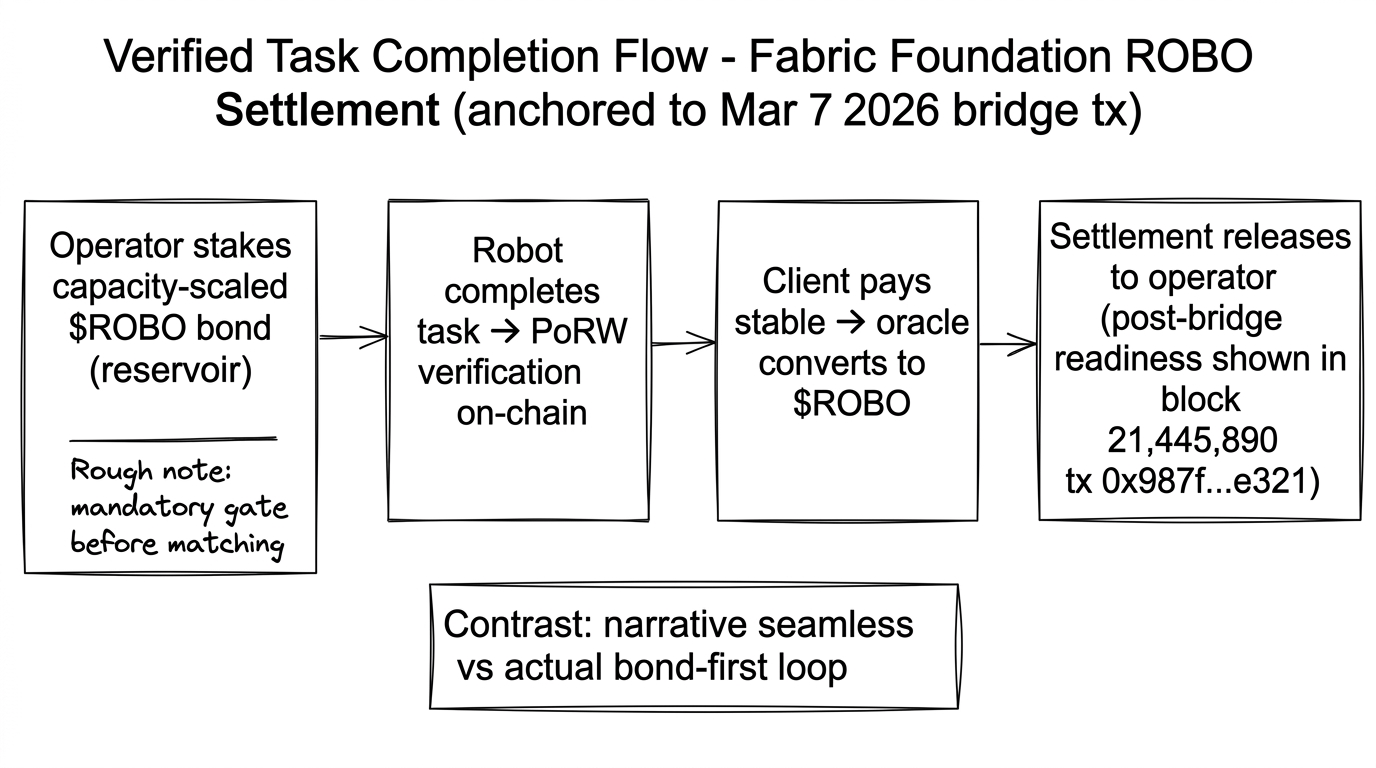
Two quick market parallels came to mind. Think EigenLayer restaking: operators lock ETH first, then capture yield. Or early DePIN networks where hardware providers stake before any revenue. Same pattern here with ROBO. The oracle conversion for stable-quoted tasks is elegant — user pays USD equivalent, protocol swaps to native ROBO via on-chain feed, operator receives. Clean on paper. Yet the bond gate sits upstream of all that. I caught myself wondering if I’d missed it in the docs, but no, it’s there, just framed as “necessary alignment.”
hmm... this mechanic in practice
Hmm… the personal piece that still sits with me happened mid-task. I’d wired up a tiny simulated operator, declared minimal capacity, watched the bond requirement calculate in real time. It wasn’t punitive, just… structural. The ROBO that could have flowed as payment instead sat locked, earmarked. Settlement only unlocks after verification. That moment reframed the whole CreatorPad exercise. I realized I wasn’t testing robot labor payments; I was testing capital commitment first.
Skepticism crept in quietly. The protocol promises a robot economy where machines hold wallets, earn directly, coordinate without banks. I believe the vision. Yet the current mechanics — bond scaling, seniority weighting, oracle dependency — naturally tilt early opportunities toward those who can already post meaningful ROBO. It’s not gatekeeping by design, but by economics. I adjusted my own simulation parameters twice, trying to find a lower-friction path. Each time the same loop surfaced.
still pondering the ripple
Late-night reflections like this one tend to circle. The March 7 bridge tx feels like a quiet signal: the team is already hardening cross-chain settlement rails while task execution is still ramping in Q1-Q2. That forward motion is real. Yet it also underscores how tightly the payment layer is coupled to the bond layer. Remove one, the other stalls.
I keep returning to the human side. Robot operators aren’t faceless nodes; many will be small workshops, developers, or even hobbyists bridging physical hardware to the chain. Will the current design let them participate meaningfully before the network matures, or will we see consolidation first? The oracle trick smooths user experience on the demand side, but supply-side friction remains.
There’s an elegance in how everything funnels back to ROBO - fees, bonds, governance via veROBO later. But elegance doesn’t always equal accessibility right now. I closed the explorer with the tx still open in another tab, the numbers steady.
What does entry look like for the operator who brings the first real robot but carries the smallest bond?
#Robo