
Let’s be real—I’m bored of the "privacy" movie in crypto. We’ve all seen it: a project launches with a massive privacy narrative, everyone calls it a revolution, and then the friction starts. Liquidity dries up, builders disappear, and the story just gets recycled until it’s paper-thin. Most of the time, privacy feels like a costume—something you put on to look edgy until it actually becomes too heavy to use.
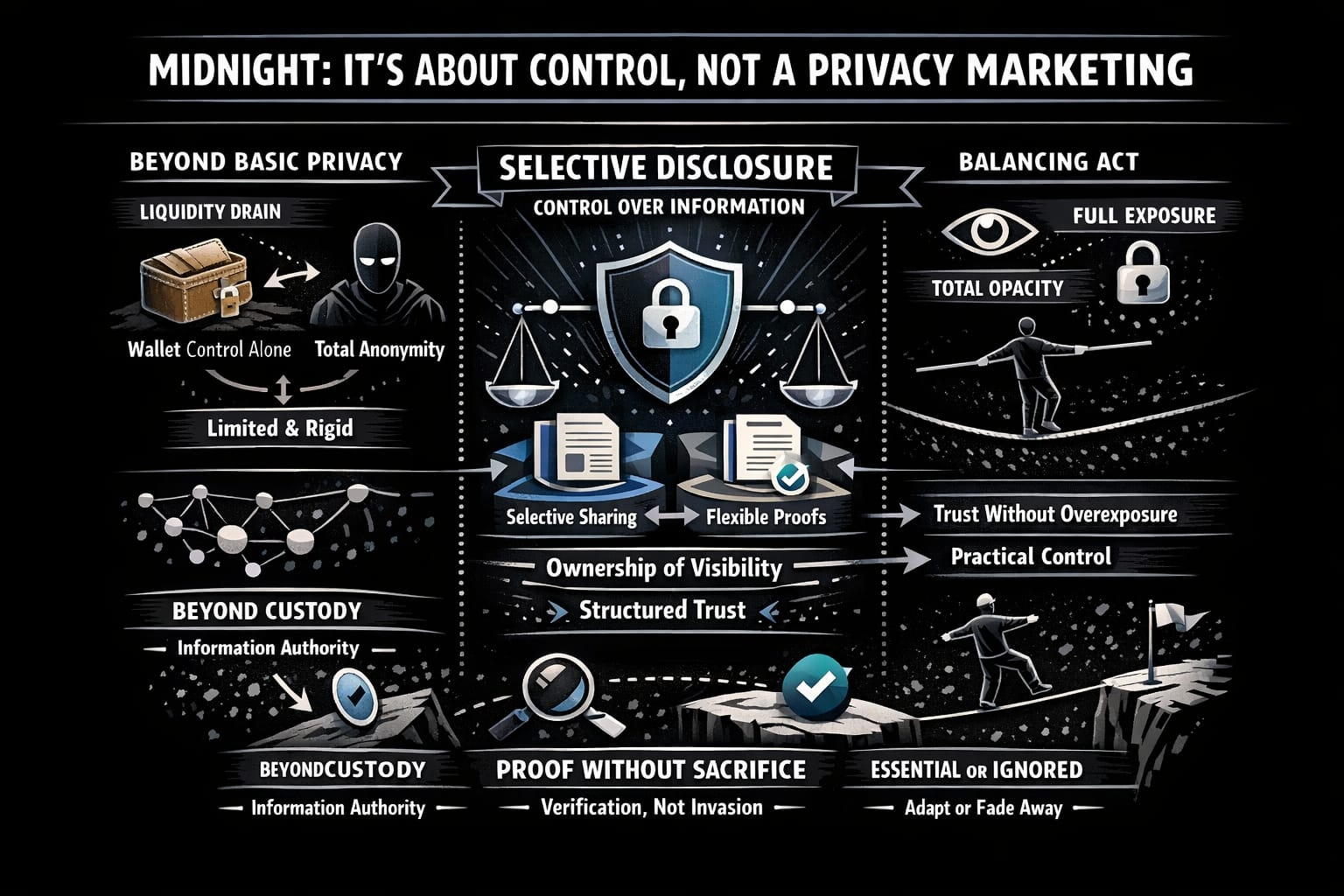
But Midnight feels a bit different to me, and not for the reasons people usually repeat. What caught my eye isn’t that they’re obsessed with hiding everything. That would be the easy, lazy angle. What they’re actually circling is control. Not just wallet control, but control over information itself. Who sees it? Who doesn’t? What gets proven without dumping your entire life story onto a public ledger?
This is where blockchain is actually broken in practice. Public rails are great until they’re not. They work fine for basic settlement, but for real companies and real users, that total transparency becomes a grind. It’s just too much exposure and unnecessary data leakage. Midnight seems to get that the real issue isn't whether information can be verified—it's whether that verification always has to come with full exposure.
A lot of crypto still acts like trust only exists when everything is laid bare. Midnight is pushing against that. It’s the idea that trust should come from proof, not from forcing people to surrender context they never should have had to expose. People talk about "ownership" all the time, but they usually just mean custody. Hold your keys, hold your assets. Fine. But Midnight is reaching for something heavier: Ownership as authority over visibility. In any digital system, whoever controls the flow of information controls the relationship itself. Not just the asset—the relationship. That’s a huge difference.
I like that they’re aiming for "selective disclosure." It’s a dry phrase, but it means making privacy useful instead of theatrical. Structured instead of absolute. I trust that instinct a lot more than the usual chest-beating around anonymity.
Still, instinct is cheap. The real test is whether this can survive contact with actual use. I’ve seen enough "elegant" architectures fail because the tooling was clunky or the user experience felt like a second job. Midnight sits in a weird middle ground: too private for the loud transparency crowd, and too structured for the total opacity romantics. That’s a risky place to be—you either become essential or you get ignored while the market chases simpler lies.
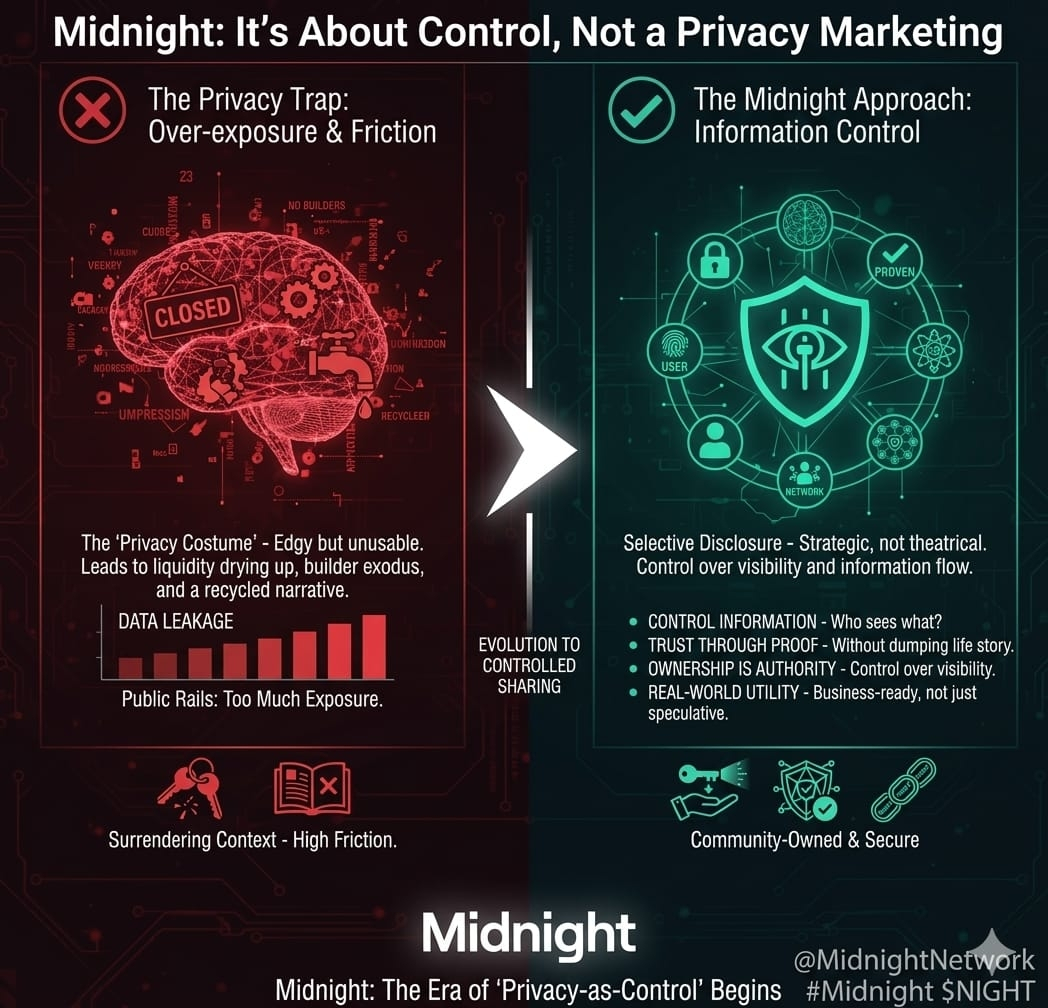
I’m watching this with half-interest and half-suspicion. There’s a good chance it gets flattened by the same market machinery that flattens everything else—narrative recycling and short attention spans. But there’s something quietly important here. The next stage of this industry won't belong to systems that expose everything, and it won't belong to the ones that hide everything either. It’ll belong to the ones that understand how information should move, when it should stop, and who gets to decide.
Midnight might be reaching for that. Or maybe it’s just another project trying to survive the grind with a better vocabulary. We'll see.
#Midnight #Night #BTCReclaims70k #AaveSwapIncident @MidnightNetwork $NIGHT