
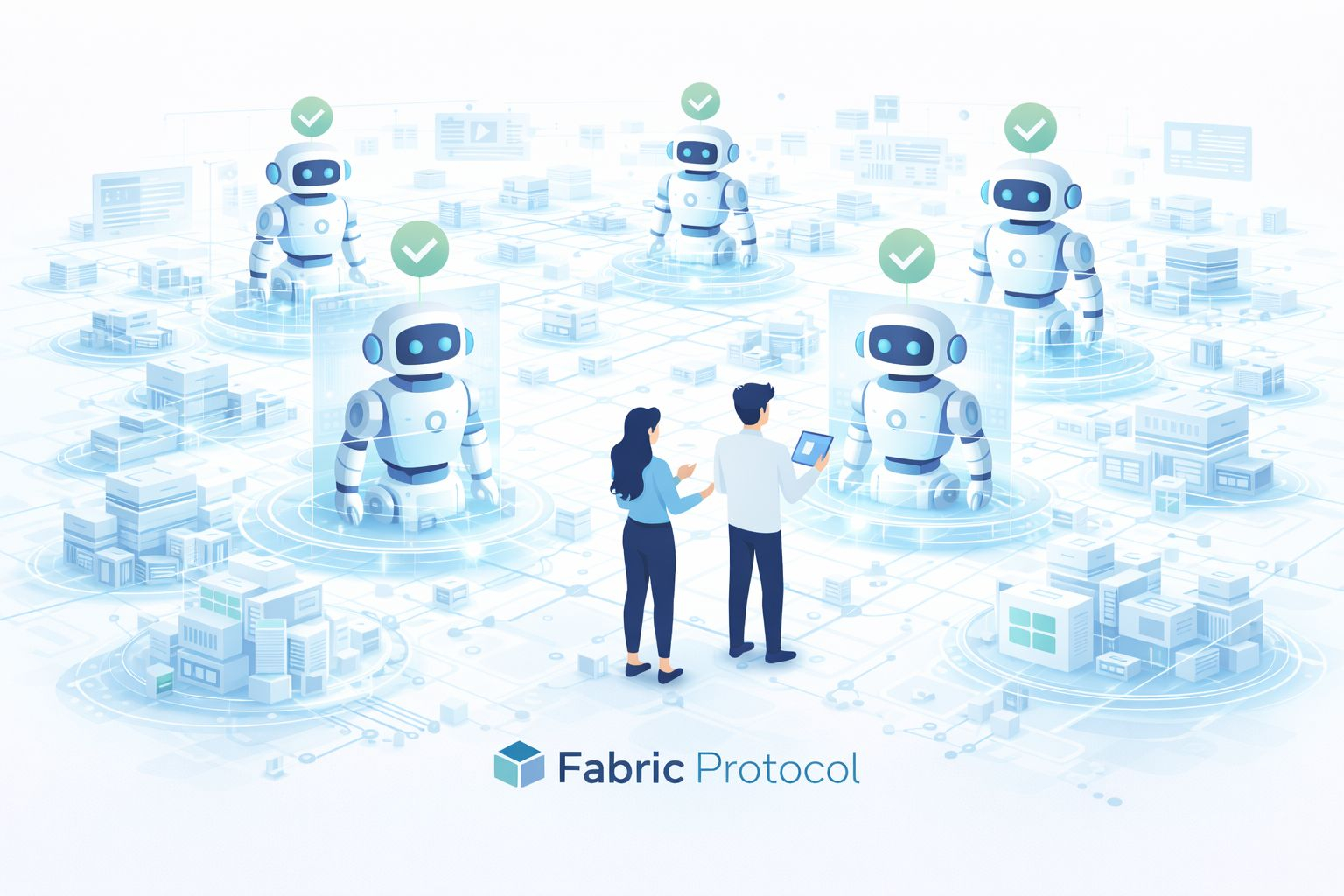
 Robots are slowly entering real life. Not only in factories anymore. We already see delivery robots, warehouse machines, AI powered assistants, even robots helping in hospitals. But one big problem still exists — robots today don’t share a common system of trust and coordination.
Every company builds its own closed ecosystem. One robot talks to its own server, another follows a different system. If millions of robots start operating in cities, industries, and homes, this fragmented structure can become messy.
Fabric Protocol is trying to solve that problem.
Fabric is a global open network supported by the Fabric Foundation. Instead of building one robot, it focuses on something more important — the infrastructure that connects robots, AI agents, and humans together.
Think of it like a shared digital brain where machines can operate under clear rules.
At the core of Fabric is verifiable computing. This simply means when a robot performs a task or makes a decision, the system can verify how that decision happened. Not hidden logic, but transparent processes that can be checked.
The protocol also uses a public ledger to coordinate data, computation, and governance. This helps track how robots interact with information and how they follow rules. It creates a structure where machines do not just act independently but operate within a network of accountability.
Another interesting concept is agent-native infrastructure. Instead of treating robots like simple tools, Fabric treats them like participants in the system. Each robot or AI agent has defined roles, permissions, and responsibilities inside the network.
This idea may sound futuristic, but it prepares for something very real. In the future, robots may deliver packages, manage warehouses, inspect buildings, and maintain infrastructure. If thousands of machines operate together, they need shared standards and coordination.
Fabric Protocol also uses modular infrastructure, meaning developers can add different components without rebuilding the entire system. This allows innovation to happen faster while still keeping the network organized.
For the Binance community, this is an example of how blockchain technology can expand beyond finance. Crypto originally solved trust in digital money. Now some projects are exploring how the same principles can support machine coordination and human-robot collaboration.
Fabric is not promising overnight breakthroughs. Infrastructure rarely works like that. Instead it focuses on building the foundation where robots can evolve together safely.
Because in the future, the real challenge will not be building robots.
The real challenge will be making sure robots can work together, follow rules, and stay aligned with human systems.
And Fabric Protocol is trying to build that shared structure before the robot economy fully arrives.