

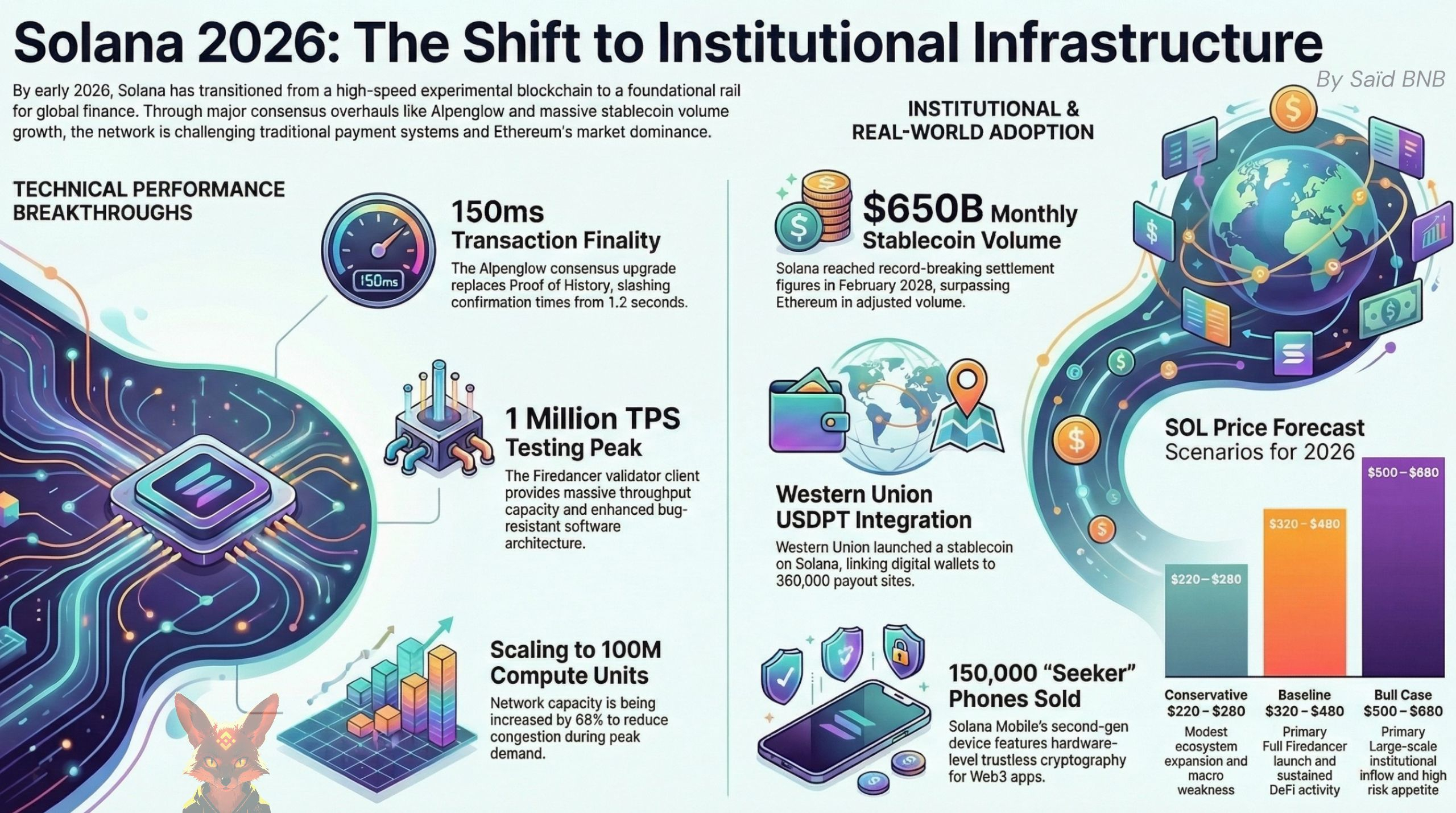
In the opening months of 2026, the surface-level narrative of the digital asset market suggests a period of cooling. The Crypto Fear & Greed Index currently sits at a chilling 19, signaling "Extreme Fear" among retail participants. Price action for Solana (SOL) remains trapped in a consolidation range, hovering between $85 and $91, leading many casual observers to speculate that the network’s period of explosive growth has concluded.
However, a closer look at institutional flow metrics reveals a massive disconnect between retail sentiment and fundamental network utility. While retail traders fret over daily charts, "smart money" is moving in the opposite direction; whale wallets holding between 100,000 and 1,000,000 SOL have been quietly accumulating since February 19, 2026. This conviction is underpinned by a staggering $650 billion in stablecoin transaction volume processed in February alone—a surge that occurred while the broader market remained paralyzed by fear.
To understand why 2026 represents a "structural reset" rather than a "washout," we must analyze the technical and institutional milestones that are fundamentally redefining the network. Solana has transitioned from a playground for speculative retail activity into a high-throughput execution rail for global finance.
1. The 150-Millisecond Speed Demon: Enter Alpenglow
The most significant technical milestone of the year is the deployment of the Alpenglow consensus protocol (Agave 4.1). For years, Solana’s transaction finality hovered around 12 seconds—impressive by legacy blockchain standards, but a latency bottleneck for high-frequency institutional applications. Alpenglow shatters this, reducing finality to a mere 100–150 milliseconds.
This leap in performance is achieved by removing the overhead of Proof of History (PoH) and on-chain vote transactions, simplifying the mechanism by which the network agrees on blocks. Furthermore, Alpenglow introduces the Validator Admission Ticket (VAT), a 1.6 SOL fee required for validators to enter the consensus set each epoch. This fee streamlines the validator set, ensuring only high-performance nodes participate in the core consensus.
"Alpenglow represents a fundamental simplification of how the network agrees on blocks, materially improving reliability while sharply reducing confirmation times."
Solana's new consensus architecture also introduces a critical safety threshold:
20+20 Resilience: The Alpenglow protocol ensures the network remains safe and operational even if 20% of validation nodes act maliciously and another 20% are simultaneously offline.
2. Western Union and the Death of Intermediaries
In a landmark move for global payments, Western Union has integrated its "Digital Asset Network" with the Solana blockchain. Utilizing the USDPT stablecoin issued via Crossmint, Western Union now connects digital wallets directly to 360,000 physical payout locations worldwide.
This is not merely a technical partnership; it is an exercise in protecting profit margins. By leveraging Solana as a global payments rail, Western Union bypasses multiple bank intermediaries and eliminates the settlement delays and currency conversion fees that have historically burdened the remittance industry. This creates significant operating leverage, allowing the firm to defend its market share against crypto-native competitors while offering near-instant cross-border liquidity.
Institutional Benefits of the Western Union Integration:
Near-Instant Settlement: Global fund movement in milliseconds rather than 3–5 business days.
Operating Leverage: Enhanced margins through the removal of intermediate correspondent banks.
Global Physical Connectivity: Digital-to-cash conversions in over 200 countries.
Sub-Cent Transaction Costs: Utilizing blockchain rails to drastically reduce the cost of cross-border settlement.
3. Firedancer: Shattering the 1 Million TPS Barrier
The 2026 full release of the Firedancer validator client has fundamentally altered Solana’s reliability profile. In testing, Firedancer demonstrated the capacity to process 1 million transactions per second (TPS)—a ~333x increase over the current network speed of roughly 3,000 TPS.
Beyond raw throughput, Firedancer addresses historical reliability concerns through its "tiled" architecture. By isolating validator tasks into separate, independent tiles, the system ensures that a software bug in one component can be restarted without causing a total network outage. To further cement institutional trust, the network maintains a $500,000 bug bounty program, proving its commitment to "bug-resistant" engineering. The result is a network with two independent client implementations (Firedancer and Agave), providing the same level of resilience that has long been the hallmark of Ethereum.
4. The $650 Billion Milestone: Overtaking Ethereum in Stablecoin Settlement
February 2026 Grayscale data indicates a tectonic shift in capital flow. Solana’s stablecoin transaction volume reached 650 billion for the month, but the "signal" lies in the adjusted metrics. When filtering for organic volume—excluding internal churn and bot activity—Solana officially surpassed Ethereum (551 billion) and Tron ($272 billion) in monthly settlement volume.
This "utility-first" growth is being accelerated by a shifting legislative environment, specifically the GENIUS Act, which enables the integration of stablecoins as high-quality collateral in institutional finance. This transition suggests that user demand is moving away from speculative assets and toward practical, high-velocity infrastructure.
"There is a clear shift in user demand toward practical infrastructure rather than purely speculative activity, positioning Solana as the leading blockchain for retail and institutional stablecoin settlements."
5. Web3 in Your Pocket: The 150,000-Unit "Seeker" Success
The shipping of the "Seeker" smartphone on August 4, 2025, proved that native Web3 hardware is no longer a niche gimmick. With 150,000 units pre-sold, the Seeker utilizes a "TEEPIN" (Trusted Execution Environment Platform Infrastructure Network) architecture to create a trustless environment for digital assets.
Each device includes a Seeker Genesis Token, a non-transferable NFT that serves as the mechanism for unlocking rewards and exclusive content within the ecosystem. By controlling the full hardware-software stack—including the SeedVault and dApp Store 2.0—Solana is effectively challenging the traditional mobile duopoly of Apple and Google.
Seeker Hardware Specifications:
Processor: MediaTek Dimensity 7300 (Octa-core)
Memory/Storage: 8GB RAM / 128GB UFS 3.1
Display: 6.36" AMOLED, 2670x1200 resolution, 120Hz dynamic refresh rate
Security: Integrated SeedVault self-custodial wallet
Connectivity: 5G, Wi-Fi 6, Bluetooth 5.4
Conclusion: The Structural Reset
As 2026 progresses, it is clear that we are witnessing a permanent market segmentation. Ethereum has solidified its role as the high-security settlement layer for innovation and long-tail assets, while Solana has emerged as the premier high-performance execution layer for global institutions.
The data confirms that traditional finance is no longer just "watching" Solana—it is settling on it. When giants like Western Union can settle transfers in milliseconds for sub-cent fees, it marks the end of an era for legacy banking overhead.
The institutional era of Solana is here. In a world where global giants utilize decentralized execution layers to move billions instantly, we must ask: In a world where Western Union settles in milliseconds for sub-cent fees, what happens to the traditional banking infrastructure we've relied on for decades?
Share your thoughts in the comments 👇
