
Financial markets rarely follow a perfectly straight path. Periods of excitement and rapid growth are often followed by moments of calm where prices move within a narrower range. These quieter periods may look uneventful on the surface, but they often hold important clues about what might happen next. Recently, $ROBO has entered exactly this type of phase.
After experiencing a strong upward push, ROBO encountered resistance near its recent highs. The market reacted quickly, and the price pulled back. Such reactions are natural after rapid growth, as traders who entered earlier may take profits while others reassess the strength of the trend. What matters more than the pullback itself is how the market behaved afterward.
Instead of continuing downward with heavy selling pressure, $ROBO began to stabilize. Prices started moving within a tighter range rather than collapsing further. This kind of behavior usually suggests that the market is searching for equilibrium. Buyers and sellers are both active, but neither side currently has complete control.
Momentum indicators also reflect this transition. Earlier, the rapid price increase pushed momentum readings into higher territory. Now, those readings have cooled and returned closer to neutral levels. This shift often occurs when a market pauses to reset after a strong move. In many cases, such resets allow the market to rebuild strength before attempting another directional move.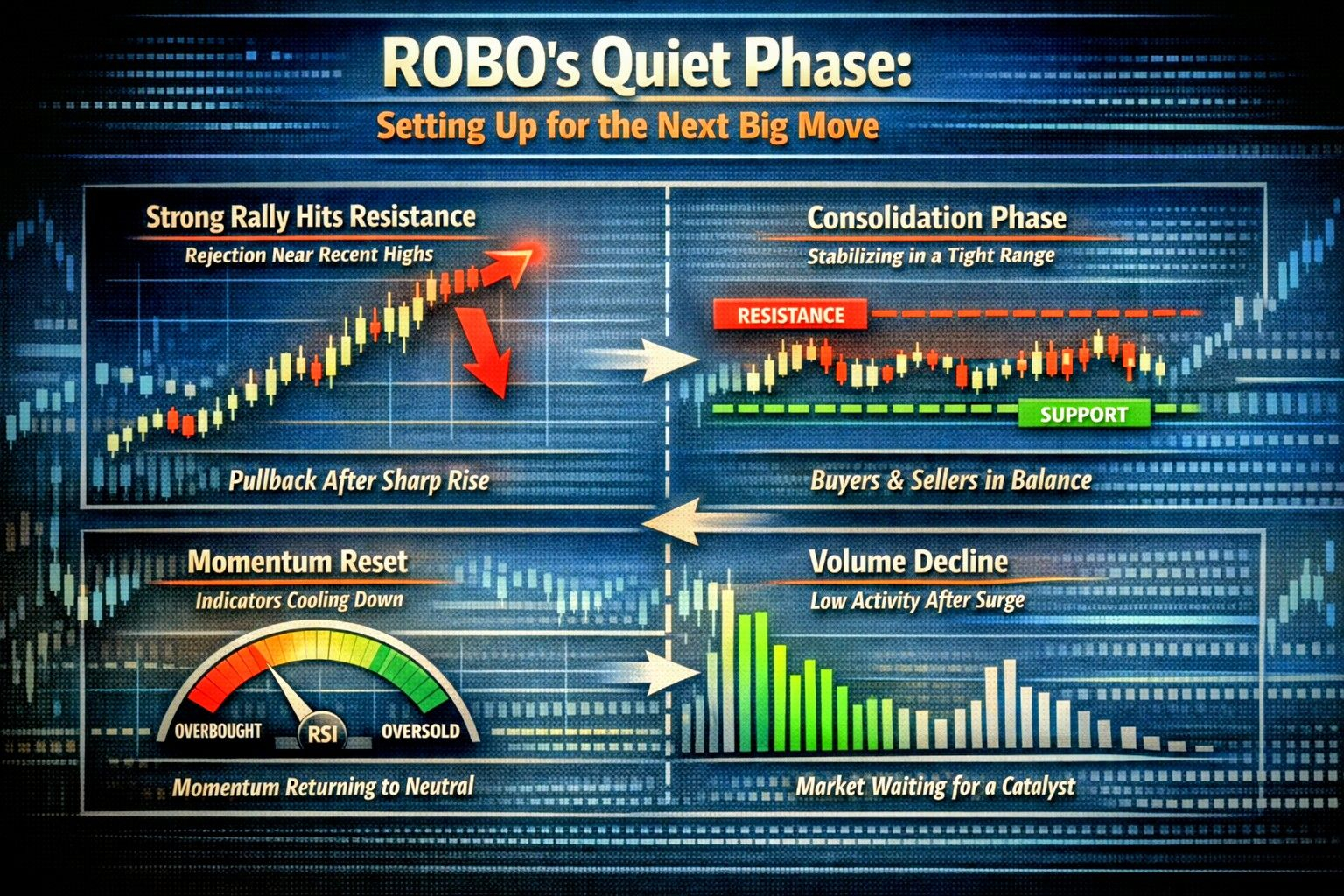
Another important observation comes from trading activity. During the earlier price surge, trading volume increased significantly, which is typical when emotions and excitement enter the market. Afterward, however, trading activity slowed down. Lower volume during consolidation often indicates that participants are waiting rather than rushing into new positions.
At the same time, derivatives data suggests that many traders are still involved in the market. Open Interest remains relatively elevated, meaning positions are still active. When Open Interest stays high while price movement becomes limited, it can signal that traders are preparing for a larger move. Both bullish and bearish positions may be building simultaneously, creating tension within the market structure.
Situations like this can eventually lead to powerful price reactions. If buyers regain confidence and push the price above key resistance levels with strong participation, momentum could return quickly. A breakout in that scenario may force short sellers to close positions, adding additional fuel to the upward move.
On the other hand, if support levels weaken and selling pressure begins to grow, the market could move downward more aggressively. Breakdowns often occur when traders lose confidence in the stability of the range.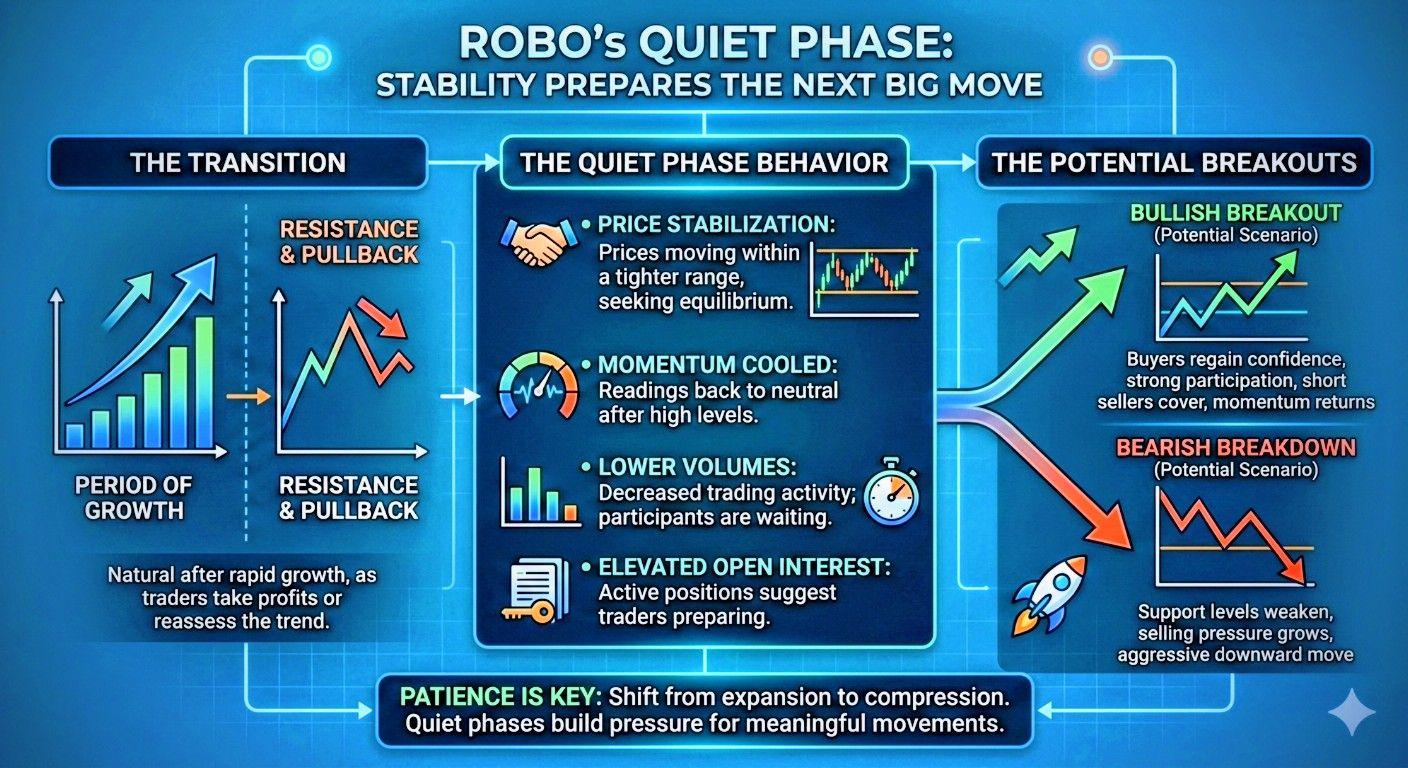
For now, the most important observation is the shift from expansion to compression. The market has moved from a phase of rapid movement into one of tightening structure. Historically, such phases rarely last forever. They typically resolve with a decisive move once enough pressure builds inside the range.
For traders and observers alike, patience becomes the key factor. The market is not yet revealing its final direction, but the current behavior suggests that something significant may be forming beneath the surface.
In many cases, the quietest periods in a market are the ones that eventually lead to the most meaningful movements. ROBO may currently be in that very stage-a moment of calm before the next chapter begins.
