
Last Thursday, I had to explain to our infra team why an agent upgrade was blocked by our own company wallet. Not the network. Not congestion. Our wallet.
We had deployed a machine coordination layer that was supposed to be neutral infrastructure. Yet the authority to modify validator parameters still sat with a corporate multisig controlled by five executives. When a validator flagged inconsistent state propagation, we needed to adjust a threshold setting. It took 52 minutes to gather signatures.
That was the moment I stopped pretending infrastructure and corporate control were separate.
Fabric Protocol forced that separation in a way that felt uncomfortable at first. Instead of binding machine governance to our company’s operational hierarchy, Fabric lets you encode governance rules directly at the protocol layer. Validators enforce them. Not your leadership team. Not your finance department.
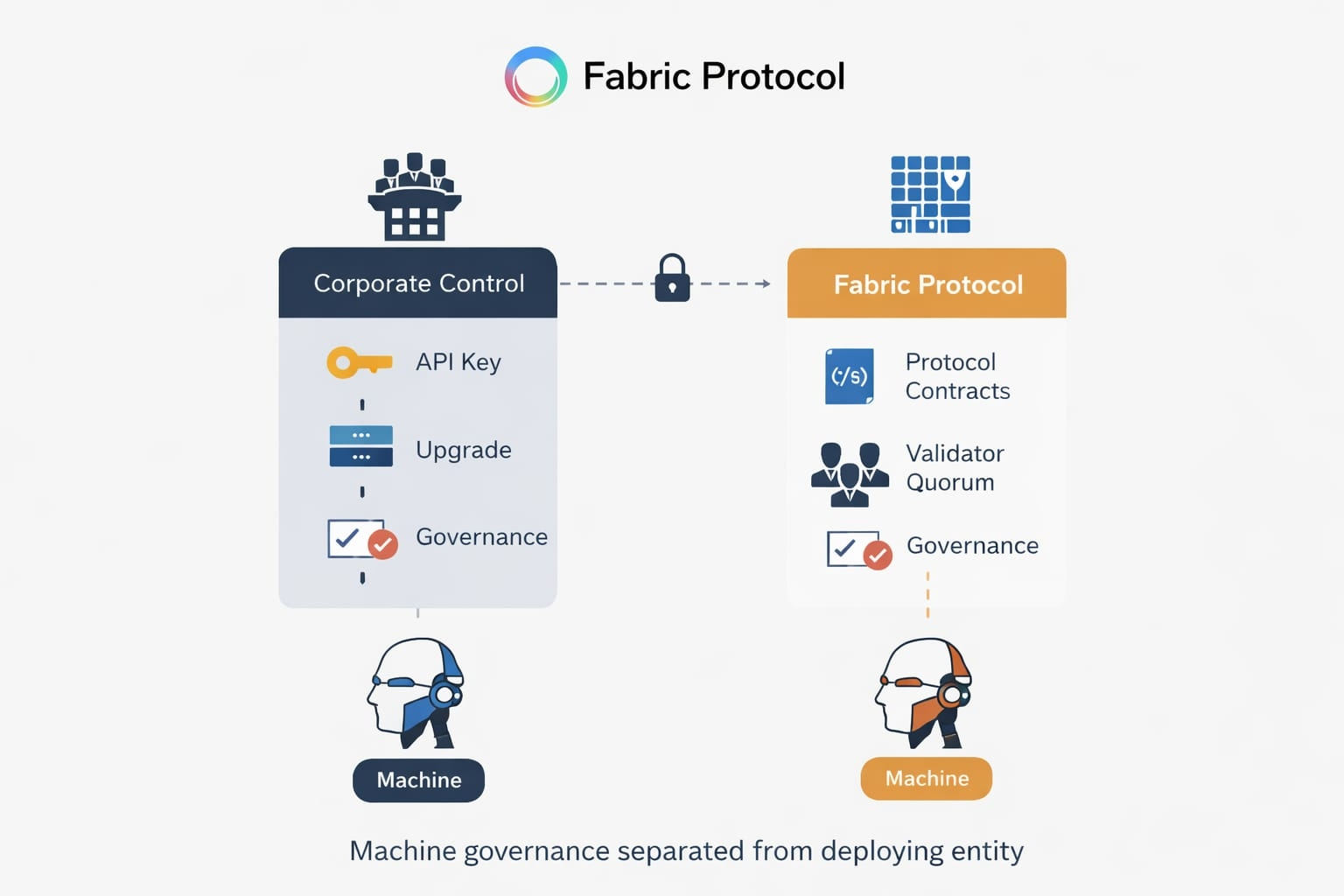
The first thing I migrated was upgrade authority for one of our autonomous routing agents. Before Fabric, upgrades required internal approval even if the change was purely technical. After migrating governance to Fabric contracts, upgrade proposals were evaluated by predefined quorum rules tied to machine stakeholders, not corporate officers. The practical difference showed up immediately.
During a stress test, our agent began over allocating compute across three nodes, pushing utilization to 87 percent when our safe band was 70. Under the old model, we would escalate to management because parameter changes affected billing exposure. On Fabric, the governance object already defined adjustment boundaries. A proposal was submitted onchain, validated, and executed in 16 minutes. No executive approval. No manual override.
What changed was not speed alone. It was clarity. Governance rules were explicit and queryable. We tracked mean governance execution time across six changes. It dropped from 41 minutes pre Fabric to 15 minutes post migration. That number mattered less than what it exposed. Most of our delay came from corporate friction, not technical complexity. Fabric made that friction visible.
There is a tradeoff. Once governance lives at the protocol layer, you cannot quietly override decisions when revenue pressure builds. Two weeks ago, market demand spiked and we wanted to temporarily relax a resource cap. Under our previous setup, I could have approved that instantly. On Fabric, the governance window was fixed. The vote period was eight blocks. We waited. We lost roughly 3.2 percent in potential revenue during that interval. It was frustrating. I will admit that.
But the separation held. The machine infrastructure did not bend because leadership felt urgency. That stability has long term implications. It reduces the risk of governance capture by the deploying company itself.
Another operational shift was auditing. When external partners asked who controlled validator updates, we no longer provided a flowchart of internal roles. We pointed to Fabric governance contracts. Everything was encoded. In our last audit cycle, documentation prep time dropped from about 18 hours to under 5. The governance state was transparent. We were not explaining intent. We were showing enforcement.
What Fabric Protocol really changed for us was the assumption that deploying infrastructure gives you permanent control over it. It does not. Or at least, it should not.
Separating infrastructure from corporate control introduces discipline. It also introduces limits. You gain predictable machine governance, but you surrender executive shortcuts. That tension is real. I still feel it every time a proposal waits out its confirmation period.
But after seeing how easily corporate authority seeps into technical systems, I am less comfortable with the old model. Fabric did not make governance easier. It made it independent.
@Fabric Foundation #ROBO $ROBO
