

Every day, I’m using artificial intelligence. I’m asking it questions. I’m generating ideas. I’m reading summaries. And most of the time, it sounds confident. But I’m also noticing something important: confidence doesn’t always mean correctness.
Sometimes the AI makes things up. Sometimes it shows bias. Sometimes it gives an answer that looks polished but turns out to be wrong. When I’m using AI casually, that might not be a big deal. But when I’m thinking about AI running financial systems, supporting healthcare decisions, or operating autonomously, I start asking a different question: how do I know this output is actually reliable?
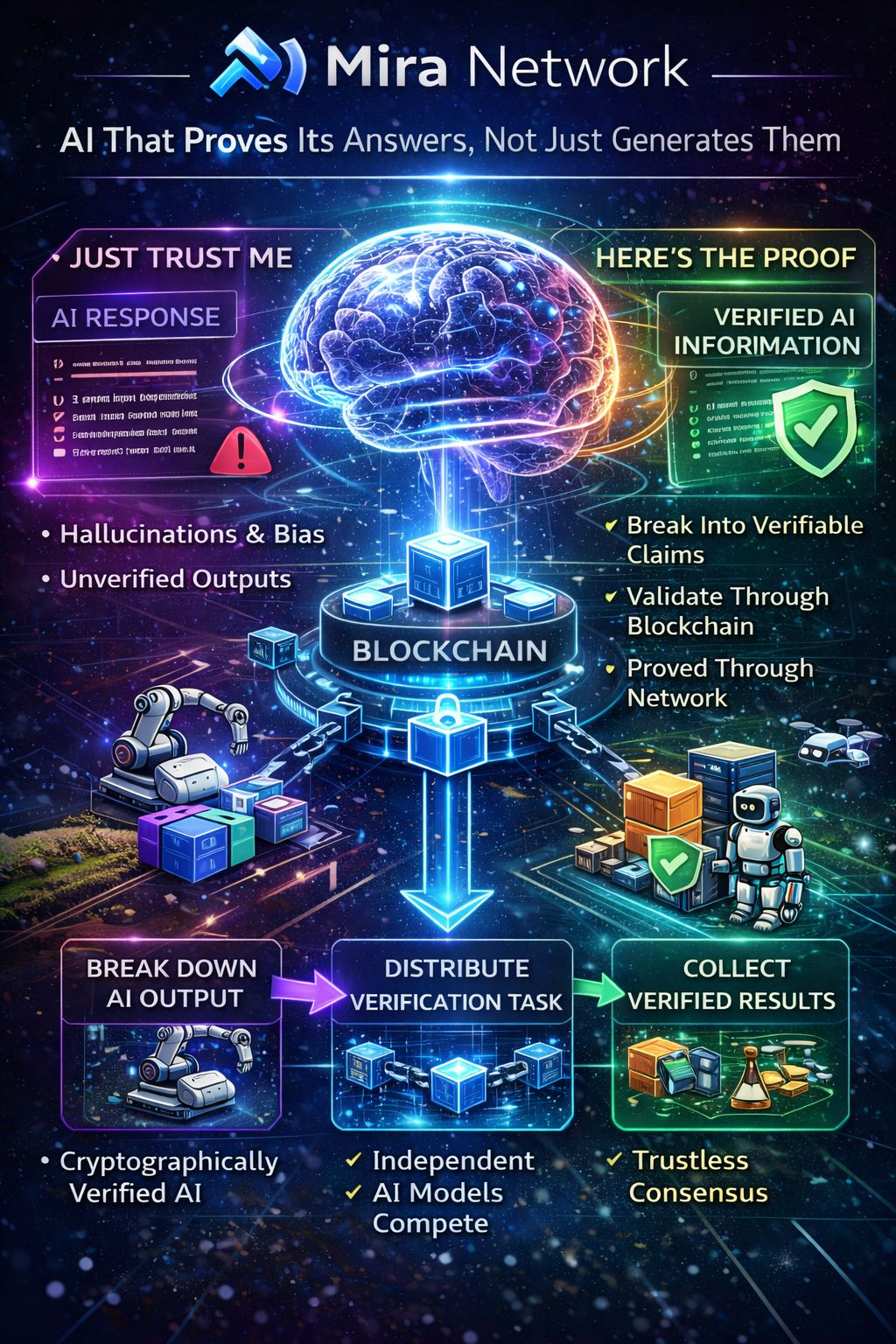
That’s where Mira Network comes in.
When I look at Mira, I’m not just seeing another AI tool. I’m seeing a system that says, “Don’t just generate answers. Prove them.” Instead of trusting a single model’s output, I’m working with a protocol that verifies whether those outputs can stand up to scrutiny.
Let me explain it the way I understand it.
Right now, most AI systems work like this: I type in a question, one model processes it, and it gives me an answer. That’s it. If the model is wrong, I might not know unless I double-check it myself. And in many cases, people don’t double-check. They assume the AI is correct because it sounds correct.
Mira is trying to change that dynamic.
Instead of taking one answer at face value, I’m breaking that answer into smaller pieces — smaller claims. If the AI says something complex, I’m not treating it as one giant block of truth. I’m asking: what are the specific statements inside this response? What facts are being asserted? What conclusions are being drawn?
Then those individual claims are sent across a decentralized network of independent AI models. I’m not relying on just one model anymore. I’m distributing the verification process across many different participants.
Each independent model checks the claim. It evaluates whether it’s accurate, consistent, or supported by available data. Instead of trusting a central authority to approve the result, I’m watching the network come to a form of agreement through blockchain consensus.
That’s a big shift.
When I hear “blockchain consensus,” I don’t think about hype. I think about shared agreement recorded publicly. I’m seeing a system where results aren’t just privately validated behind closed doors. They’re verified through a network where incentives matter and records are transparent.
Mira transforms AI outputs into cryptographically verified information. That means the result isn’t just text on a screen. It’s tied to a proof. It’s anchored in a process that shows how it was checked and who participated in validating it.
Why does that matter?
Because AI hallucinations are real. I’ve seen AI confidently cite sources that don’t exist. I’ve watched it create statistics that sound plausible but are fabricated. In low-stakes situations, that’s annoying. In high-stakes situations, it’s dangerous.
Mira is working to make AI suitable for critical use cases places where reliability is not optional. I’m thinking about financial contracts, compliance reporting, supply chain automation, or even AI agents making decisions without human oversight. In those environments, “probably correct” isn’t good enough.
By distributing verification across multiple independent AI systems, Mira reduces the risk that a single flawed model determines the outcome. If one model has bias, others can challenge it. If one makes a mistake, the network can flag inconsistencies.
What I find interesting is that this isn’t just about technical design. It’s about incentives.
In Mira’s system, validators are economically incentivized to be honest and accurate. I’m not just hoping participants behave well. I’m designing a structure where good behavior is rewarded and bad behavior has consequences.
That’s where the idea of trustless consensus comes in. I’m not relying on a central company to say, “Trust us, we checked it.” I’m relying on a decentralized process where agreement is reached through rules and incentives, not authority.
When I zoom out, I see Mira separating two major functions: generation and validation.
Generation is fast. AI can produce content in seconds. Validation is slower, but it’s necessary. Instead of forcing one system to do both, Mira creates a layer where generation happens first and verification follows.
That layered approach feels important to me. It acknowledges that AI is powerful but imperfect. Instead of pretending hallucinations don’t exist, I’m building a structure to catch them.
I also like that Mira breaks complex outputs into verifiable claims. That’s a practical strategy. If I try to verify an entire essay or analysis as one unit, it’s too big and vague. But if I isolate specific statements, I can test them individually.
It’s similar to fact-checking in journalism. I’m not asking, “Is this entire article true?” I’m asking, “Is this claim accurate? Is this data point real? Is this conclusion supported?”
By doing that at scale across AI models, Mira creates a verification mesh around AI outputs.
Another thing I’m watching closely is how this changes the way AI agents might operate in the future. If AI systems are going to act autonomously making trades, executing contracts, triggering processes they need a way to prove that their decisions are based on verified information.
With Mira, I’m not just generating outputs. I’m attaching proof to them. That proof can be checked by others. It can be referenced later. It can become part of an audit trail.
In industries where compliance and accountability matter, that could be a major shift.
Of course, I also understand that no system is perfect. Decentralization introduces coordination challenges. Consensus mechanisms have trade-offs. Verification takes time and resources. But I see Mira attempting to balance speed with reliability rather than sacrificing one entirely for the other.
The bigger theme I’m noticing is this: AI is moving from being a helpful assistant to becoming an active participant in systems. As that transition happens, the standard for reliability has to rise.
I can’t treat an autonomous AI agent the same way I treat a chatbot helping me brainstorm ideas. The risks are different. The consequences are different.
Mira Network feels like a response to that evolution. I’m not just building smarter AI. I’m building infrastructure that makes AI accountable.
When I think about the future, I imagine a world where AI-generated information isn’t just accepted because it looks polished. I’m imagining a world where AI outputs come with verification by default where proof is built into the process.
Instead of saying, “Trust the model,” I’m saying, “Check the network.”
That mindset shift is powerful.
Right now, we’re still early. AI is advancing quickly, and reliability problems are still common. But I’m watching projects like Mira experiment with new ways to make AI safer and more dependable.
I’m asking better questions. I’m looking for systems that don’t just produce answers, but stand behind them. And in that context, Mira Network represents something important: a move toward AI that can prove what it claims.
Not just intelligence but verified intelligence.