

I was halfway through rewriting a trade note when my AI did that thing again. It gave me a clean, confident explanation for why a token was moving, tied it to a “partnership,” tossed in a couple numbers, and wrapped it like it was settled. I almost sent it out. Then I checked one of the numbers and it was wrong. Not wildly wrong. Just wrong enough to change the story. That’s the part that irritates me, because in markets “slightly wrong” is how you end up positioned on the wrong side of a move.
So when I look at Mira Network, I’m not starting from the usual “AI narrative.” I’m starting from the trader’s pain point. AI outputs are useful until they quietly lie to you with a straight face. Mira’s entire pitch is basically, stop trusting one model’s confidence and start forcing claims through verification that you can audit. That’s not a vibe. That’s a workflow change.
Now here’s what’s actually worth your time today. $MIRA has been moving. On Feb 27, 2026, it’s trading around $0.11 and it’s up roughly 27 to 29% in the last 24 hours depending on the feed you watch, with tens of millions in daily volume and a market cap in the high $20Ms. Circulating supply is about 244.9M against a 1B max supply. That combination matters more than the percentage candle. When you have a relatively small cap and that kind of turnover, you can get sharp moves that look like “new regime” when it’s really just liquidity meeting attention.
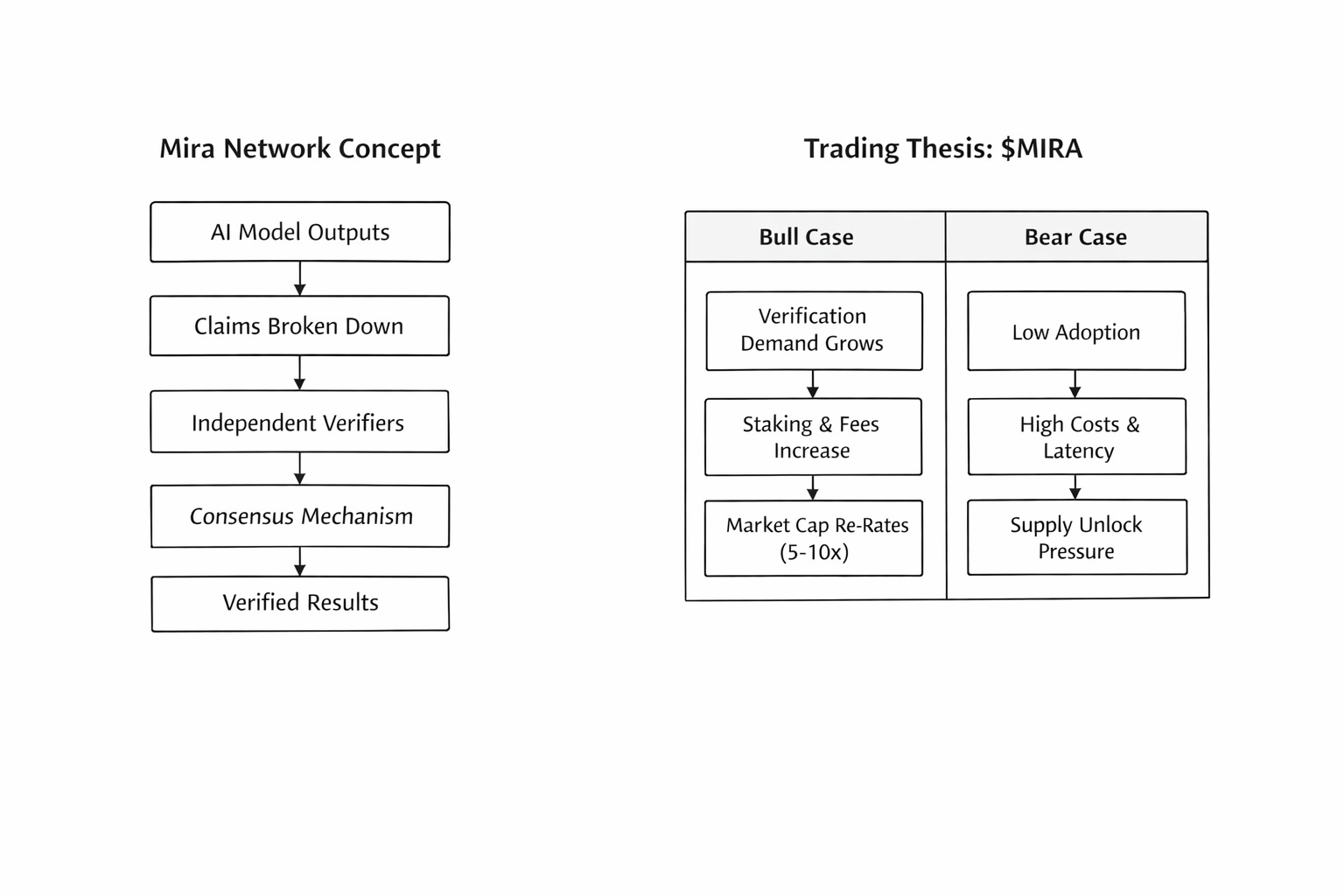
If you’re looking at this like a trader, the question isn’t “is AI verification important.” It’s “is this market pricing a real demand curve or just a headline loop.” Mira’s own positioning is that it coordinates multiple AI models to verify outputs via blockchain-style consensus, and one of the bolder claims floating in official research coverage is that it can push verified accuracy to 95%+ versus a 70 to 75% baseline for current AI systems. If that delta is even directionally true in production settings, the product is not “another AI token.” It’s a quality control layer. Think of it like settlement and auditability for statements, not for dollars.
The way I translate the tech into trading consequences is simple. Most AI answers are bundles of claims. A number. A timeframe. A causal link. A definition. Mira’s model, as described, is to break the output into claims, have independent verifiers check them, and then aggregate a result the network can stand behind economically. In practice, that means fewer moments where you ship something that’s polished and wrong. If you’ve ever had to unwind a thesis because one “trusted” stat was fake, you get why that matters.
But I’m not treating this like a free lunch. There’s a tradeoff right in the middle of the thesis. Consensus is not truth. If verifiers share the same blind spots, they can agree on the same wrong answer. And verification adds overhead. Latency, cost, complexity. If it’s too slow or too expensive, builders will skip it until they get burned, which is exactly how risk builds up. So the adoption question is not philosophical, it’s operational. Can Mira deliver verification fast enough and cheap enough that people keep it turned on when nobody’s watching.
This is also where token structure starts to matter. With roughly 24 to 25% of supply circulating and the rest still locked, you have an overhang that traders can’t ignore. Even if you love the product, unlock dynamics can turn every rally into a distribution event if the market knows new supply is coming. People will front run it. Liquidity will thin out at the wrong time. If you want a clean trend, you need either strong organic demand that absorbs unlocks or a schedule that doesn’t choke the market.
So what’s my thesis right now. I think $MIRA is pricing optionality on one very specific thing: verified outputs becoming a requirement, not a feature. Not for everyone. For the workflows where being wrong is expensive. If that happens, a verification network can capture fees, staking demand, and mindshare as a default layer. But that only holds if usage shows up in the numbers, not in narratives.
A realistic bull case is not “this goes to the moon.” It’s more like, if the network sees consistent growth in verification requests and staking participation, the market starts valuing it less like a meme and more like an infra token. If the market cap is around $27M today, a move to $150M to $300M is not crazy in a risk-on tape if usage and fee signals show up, especially with a smallish float. That’s a 5 to 10x type of re-rate. I’m not saying it happens. I’m saying that’s what the market tends to do when it believes there’s a real service being paid for.
The bear case is uglier and honestly more common. Verification demand doesn’t materialize beyond a narrow set of demos. Costs stay high. Latency stays annoying. Or a competing approach wins because it’s simpler, even if it’s less principled. Then $MIRA trades like a liquidity toy. Big spikes on attention, slow bleed when attention leaves, and the unlock overhang becomes the dominant driver. You’ll see it in the tape. Lower highs, volume that fades, rallies that get sold faster than they build.
What would change my mind in either direction. For bullish confirmation, I’d want to see repeated evidence that verification is being used in real workflows, not just talked about. I’d watch for metrics the protocol itself can credibly report over time, like number of verification jobs, fees paid for verification, verifier participation and staking levels, and any publicly defensible accuracy benchmarks that don’t look like cherry-picked tests. For bearish confirmation, I’d watch for the opposite. High volume but no sustained usage signals, supply unlock fear dominating price action, and a market that can pump 30% in a day but can’t hold gains across a week.
If you’re trading it, don’t fall in love with the story. Trade what you can measure. Price reaction around key levels, volume quality, and whether the market respects the idea that this is infra and not just another narrative token. And keep one thought in your head the whole time. The day your AI confidently lied to you was not dramatic. It was ordinary. If Mira ever becomes essential, it’ll be because it solves that ordinary problem at scale, not because it sounds good in a thread.
