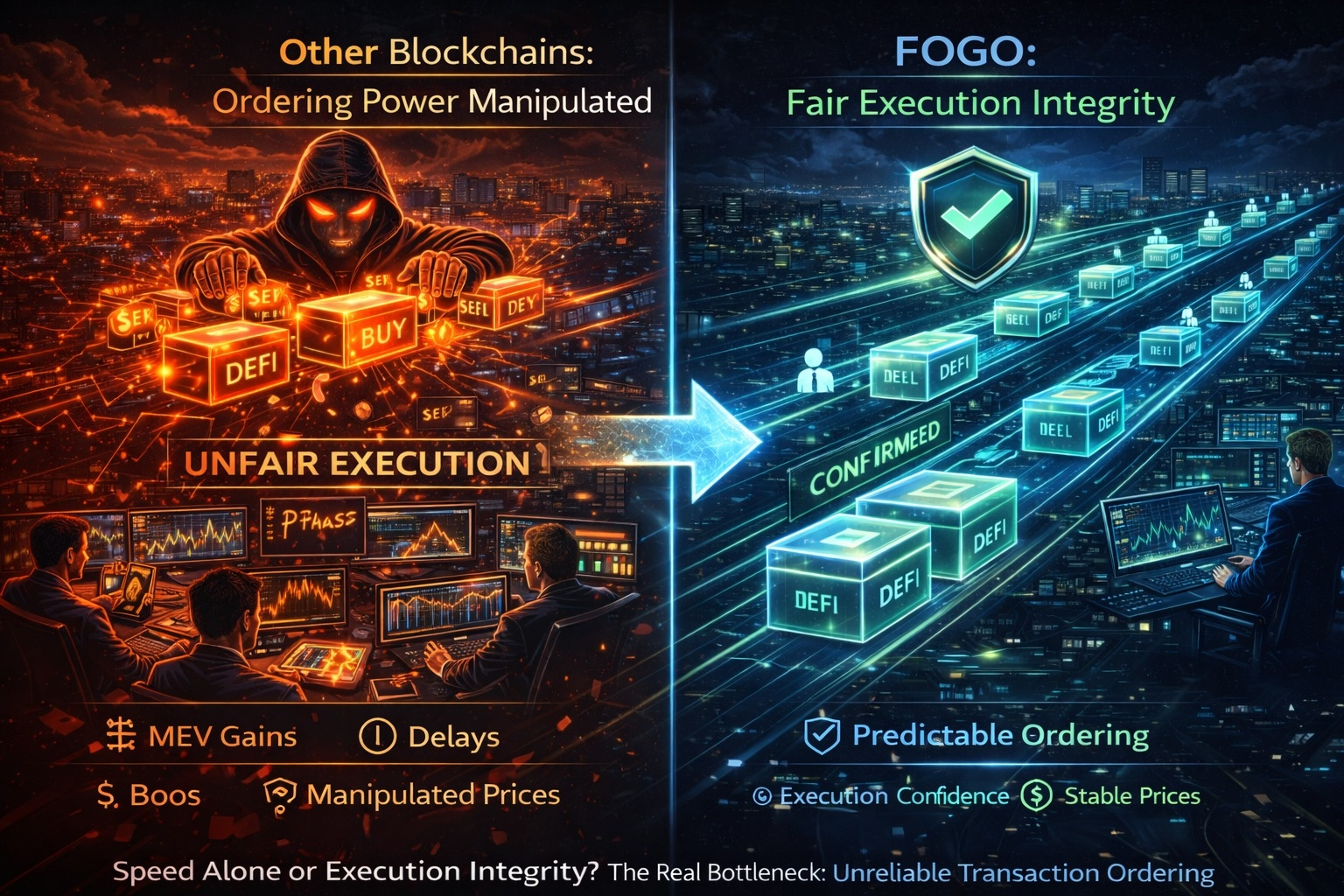
Most people think crypto’s main problem is speed. They see gas fees spike, watch transactions stall, and figure the issue must be throughput. But if you actually sit down and watch trading or onchain activity during those wild, volatile moments, you notice something else going on. It’s not just that transactions show up late—they show up out of order, the prices don’t line up, and what you get often feels off from what you intended. The network’s moving, but the whole experience doesn’t feel fair. That’s the real bottleneck in crypto right now. Not just how much stuff the system can handle, but how well it actually executes your intent. On paper, blockchains brag about speed—thousands of transactions per second, fast blocks, cheap fees. But users still run into slippage, sandwich attacks, weird fills, and random priority changes. Technically, everything’s working, but the actual experience feels warped. It’s not just about who pays the most or who gets in first. It’s about who can mess with the order, hide their transactions, or game validator incentives. This is where the real problem hides: ordering power. In most blockchains, your transaction goes into a public waiting room. Validators or block builders decide who gets in first—and that order is valuable. So a whole side economy has popped up, built around extracting profit from how transactions are sequenced. People call it MEV, which makes it sound like a technical edge case. But honestly, it’s more like a hidden tax. You send your intent to the network, and someone else gets to twist it for their own gain. It’s everywhere, even if you don’t see it. Traders end up paying more than they wanted. Liquidations happen sooner than they should. DeFi trades don’t land at the quoted price. The network’s fast, but execution is messy. So here’s the bigger question: Blockchains are supposed to be neutral. Why does transaction order feel like some private auction? Most of the conversation around scaling is about making the road wider—more throughput, faster blocks, more parallel stuff. But if the rules let certain players cut in line for profit, then adding more lanes just makes the race crazier, not fairer. It might even make things worse. That’s where Fogo comes in. Instead of chasing speed records, Fogo zeroes in on execution integrity. The idea’s pretty simple but goes deep: if you make transaction ordering predictable, there’s less value to extract, and users get better outcomes. Instead of shrugging off MEV as “just how things work,” Fogo treats it as a design flaw to fix. Sure, Fogo wants to be fast and consistent on the surface. But under the hood, the whole system is built to cut down on the chances for people to mess with transactions between when you hit send and when your trade goes through. The goal isn’t just low latency—it’s low distortion. Think of it this way: speed is like a stopwatch, but fair ordering is like a ruler. Speed tells you how quickly the transaction lands. Fair ordering tells you how close the result matches what you actually wanted. Fogo’s whole approach is about tighter coordination between when they take in transactions and how they build blocks. That shrinks the window where people can play games with the order. If you can’t secretly reshuffle transactions for profit, the incentives shift—less extraction, more focus on validating honestly. And if this works, it unlocks something crypto rarely talks about: execution confidence. For traders, it means less sneaky slippage. For DeFi protocols, more reliable liquidations and fair prices. For builders, it’s a base layer where outcomes depend on the market, not on invisible middlemen. The impact is subtle, but it matters. When users actually trust execution, they trade harder, provide more liquidity, and stop obsessing about slippage or overcollateralizing just to feel safe. Over time, that makes capital flow better across the whole ecosystem.
This is why the conversation around $FOGO isn’t just about performance stats. The token lives inside a network built to keep validators and users on the same page. Rather than squeezing out every possible profit, the system tries to reward processing that’s honest and predictable. That’s a big shift, and honestly, it’s part of a bigger trend in crypto. Early on, blockchains chased decentralization. Then came a race for speed. Now, a new front is opening up—this time, it’s about how well networks actually execute, how fair they are, and how efficiently they run. It’s not just about cranking out fast transactions anymore; it’s about delivering clean, reliable results. But let’s not ignore the tradeoffs. Cutting down on MEV means validators lose some revenue streams. If you limit how they can order transactions, you need to give them other reasons to stick around—better incentives, or solid participation economics. If rewards drop too much, you risk losing security or decentralization. And then there’s the messy reality of how people behave. Networks can launch with all the right protections, but over time, clever players find new ways to game the system. MEV isn’t a single problem; it’s a whole set of incentives. Close one loophole, and another pops up somewhere else. Fogo’s design seems to get this. The goal isn’t to wipe out extraction altogether, but to shrink the places where it can happen, while keeping validators pointed toward the long-term health of the network. In that way, Fogo isn’t chasing perfection. It’s just trying to rebalance the economics of execution, tip things back toward fairness. And timing matters. As institutional money, pro trading shops, and high-frequency players pour into crypto, execution quality starts to matter more than just raw speed. Traditional markets learned this a while ago. Fair ordering, predictable matching, less information leakage—these things build liquidity. Crypto’s reaching that same point. We’re seeing the signs everywhere: private mempools, intent-based systems, batch auctions, order flow protection. All these tools are trying to answer the same question—how do you turn what users want into what actually happens, without hidden games in the middle? Fogo’s approach is a bit different. Instead of adding another layer on top to patch things up, it tries to make the base network itself more predictable. If it works, the impact could go way beyond trading. Fair NFT mints, honest onchain gaming, better governance, real-time finance—they all depend on reliable execution. Any place where timing matters gets better when outcomes are steady and earned. Still, will users notice? That’s the big one. Execution quality is one of those things you only miss when it breaks. People don’t throw parties for fairness like they do for speed. But markets care. Liquidity follows places where outcomes are consistent and the hidden costs are low. That might end up being Fogo’s real value. Not as the flashy, headline-grabbing chain, but as the network where everything just works and the friction fades into the background. The real bottleneck in crypto was never just speed. It was always the gap between what users submit and what the network delivers. Every time a transaction gets reshuffled, every hidden extraction, that gap grows. Fogo’s making a bet: closing that gap is more important than shaving off another millisecond. Will $FOGO pull it off? Hard to say. Promising better infrastructure is easy. Aligning economics is a lot tougher. But the industry’s waking up to a new reality: the future of blockchains will be shaped less by raw speed, and more by how fair they are. If things keep heading this way, the winners might not be the ones making the most noise. They’ll be the ones where everything just works. Quiet, predictable, boring even. Where the system stays out of your way and does what you ask. That’s the kind of quiet where trust takes root.