
The Guiding and Establishing National Innovation for U.S. Stablecoins (GENIUS) Act , signed into law on July 18, 2025, has fundamentally reshaped the stablecoin landscape. For a holder of $USDT and $USDC USDC , the impact ranges from increased security and legitimacy to potential operational shifts for the issuers.

1. Impact on USDC (Circle)
USDC is widely considered the primary beneficiary of the GENIUS Act due to its long-standing focus on U.S. compliance.
Increased Legitimacy: The Act provides a clear federal framework, effectively "legalizing" USDC as a regulated payment instrument in the U.S.
Market Share Growth: Since the Act's passage, USDC's market share has risen from 21.5% to 25.5% , as institutional users migrate toward fully compliant, audited issuers Source
Reserve Safety: The Act mandates a 1:1 reserve ratio in cash and short-term U.S. Treasuries, which aligns with Circle’s existing practices, ensuring your holdings are backed by high-quality liquid assets.
2. Impact on USDT (Tether)
Tether faces more significant structural challenges under the new law, though it remains the market leader.
Compliance Pressure: The Act requires issuers to hold reserves in safe assets (cash/Treasuries) and provide audited annual reports. Tether’s historical use of Bitcoin and gold as partial backing and its opaque audit history have drawn scrutiny Source
U.S. Operations: Analysts suggest Tether may struggle to operate directly in the U.S. without significant changes. CEO Paolo Ardoino has hinted at issuing a localized, compliant stablecoin specifically for the U.S. market to maintain operations.
Grace Period: Tether has a compliance window (roughly 18 to 36 months depending on the specific bill version) to align its reserves and reporting with the new standards.
3. Key Changes for You as a Holder
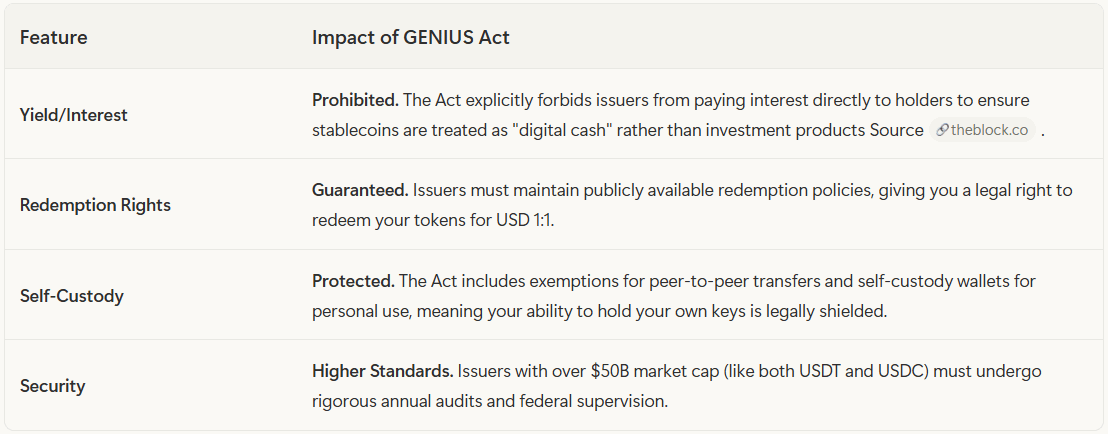
Summary & Actionable Insight
The GENIUS Act has effectively "de-risked" the stablecoin market by removing algorithmic or under-collateralized tokens from the regulated U.S. ecosystem. While USDC is the "gold standard" for compliance under this Act, USDT is in a transition phase to meet these new requirements. If you are a U.S.-based user, you may see platforms increasingly favor USDC or new bank-issued stablecoins (like those planned by BNY or JPMorgan) over the next 12–18 months.
Disclaimer: This report is based on legislative developments as of early 2026. Regulatory implementation is ongoing and subject to further agency rulemaking.