Imagine you’re trying to send a transaction at the exact moment everyone else is also trying to send one. Maybe the market just moved hard, a new token launched, an airdrop claim opened, or some big listing went live. Most chains look great when it’s quiet, but the real test is what happens when the whole crowd shows up at once.
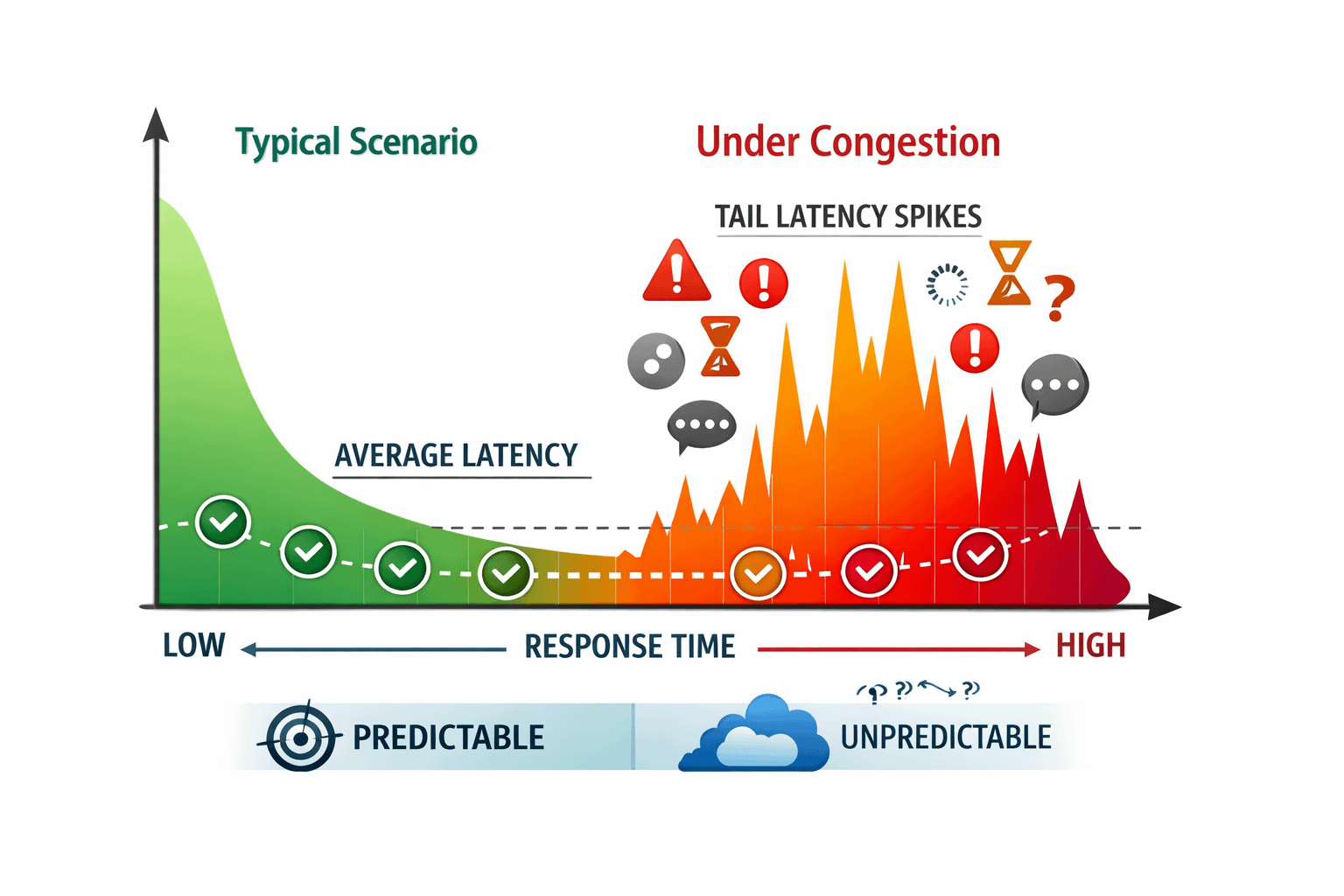
That “crowd moment” is what people casually call congestion, but the pain isn’t only “the chain is slow.” The real pain is unpredictability. One minute things confirm instantly, the next minute you’re stuck refreshing your wallet, re-trying, watching errors, and wondering if your transaction is lost or just waiting in a messy line. In many high-throughput systems, the average speed is not the problem—tail latency is. Even if most transactions confirm fast, the slowest few percent become painfully slow, and if you happen to be in that slice, the chain feels broken.
Fogo is built with the mindset that real-time finance can’t live on “fast on average.” It needs to be consistent under stress. So instead of treating congestion like something you only solve with higher fees, it tries to reduce the root causes that make networks wobble when demand spikes: long-distance coordination and performance variance across validators.
One of Fogo’s biggest ideas is zoned consensus. In plain language, validators are grouped into zones, and at any given time only one zone is actively participating in consensus. The rest of the network still stays synced, but the “decision loop” for producing blocks and voting is kept inside a tighter set of validators. This matters because when a consensus quorum is spread across the planet, geography becomes a hidden tax. Distance adds unavoidable delay, routing adds randomness, and the slowest links start to define what “normal” feels like. Under heavy load, that randomness becomes more visible, and users experience it as sudden spikes, stalls, and inconsistent confirmations. By keeping the active consensus group in a zone, Fogo is basically shortening the critical path so it can stay steadier when traffic turns ugly.
There’s also the idea of rotating zones based on time—sometimes described as a follow-the-sun approach. The human version is simple: usage, liquidity, and exchange activity aren’t evenly distributed 24/7. If you can keep the active consensus closer to where the action is during that part of the day, you reduce the distance a lot of users effectively pay. Less distance usually means less variance, and less variance means congestion is less emotionally painful, even when throughput is being pushed.
But zoning alone isn’t enough if validators behave wildly differently. A common cause of “it feels congested” is that not every validator is equally capable. Underpowered machines, poor networking, misconfigurations, or jittery scheduling can create outliers. In distributed systems, outliers are dangerous because they don’t just slow themselves down—they can slow down everyone’s ability to agree and propagate. Fogo leans into the idea that validators should meet serious performance requirements so the network doesn’t inherit the chaos of hobby-grade setups. That’s a deliberate tradeoff: you get more deterministic performance, but you accept that running a validator is a higher-bar operation.
On the software side, Fogo’s SVM approach is tied to Firedancer-style engineering, including an intermediary “Frankendancer” client described as combining Firedancer components with Solana’s Agave codebase. The practical reason this matters for congestion is that the validator is engineered like a pipeline built for bursty demand. Instead of one big process trying to do everything and getting knocked around by the operating system under load, the design breaks work into specialized components (“tiles”) and pins them to cores to reduce scheduling randomness. This is exactly the kind of engineering that helps when demand comes in waves: fewer random pauses, fewer unpredictable stalls, more stable latency.
Networking is another silent killer in congestion. Under heavy demand, leaders can become bottlenecked not because the VM can’t execute, but because the node can’t ingest, verify, deduplicate, and pack transactions fast enough. Fogo’s described design includes high-speed packet handling paths and parallelization of expensive steps like signature verification. The point is straightforward: in rush hour, you want the system to keep moving smoothly, not choke at the entrance ramp.
Even with all of that, congestion can still happen when demand outstrips capacity. That’s where prioritization fees come in, similar to what users already understand from Solana-style fee behavior: you can attach an extra tip during busy moments to improve your inclusion chances. The important thing is that Fogo’s “story” isn’t “just tip more.” It’s “make the network less chaotic first, then let priority fees handle the truly extreme spikes.”
There’s also a quieter piece: user behavior makes congestion worse when the experience is frustrating. When wallets throw errors, users and bots retry aggressively, creating more noise. Fogo Sessions aims to reduce friction by allowing time-limited scoped permissions through session keys, and it also opens the door for app-managed fee experiences (including sponsorship), with constraints. It’s not a magic congestion switch, but it can help reduce the panic-click and spam-retry patterns that inflate traffic when the network is already hot.
If you zoom out, Fogo is not only chasing a big throughput number. It’s chasing a particular feeling: the chain should stay calm when everyone shows up. That’s load management in the real world. A system that doesn’t swing wildly from “instant” to “forever,” doesn’t turn inclusion into a lottery, and doesn’t feel unpredictable at the exact moments people care most.
There’s a tradeoff baked into this approach, and it’s worth saying plainly. Localizing consensus and enforcing performance standards can push the network toward determinism and speed, but it can also raise questions about how permissionless validator participation is in practice and how the network balances decentralization ideals with market-grade performance goals. Whether that tradeoff is acceptable depends on what you want from the chain. If your target is real-time trading, payments, and high-frequency app behavior, predictability under load is the whole game. If your target is maximum openness to any validator anywhere on any setup, you’ll naturally scrutinize this approach harder.
That’s basically Fogo’s congestion strategy in human terms: tighten the consensus loop so geography doesn’t sabotage you, reduce validator variance so outliers don’t define your worst moments, build the validator like a low-latency pipeline so burst traffic doesn’t create jitter, and use priority fees as a pressure valve for the rare moments when demand still exceeds capacity.