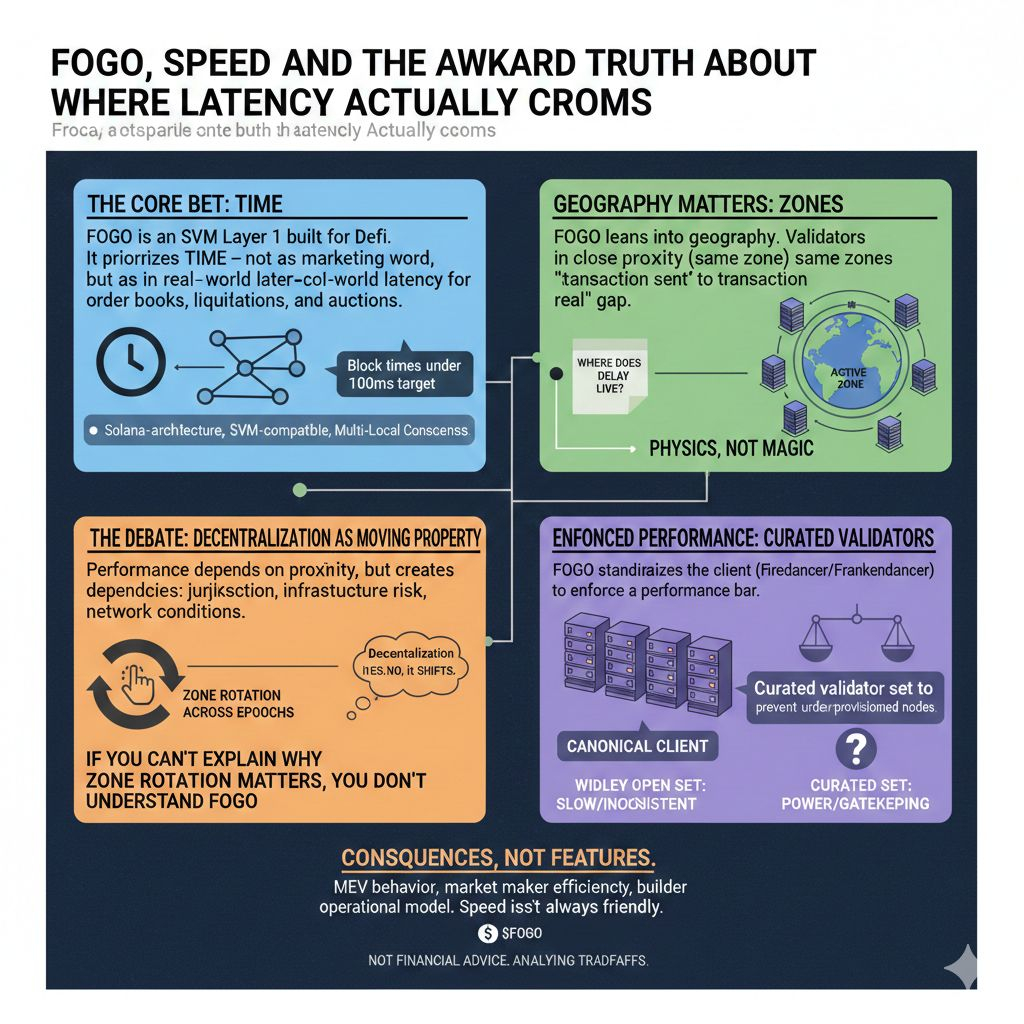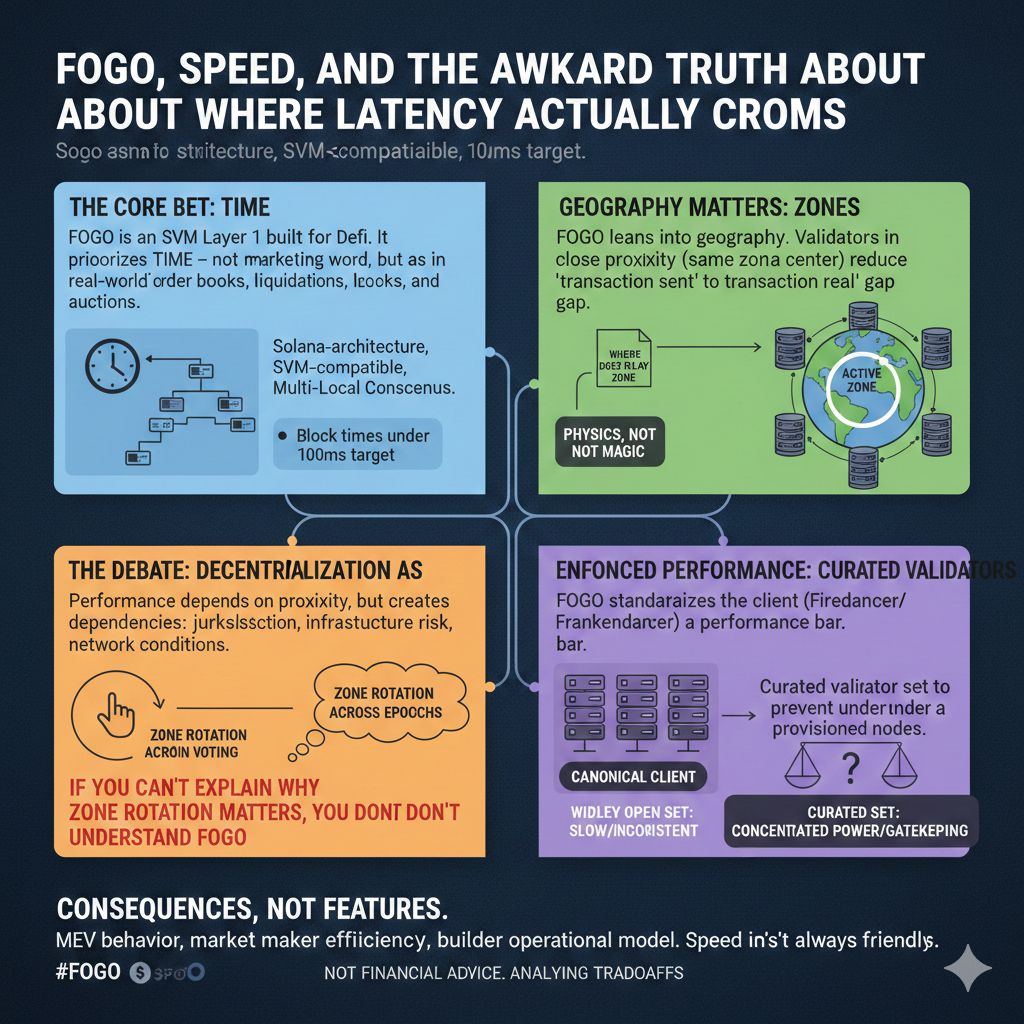
If you’re posting about @fogo just to tick a box, you’ll run out of ideas fast. The only way to keep writing something real is to look at what Fogo is actually betting onand why that bet is a little uncomfortable for people who treat “decentralization” like a slogan instead of an engineering trade.Fogo is an SVM Layer 1 built for DeFi that cares about one thing more than most chains admit: time. Not “time” as a marketing word. Time as in whether an onchain order book can behave like an order book, whether liquidations land when they should, whether auctions feel crisp instead of mushy. The docs put it plainly: it’s Solana-architecture, SVM-compatible, and designed around multi-local consensus to push latency down. That’s the core. Everything else is decoration.Here’s the detail that matters and that most people skip: Fogo doesn’t pretend the internet is flat. It leans into geography. Validators operating close togethersame zone, ideally even the same data centerreduces the gap between “transaction sent” and “transaction becomes real.” The architecture page even spells out the idea of zones co-locating to approach hardware limits, with block times under 100ms as the target in that setup. That’s not magic, it’s physics.But let’s be honest: this is where the debate starts, not where it ends.Because if performance depends on tight proximity, you’re also admitting that where the active zone sits changes the chain’s lived reality. Different jurisdiction, different infrastructure risk, different network conditions. Fogo’s answer is rotation: move the zone across epochs so the system doesn’t permanently anchor itself to one place, and use on-chain voting to coordinate the next location. That’s clever. It’s also a reminder that decentralization isn’t a constant “yes/no” switchit can become a moving property that shifts with operations and governance.Blunt line: if you can’t explain why zone rotation matters, you don’t understand what makes Fogo different.
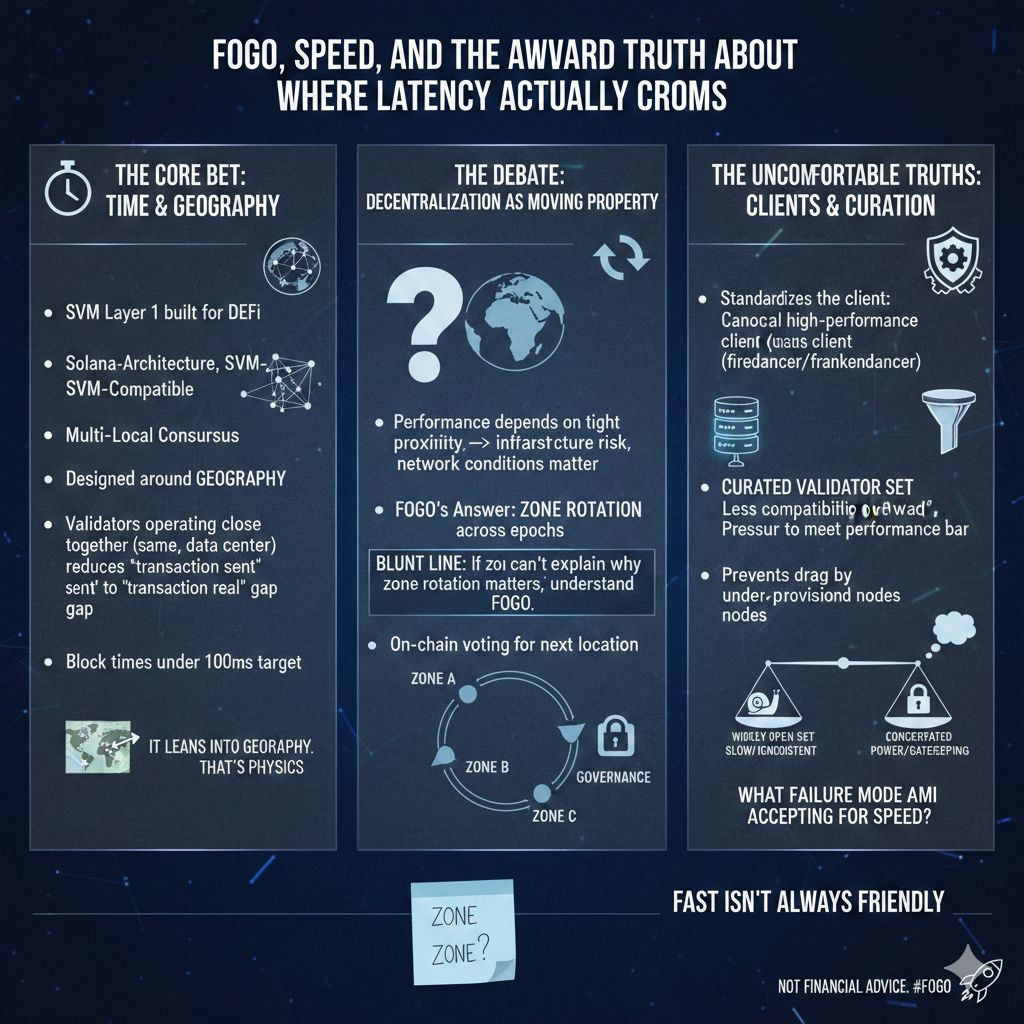
There’s another part that’s easy to miss if you only read tweets: Fogo standardizes the client. The docs describe a canonical high-performance client based on Firedancer (with an initial path using Frankendancer before full Firedancer), and they’re explicit about the motivation: less compatibility overhead, less “some validators are slow so everyone must wait,” more pressure to meet a performance bar or lose revenue through missed blocks. That’s not a cute technical preference—it’s a social contract enforced by incentives and, yes, by selection.And that leads to the line that will bother maximalists: Fogo uses a curated validator set to keep the network from being dragged down by under-provisioned nodes. You can argue about that choice all day. You should, actually. Because for traders and builders, the question isn’t “Is this pure?” The question is “What failure mode am I accepting in exchange for speed?” A widely open validator set can fail by becoming slow and inconsistent. A curated set can fail by concentrating decision power and gatekeeping. Pick your poison, then measure it.This is why writing about $FOGO can stay fresh daily without repeating yourself: you’re not writing “features,” you’re writing consequences. What does it mean for MEV behavior if the network can enforce norms? What does it mean for market makers if latency is low enough that micro-inefficiencies don’t sit around waiting to be harvested? What does it mean for builders if the chain is SVM-compatible but the operational model is opinionated?A tiny micro-detail from my own workflow: I keep one sticky note on my screen that just says “Where does the delay live?” and I’ve already circled the word “zone” twice today. Sounds silly, but it stops me from posting fluff.And one imperfect sentence, because that’s how real writing looks: It’s fast, yes, but fast isn’t always friendly when you’re the one on the wrong side of execution.Also, to be clear, none of this is me telling you to buy anything. I’m not here to sell you $FOGO. I’m here to point at the real tradeoffs so your posts about #fogo don’t read like copy-paste noise. If Fogo wins, it won’t be because it shouted “high performance” the loudestit’ll be because its design choices hold up when the market is busy, messy, and unforgiving. And that’s the only time speed actually counts.