

I have noticed something over the years watching crypto projects try to solve privacy. It almost always breaks in one of two ways. Either everything is public and businesses hate it. Or everything is hidden and regulators panic. There’s rarely a middle ground that actually works in practice.
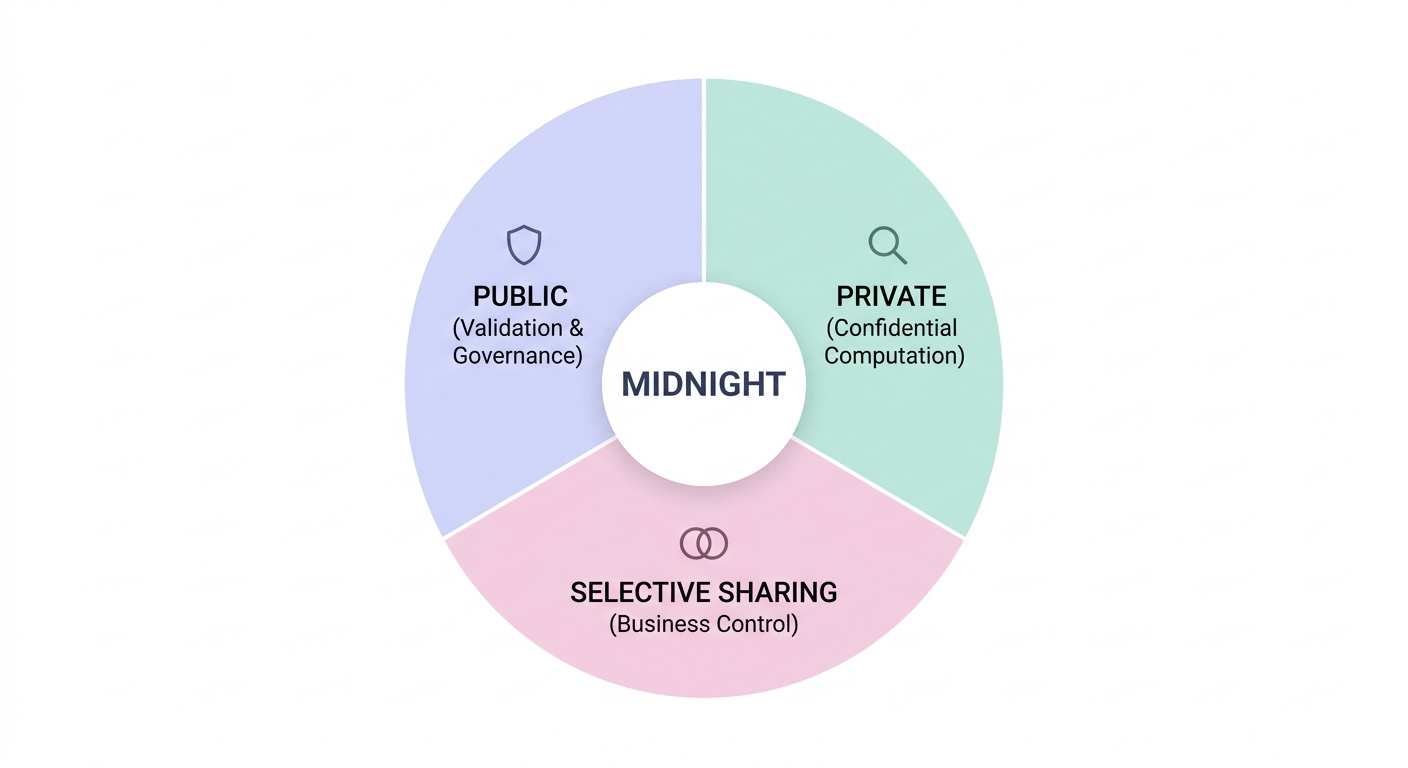
@MidnightNetwork is trying to operate right in that middle zone. The project comes from Input Output Global the Cardano side of the industry and it’s being built as a partner chain rather than some isolated experiment. The goal isn’t to replace public blockchains. It’s to add a privacy layer that businesses can actually use.
Because here’s the uncomfortable truth most companies simply cannot run their operations on a fully transparent ledger.
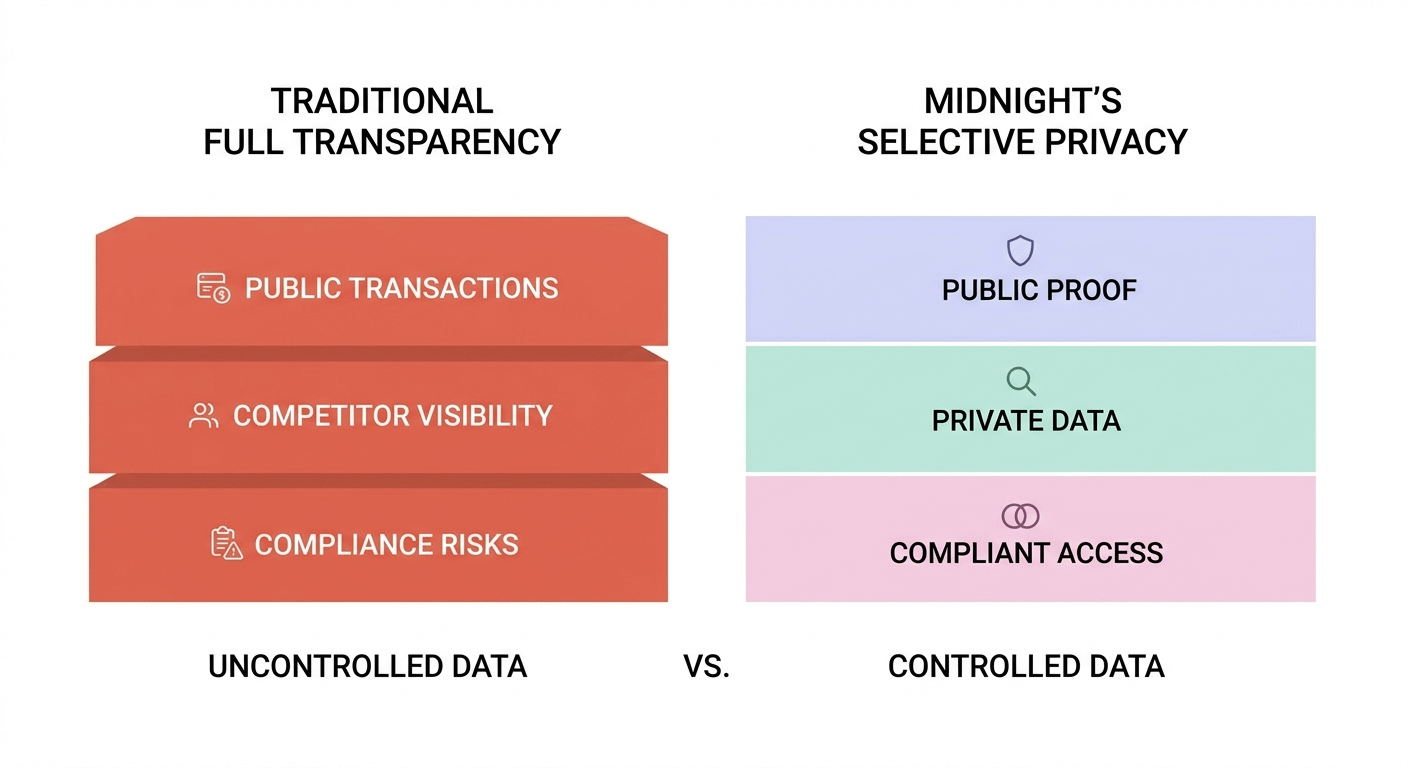
I ran into this personally a few years ago when I was looking at supply-chain protocols. On paper everything looked amazing. Payments settle instantly. Records are permanent. Trust is built into the system. But the moment you talk to real operators, the problem shows up immediately. They don’t want their competitors seeing every supplier payment or inventory flow. That kind of transparency turns into free intelligence for rivals.
That’s where Midnight’s approach starts to make sense.
The network relies on zero-knowledge proofs. In simple terms, the chain doesn’t reveal the transaction details. It just proves that the rules were followed correctly. The math verifies the outcome without exposing the data behind it.
Short version proof without exposure.
For a business owner that removes a massive friction point. They can run smart contracts, settlements, or compliance checks without broadcasting internal data to the entire market.
The system itself splits activity into two layers. One side stays public. That’s where validation and governance happen. The other side handles the private computation. Sensitive logic runs there. What eventually hits the chain is just a cryptographic proof that everything worked.
Clean separation.
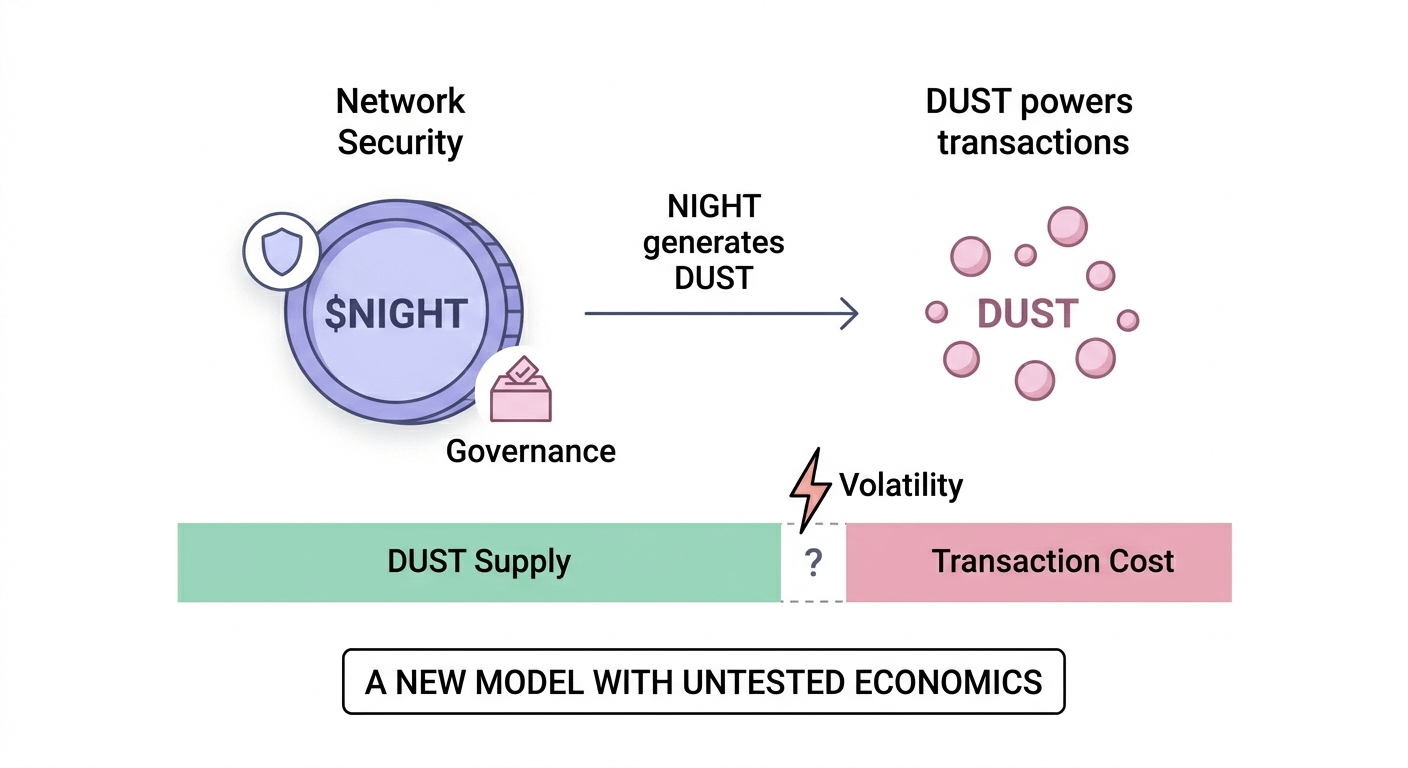
Then you get to the token model. NIGHT is the main token tied to governance and network security. Holding it generates DUST, which is used to power private transactions.
Think of DUST like the fuel tank for confidential computation.
The idea sounds elegant. But crypto veterans see the risk.
If NIGHT becomes extremely volatile which happens all the time in this market the economics behind that fuel system could get messy. Imagine the cost of running private contracts suddenly jumping because the underlying asset swings 40%. That’s the kind of scenario people quietly worry about.
It doesn’t mean the model fails. It just means it hasn’t survived a real market stress test yet.
The bigger trend here is obvious though. Radical transparency sounded great in early crypto. In reality, most industries can’t function like that.
Banks don’t want their settlement flows public. Healthcare systems can’t expose patient records. Identity networks need verification without revealing the full identity profile.
So the industry is slowly shifting toward something more practical: selective privacy.
Not full secrecy. Not full exposure. Somewhere in between.
Midnight is one attempt to build that middle layer. Whether it actually wins developer attention is another story. Crypto is full of good ideas that never reach critical mass.
But the problem it’s trying to solve is very real. And the market is starting to realize that transparency alone isn’t enough for the next phase of blockchain adoption.
