
Arundhati Roy has spoken again. And when Arundhati speaks, it is not merely words—it feels like a volcano erupting. But this is not an uncontrolled eruption. It is lava that has been building for years. Every word measured. Every sentence aimed with precision.
“Iran is not Gaza.”
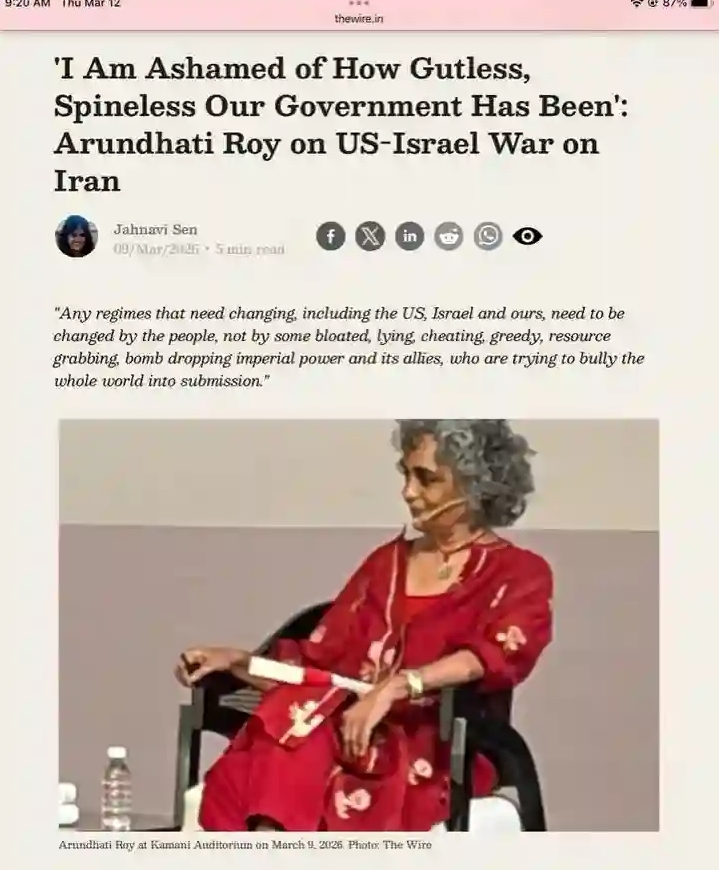
Four words—and in those four words, she summarizes an entire war.
Arundhati says that Tehran, Isfahan, and Beirut are burning. The same old perpetrators. The same old methods. Kill the women. Kill the children. Bomb the hospitals. Turn cities into rubble. And then stand there pretending to be the victim. She argues that this is what happened in Gaza Strip, and that the same is now happening in Iran.
The difference this time, she says, is that the fire may not be contained. This war could expand into a much larger theater—one that might engulf the world. The shadow of nuclear destruction hangs overhead. The same country that once dropped atomic bombs on Hiroshima and Nagasaki now appears, in her view, to be preparing to destroy one of the world’s oldest civilizations.
But the real pain in Arundhati’s speech, she says, is not only about Iran. The deeper pain is about India.
She says she stands with Iran—without hesitation and without conditions. If any government must be changed—whether it is United States, Israel, or even her own—it should be the right of the people, not of a bloated, deceitful, bomb-dropping empire.
Then she turns toward her own country. And from this point, the speech becomes less a speech and more like a post-mortem.
She says: Iran is standing firm. India is shrinking back.
There was a time, she says, when India was poor—very poor. But it had dignity. It had self-respect. Today, she argues, it is a wealthy country with poor and unemployed people—where hatred is fed to the public instead of bread, poison instead of truth. Dignity gone. Respect gone. Courage gone. Only preserved in films.
“What kind of people have we become?” Arundhati asks. How can a democratically elected government remain silent when, she says, powerful nations kidnap or kill leaders of other countries?
She points out that India’s Prime Minister Narendra Modi embraced Benjamin Netanyahu shortly before attacks on Iran. What does that mean, she asks? India also signed trade agreements with the United States that she argues could harm Indian farmers and the textile industry. Now, she says, India has been “allowed” to buy oil again from Russia—“allowed,” she emphasizes. Permission for what else, she asks sarcastically—going to the bathroom, taking leave, meeting one’s mother?
Every day, she claims, American politicians mock India. Donald Trump publicly insults it, she says, while India’s leaders respond with polite smiles and diplomatic embraces.
She opens another wound: during the peak of the war in Gaza, India reportedly sent thousands of poor laborers to Israel to replace Palestinian workers. Now, she says, when Israelis hide in bunkers during attacks, those Indian workers are not allowed inside. What does that say about India’s place in the world?
Arundhati recalls an old Chinese phrase: “the empire’s pet dog.” She says that people once mocked this expression, but today it feels uncomfortably accurate. The only difference, she says, is that in films India’s fictional heroes walk proudly, winning imaginary wars—muscular on screen but empty in thought—feeding the audience’s anger through meaningless violence.
According to her, this speech is not merely a speech. It is a mirror. But a mirror only shows what stands before it. The tragedy, she says, is that many people no longer have the courage to look into that mirror.
Iran, she concludes, is fighting at a heavy cost. India, she argues, is bowing for free. And history, she says, records both—the ones who fight and the ones who bend.


