


I’ve been watching how different blockchains design their token systems and one pattern appears again and again. A single token is expected to do everything. It secures the network it participates in governance and it also pays for every transaction that happens on the chain.
At first that seems efficient. But the longer you look at it the more it feels like too many responsibilities placed on one asset.
Midnight takes a slightly different route.
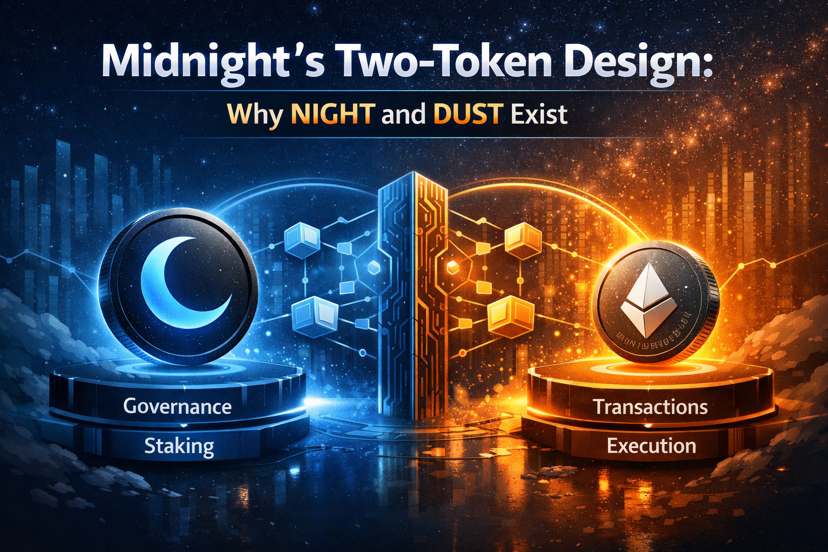
Instead of relying on one token for every function the network separates roles between two assets NIGHT and DUST. The idea is fairly simple although the implications are a bit more interesting.
NIGHT acts as the main economic token connected to the network. It represents participation in the ecosystem and plays a role in governance and security. In other words it sits closer to the longterm structure of the network.
DUST serves a different purpose. It is used for operational activity on the chain things like transactions or smart contract execution. Rather than spending the main governance token directly every time someone interacts with the network DUST becomes the resource used for those operations.
This kind of separation is not very common yet but it addresses a problem that many blockchains quietly deal with.
When the same token is used for both governance and gas fees heavy network activity can push the token into constant circulation. Users buy it spend it to perform actions, and the cycle repeats. Over time that dynamic can blur the difference between longterm ownership and shortterm usage.
Midnight’s structure tries to create a bit of distance between those two things.
The network itself is focused on programmable privacy. Using zeroknowledge proof technology applications can verify certain information without revealing the underlying data. In practice that means a system can prove something is true while still keeping the sensitive details hidden.
This concept sometimes gets described as rational privacy. It is not about hiding everything completely but about controlling what information becomes visible and when.
That approach matters for real-world systems where privacy and verification both matter. Financial contracts identity systems or enterprise coordination often involve data that cannot be fully public but still needs some level of proof.
Midnight is trying to build infrastructure where those situations are easier to handle.
Of course, design ideas alone do not determine whether a blockchain succeeds. What matters more is whether developers find the system useful enough to build applications on top of it.
If confidential smart contracts become something developers genuinely need then Midnight’s architecture could become relevant very quickly.
If that demand never appears the network will simply remain another interesting experiment in blockchain design.
For now, the project mostly shows that token systems are still evolving. Sometimes the innovation is not a completely new concept, but a small change in how the pieces of a network fit together.