

I remember the first time I tried to trade a machine economy story on narrative alone. It looked clean on paper, the market loved the idea for about a week, and then the same problem showed up that usually kills these setups: nobody could tell whether the network was creating real economic activity or just recycling attention. That’s the frame I’m using with Fabric. Not “robots are interesting.” Not even “proofs are interesting.” The real question is whether crypto can verify that a machine actually did useful work, and whether that verification is strong enough to keep operators, developers, and token holders engaged after the listing pop fades. That’s the retention problem. And for traders, that matters more than the slogan. The risk is not subtle here. ROBO is trading around $0.0409, down about 7.5% on the day and 8.9% on the week, with roughly $46.7 million in 24 hour volume against a market cap near $91.4 million. Fully diluted value sits much higher, around $409.6 million, which tells you straight away that future supply still matters. CoinGecko also shows the token hit an all time high of $0.06071 on March 2, 2026, then pulled back hard within days. That’s not the chart of a settled market. It’s the chart of a new asset still looking for a real clearing price while speculation runs ahead of operating proof. If you’re eyeing this, that volatility is not background noise. It is the trade.
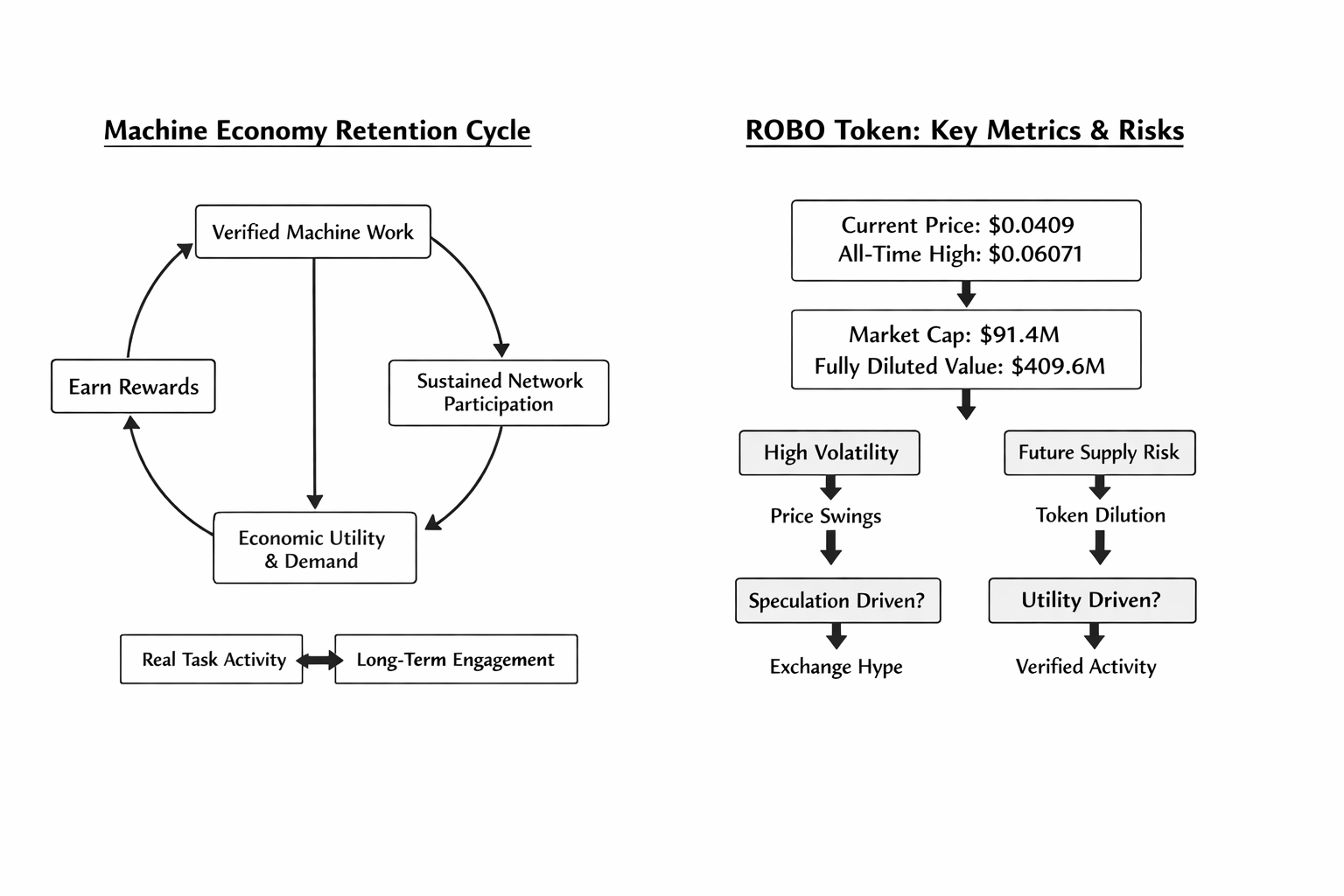
Still, here’s the part that made me take a second look. Fabric is not really framing rewards like a standard proof of stake system where capital sits there and collects yield for existing. In the whitepaper, the reward logic is tied to verified work, quality, and recent activity. It explicitly says passive eligibility is out, verified tasks are in, and that a participant with lots of tokens but zero work gets zero rewards. That sounds small until you think through the market consequences. Most crypto networks can survive a while on financial loops alone. Fabric is trying to force a service loop. Work has to happen, get verified, and stay good enough to keep earning. Think of it like a warehouse payroll system instead of a dividend stream. No shift, no pay. That design goes straight into the retention question. A lot of machine or AI adjacent tokens can attract traders for a month. Very few can retain operators over quarters. Fabric’s model only really holds together if people keep showing up to do the hard part: perform tasks, submit verifiable contributions, maintain quality, and accept that rewards decay without ongoing activity. The whitepaper even frames this as a self stabilizing participation dynamic where active contributors should rise or fall with network demand. In theory, that’s healthier than paying people for parking capital. In practice, it creates a much tougher test. If real task demand is thin, retention weakens fast because the token has less operational gravity pulling people back in. That’s also where my main frustration sits. Fabric’s core idea is sharp, but sharp ideas in crypto still run into ugly execution realities. Verifying machine work is only valuable if the market believes the verification maps to something economically meaningful. If proofs become easy to game, too abstract for buyers to understand, or disconnected from actual demand for robotic services, the whole structure starts drifting back toward narrative speculation. Even Fabric’s own documents lean on future primitives around verifying work, compliance, efficiency, power consumption, and user feedback. That tells me the architecture is aiming far, but it also tells me some of the hardest commercial validation still sits ahead, not behind. So what am I watching? Not just price. I’m watching whether the network starts showing evidence that proof based participation is becoming habit rather than event driven behavior. The whitepaper targets a mature state where 60% to 80% of token value derives from structural utility rather than speculation, and it treats that ratio as a health metric. That’s ambitious. Maybe too ambitious early. But it gives traders a useful lens: is ROBO being pulled by actual work bonds, fee conversion, and governance use, or is it mostly being pushed around by exchange flows and new listing attention? Right now, with the token already off its March 2 peak and market activity cooling from recent surges, I’d say that question is still open. What would change my mind in either direction is pretty simple. If Fabric can show repeated, understandable proof that machine activity on the network is real, economically relevant, and hard to fake, then the retention loop gets stronger and the token starts looking less like a short cycle trade and more like infrastructure with teeth. If it can’t, the market will eventually treat “verified machine work” as just another clever phrase that never found durable demand. That’s why this one is worth watching closely right now. Don’t trade ROBO like a robot story. Trade it like a live test of whether crypto can finally pay for proven work instead of promised work, and be honest about which side of that line the network is actually standing on.
@Fabric Foundation #ROBO $ROBO
