
The more time I spend around AI, the more I feel that people are focusing on the wrong milestone.
Most of the conversation still revolves around performance. Better models. Faster replies. Stronger reasoning. More natural language. More automation. Every few weeks, there is another wave of excitement around what AI can now do that it could not do before. And to be fair, a lot of that progress is real. AI has become more useful, more capable, and far more present in daily work than most people expected.
But none of that fully answers the question that keeps staying in my mind.
Can it be trusted when the outcome actually matters?
That is the point where my attention shifts, and that is also where @Mira starts to feel important to me.
What interests me about Mira is not simply that it connects AI with blockchain. That description is too flat for what I think the deeper idea really is. What pulls me in is the fact that it treats reliability as the real problem, not intelligence alone. To me, that is a much more serious and much more necessary direction.
Because the biggest weakness in modern AI is not that it lacks fluency. It is that it often sounds certain even when it is wrong.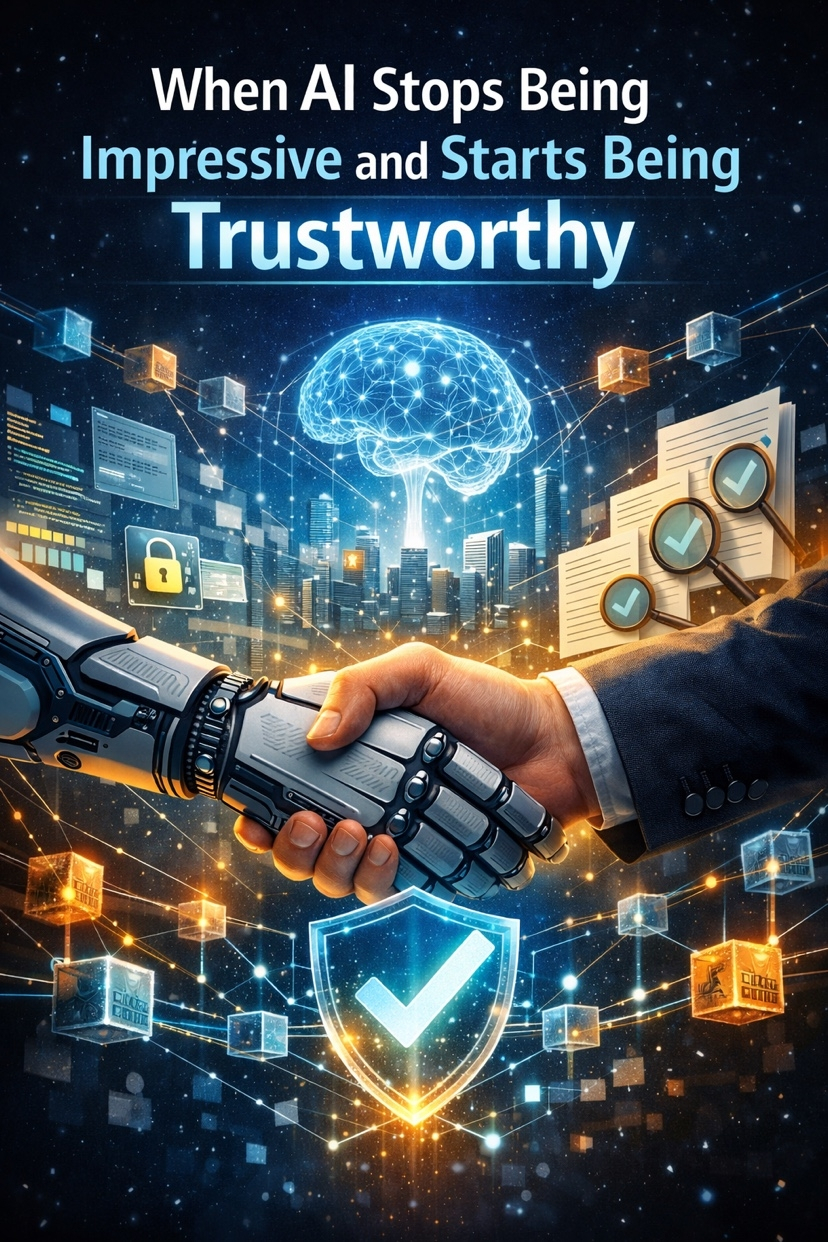
That creates a strange kind of tension. AI can give you an answer in seconds. It can summarize documents, explain topics, structure ideas, and make recommendations with a level of speed that still feels remarkable. But speed without dependable truth has limits. At some point, confidence becomes dangerous when it is not backed by something that can be checked.
And that is exactly why I think Mira matters.
I do not look at it as just another project trying to ride the AI narrative. I look at it as a response to a problem that many people already feel but do not always describe clearly. We are entering an era where AI is expected to do more than assist casually. It is starting to influence decisions, workflows, judgment, and systems that affect real outcomes. In that kind of environment, it is no longer enough for an answer to sound smart. It needs to be verifiable.
That is the shift I find meaningful.
When I think about Mira, I do not think first about technical architecture. I think about a future where AI outputs are no longer treated like something we either believe or distrust based on instinct. Instead, they become something that can pass through a process of challenge, review, and confirmation. That feels like a much healthier model for the next stage of artificial intelligence.
In a way, it changes the role of trust.
Normally, trust in AI is personal and fragile. One good answer makes people optimistic. One bad answer makes people suspicious. The entire experience swings between amazement and doubt. That is not a stable foundation for systems that are supposed to support serious use. What Mira seems to introduce is a way of moving trust away from impression and closer to validation.
That difference is bigger than it looks.
I think a lot of people underestimate how important this becomes once AI moves beyond simple convenience. If an AI helps write a caption, a mistake is harmless. If an AI supports research, automation, financial logic, risk assessment, or infrastructure decisions, the cost of being wrong changes completely. In those situations, the issue is no longer whether the model is advanced. The issue is whether the result can survive scrutiny.
That is why decentralized verification feels powerful to me as an idea. It suggests that truth should not depend on one model speaking with authority. It should come from a process where claims are broken down, examined, and validated through a wider structure. That feels more mature. More realistic. More aligned with how reliability is actually built in high stakes systems.
And honestly, I think that is the part of AI many people have been waiting for without saying it directly.
Not more theatrical intelligence.
More accountable intelligence.
That is the lens through which I see @Mira. It feels less like a product built to impress people and more like infrastructure built to reduce blind trust. I find that refreshing, because too much of the AI space still rewards appearance over assurance. There is so much attention on what looks advanced, but much less attention on what can be depended on repeatedly.
Mira, at least in how I understand its direction, speaks to that missing layer.t recognizes that intelligence alone does not create confidence. Verification does. Process does. Structure does. The ability to test an output instead of simply receiving it does.
That makes the whole idea feel more durable to me.
I also think there is something deeper here about how AI should fit into society. If these systems are going to become more embedded in work and decision making, then trust cannot stay abstract. It has to become operational. It has to be built into the way results are produced and accepted. Otherwise, we will keep living in the same pattern where AI grows more powerful while people remain unsure when to rely on it.
That is not a small issue. That is one of the central issues.
So when I reflect on Mira, I do not see it as a side project in the AI conversation. I see it as part of a much larger correction. A move away from raw output and toward validated output. A move away from centralized confidence and toward distributed confirmation. A move away from asking whether AI can answer, and toward asking whether AI can be trusted after it answers.
That question matters more to me than most benchmarks ever will.
Because in the end, the future of AI will not be decided only by how much it knows or how fast it speaks. It will also be decided by whether people can depend on it without feeling like they are taking a blind risk every time.
That is why @Mira - Trust Layer of AI Mira stands out in my mind.
It feels like a project built around the part of intelligence that comes after generation. The part where truth has to be tested, not assumed. The part where reliability becomes a system instead of a promise.And to me, that is where AI starts becoming truly useful.
