

A small delay can reveal a lot. Not long ago I was standing outside waiting for a map to refresh on my phone. It only took a few seconds. Nothing dramatic happened. I was not lost and the world did not stop. But that pause made me notice something I usually ignore. A huge part of daily life now depends on systems that feel almost invisible until they slow down.
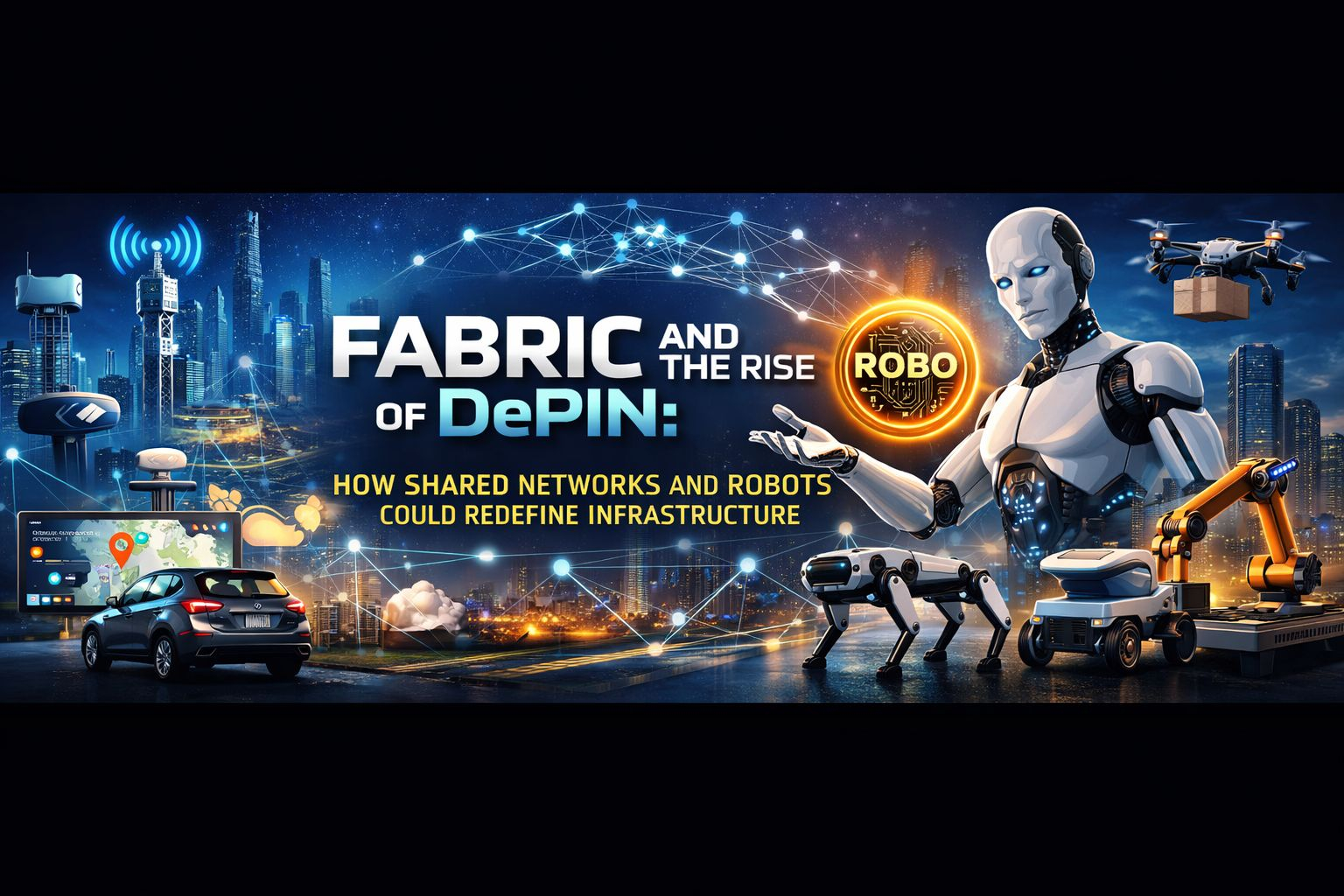
DePIN stands for decentralized physical infrastructure networks. The phrase sounds technical but the core idea is simple. Instead of one large company paying for all the hardware and controlling the whole system from the top down a network grows through many people contributing devices at the edge. Those devices can be hotspots cameras sensors weather stations or other small pieces of hardware. The network then uses those devices to deliver a real service and the people who help run it can earn rewards for participating. Messari’s recent State of DePIN 2025 report says the sector has matured into a real category of revenue generating infrastructure businesses with roughly $10 billion in circulating market cap and an estimated $72 million in FY25 onchain revenue. That is one of the clearest signs that DePIN is moving beyond pure theory and starting to prove there is actual demand for these models.
What makes this model stand out is not just the token layer. It is the way it changes the relationship between people and infrastructure. For a long time infrastructure has usually been something built far away from the people who use it. Big telecoms build coverage. Large mapping firms build maps. Specialized data companies build sensor networks. Everyone else just consumes the final service. DePIN changes that by turning the user into part of the system itself. A person with a device in a home a car or a neighborhood becomes a contributor to a network that can create real value at scale. That is a meaningful shift because it makes infrastructure feel less like a distant corporate product and more like a shared layer built from many small local contributions. Messari’s report explicitly frames this as a move from speculative experimentation to businesses that are increasingly judged by actual network usage and revenue rather than hype alone.
The timing also makes sense. Small hardware is cheaper than it used to be. Sensors edge devices and compact wireless equipment are easier to deploy than they were a decade ago. At the same time large capital heavy projects are harder to fund in a more cautious market. There is also a growing need for real world data because modern software and AI systems need more than internet text. They need information from roads buildings weather patterns logistics flows and physical environments. DePIN fits that moment because it offers a way to expand infrastructure without requiring one company to spend enormous amounts of money before anything works. The network can grow one participant at a time. That makes it feel less like a purely ideological idea and more like a practical answer to the rising cost of building the real world layer that digital systems now depend on.
Some of the best examples make the concept easy to understand because they solve problems people already recognize. Helium is probably the clearest case. Its model lets people deploy wireless hotspots and help expand coverage through a network built by its own users. Helium’s official 2025 year in review says the network ended the year connecting more than 2 million daily active users and described that as nearly ten times growth from the start of the year. That matters because it shows community built infrastructure can move past the experimental stage and support a very large number of real users. It is not just a token idea on paper. It is an example of people powered connectivity reaching actual scale.
Hivemapper is another strong example because it takes something familiar and rethinks how it is collected. Traditional mapping often depends on specialized fleets and expensive dedicated operations. Hivemapper’s own contributor documentation says the network allows anyone driving with a purpose built device to contribute to a dynamic global map. Contributors upload street level imagery as they go about normal daily driving and the network’s map AI processes that imagery into a usable map. The docs also explain that map customers use the resulting data and contributors are rewarded with HONEY tokens for useful contributions. In other words the network turns ordinary movement through the world into a living mapping layer. That is powerful because roads are already full of people. Hivemapper is not trying to create movement from scratch. It is trying to turn everyday movement into infrastructure.
The details of Hivemapper also show why DePIN is not just about plugging in hardware and hoping for the best. The network cares about data quality because low quality inputs make the map less useful. Hivemapper’s docs on dashcam view say well mounted devices are critical for high quality map data and that contributors with better unobstructed setups receive better reputation scores and therefore better rewards. That is an important detail because it shows the incentive system is tied to usefulness not just raw participation. The network is trying to align rewards with quality so the map improves over time rather than simply growing noisier. That is one of the deeper lessons of DePIN. The strongest systems are not just decentralized. They also create economic reasons for participants to contribute something the network can actually use.
WeatherXM may be the most relatable example because almost everyone has experienced the frustration of a forecast that feels wrong for their exact location. Weather can shift from one part of a city to another and a broad regional forecast does not always capture that. WeatherXM’s site describes it as a community powered weather network that rewards weather station owners and provides accurate weather services. Its network pages explicitly describe the goal as delivering accurate hyper local weather data to Web2 and Web3 enterprises and its homepage currently highlights a network map with more than 9500 weather stations. That gives the model an obvious real world use case. The closer data is to the place where people actually live and move the more useful it can become. In that sense WeatherXM is not just a crypto idea. It is a practical attempt to make weather intelligence more local and more granular.
When you look at Helium Hivemapper and WeatherXM together a bigger pattern starts to emerge. DePIN is not one narrow product category. It is a broader shift in how physical networks can be built. The common thread is simple. Instead of waiting for a central operator to deploy everything the network grows from the edge through many smaller contributions. That does not mean centralized infrastructure disappears. It means the edge becomes far more important than it used to be. It also means infrastructure can become more adaptive because the people closest to coverage gaps mapping blind spots and local weather conditions are the same people who can help fix those gaps. That is one reason the model keeps coming up in serious conversations about where the next layer of useful crypto enabled systems might come from. Messari’s 2025 report supports that framing by highlighting recurring revenue and more grounded valuation multiples among leading DePIN networks compared with the earlier cycle.
That is where Fabric becomes especially interesting because it pushes the same logic into robotics and machine coordination. Most people still think of robots as isolated tools. A warehouse robot moves bins. A drone handles a delivery route. A robotic arm performs a task on a line. We usually judge each machine by what it can do on its own. But if robots become more common in logistics manufacturing public systems and service environments then the bigger challenge will not just be motion or intelligence. It will be coordination. How do machines identify themselves. How do they request services. How do they settle transactions. How do they verify completed work. How do they interact with one another without every step being manually controlled from above. That is the problem space Fabric is trying to address.
A key part of that story is OM1 from OpenMind. OpenMind’s own documentation says OM1 allows AI agents to be configured and deployed in both the digital and physical worlds. The docs say one AI persona can run in the cloud and also on physical robot hardware such as quadrupeds TurtleBot 4 and humanoids. The OM1 GitHub page describes it as a modular AI runtime that lets developers deploy multimodal AI agents across digital environments and physical robots including humanoids phone apps websites quadrupeds and educational robots. That matters because it suggests the goal is not just to make one robot smarter. It is to create a common software layer that can move across different devices and form factors. In plain language it is trying to make robots less isolated and more interoperable.
That kind of interoperability is important because a machine becomes much more useful when it can plug into a larger system instead of living inside a closed demo. OpenMind has been explicit about that direction. Reporting on its OM1 beta launch said OpenMind viewed OM1 and Fabric together as a way for machines to operate across environments while maintaining security and coordination at scale. The interesting part here is not the marketing language. It is the architectural idea behind it. If software can give very different robots a common operating layer then a network like Fabric can try to become the coordination and settlement layer that sits above those machines. That would make Fabric less like a single robotics product and more like infrastructure for machine activity.
Fabric Foundation’s own launch post for ROBO makes that intention clear in more concrete terms. The post says the future of autonomous robots will be onchain because robots cannot open bank accounts or hold traditional identity documents and will therefore need web3 wallets and onchain identities to track payments. It also states that all transaction fees for payments identity and verification on the network will be paid in ROBO and that the Fabric network will initially be deployed on Base before eventually aiming to migrate to its own chain as adoption grows. That is a very specific vision. It imagines a world where machines need a native digital identity and payment system because the old human centered financial rails are not designed for autonomous agents. Whether that future arrives quickly or slowly is still an open question but the logic of the problem is easy to understand. If machines are going to operate with more autonomy then they need a way to identify themselves and pay for things without pretending to be human users.
Once you translate that into real life the idea becomes far less abstract. A delivery drone with a low battery could pay a charging point automatically. A warehouse robot that needs assistance could call another machine and settle the service directly. A network of robots could complete work and release payment only after the task is verified. That is the kind of world Fabric is pointing toward. It is not just about robots moving around. It is about robots existing inside an economy of services where identity coordination verification and payment happen in a shared network layer. That is a much bigger ambition than simply building a machine that can walk or carry a box. It is an attempt to build the invisible rules and rails that let many machines work together.
There is also a market layer to all of this and it is important to separate what is clearly supported from what is still hype driven. Fabric Foundation’s official post introduced ROBO in late February 2026 and public exchange related announcements match that timing. CoinMarketCap currently lists Fabric Protocol with a maximum supply of 10 billion ROBO and a circulating supply of 2.231 billion ROBO. CoinMarketCap’s listing also shows that the asset is live and actively traded. OKX’s help center has a current announcement saying ROBO perpetual futures trading opened on February 27 2026 and its listings page still shows the ROBO perpetual futures announcement among recent new listing notices. That supports the claim that ROBO quickly reached notable exchange visibility even if that visibility is not the same thing as universal spot market support on every platform.
The same caution applies to how people talk about listings and adoption. It is easy in crypto for the story to run faster than the product. A token can become liquid and widely discussed long before the underlying network has proven durable use. That is why the most responsible way to look at Fabric right now is as an early infrastructure thesis rather than a finished success story. The launch is real. The exchange attention is real. The tokenomics pointing to a 10 billion maximum supply are well documented. But the real test will be whether developers machine operators and robotic workflows actually use the network in a sustained way over time. That is where the difference between speculation and infrastructure finally becomes visible.
This is also where the idea of proof of robotic work matters conceptually even if the full long term form of it still has to prove itself. The basic idea is that a network should reward verifiable useful machine activity rather than just passive holding or vague promises. That fits the broader DePIN principle that incentives should be tied to real services. Helium rewards coverage. Hivemapper rewards useful map data. WeatherXM rewards useful weather infrastructure. Fabric’s version of that logic is that robots and supporting nodes should be rewarded for actual machine work identity verification and coordination that the network can validate. Even in its early stage that is a more grounded approach than simply attaching a token to a futuristic story without a clear service layer behind it.
What makes the whole DePIN conversation feel larger than crypto is that it reflects a deeper frustration many people already have with how modern systems are built. We depend on infrastructure that is essential yet distant. It works for us but rarely feels connected to us. It is powerful when it functions and opaque when it fails. DePIN speaks to that discomfort because it suggests some of these systems can become more participatory. The people closest to the problems can help build the solutions. The result is not necessarily a perfect utopia and it does not mean every network should be decentralized. But it does open a different path where infrastructure can be built in smaller pieces by more people and still produce something useful at scale.
That is why I think DePIN keeps attracting attention even after the initial novelty of the term wears off. The strongest version of the story is not really about tokens. It is about ownership participation and resilience. It is about whether infrastructure can grow in a way that feels closer to the places and communities that rely on it. Wireless coverage built by users. Maps updated by people already on the road. Weather intelligence generated by devices in the neighborhoods where weather actually changes. And maybe one day machine coordination built on a network where robots can identify themselves pay for services and verify completed tasks. Those are not all the same use case but they all point toward the same shift. The edge is starting to matter more.
That does not mean every project in the space will survive. Many will fail. Some will be too early. Some will be overhyped. Some will never move beyond a compelling narrative. But the underlying question is still real and that is why the sector feels worth watching. If the systems that quietly run our lives keep becoming more important then it makes sense to ask who builds them who benefits from them and whether they can become less distant than they are now.
In the end the most interesting part of DePIN may not be the technology itself. It may be what the model says about the direction of society. We are entering a period where digital systems need deeper contact with the physical world and where the cost of building that bridge is too high for centralized expansion alone to solve everything. DePIN offers one possible answer by distributing the work across many participants and rewarding useful contribution. Fabric extends that same logic one step further by asking what happens when the participants are not only people with devices but also machines that can act transact and coordinate on their own.
That is a big idea and it is still early. But sometimes the earliest signs of a real shift show up in the most ordinary places. A map that loads slowly. A forecast that feels wrong for your street. A signal that fades where it should not. A machine that can do its job but cannot yet work smoothly with the systems around it. Those small frustrations are often where the next infrastructure model starts to make sense. And that is exactly why DePIN and projects like Fabric feel important right now. They are trying to answer not just how we build better technology but how we build better invisible systems for the world we are already living in#ROBO
