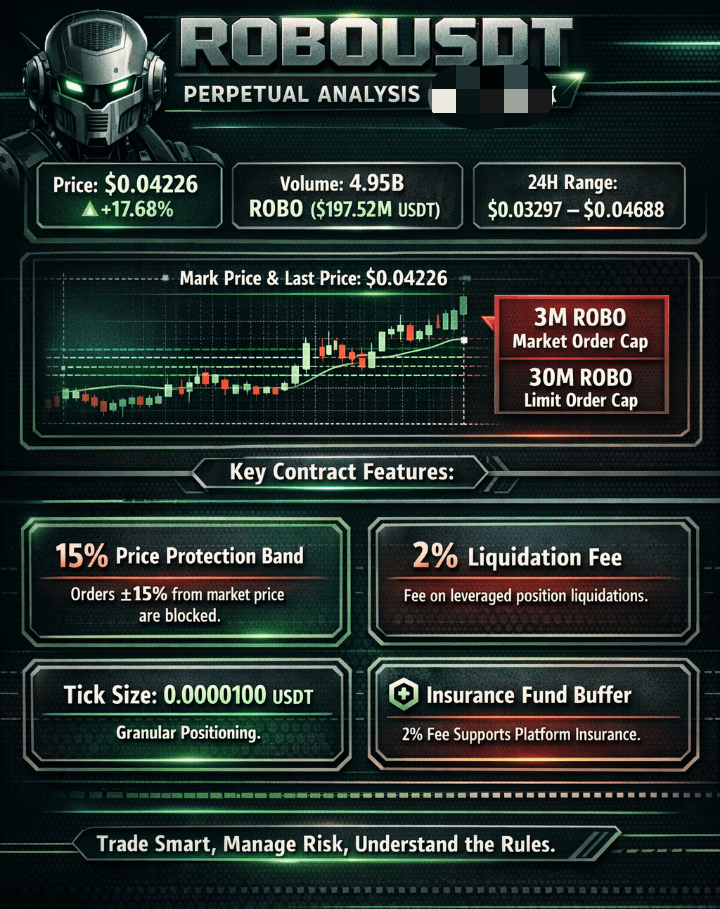
There's a particular kind of market moment that experienced traders recognize immediately, not from the price alone, but from the confluence of signals surrounding it. ROBOUSDT's perpetual swap contract on Trade-X is currently offering exactly that kind of moment. The asset is trading at $0.04226, registering a 17.68% gain over the past 24 hours, with volume reaching 4.95 billion ROBO tokens, equivalent to roughly $197.52 million USDT changing hands in a single session. For context, that volume figure isn't just a vanity metric. In perpetual swap markets, volume is the oxygen that keeps spreads tight and order execution clean. When a low-unit-price asset like ROBO generates nearly $200 million in daily notional volume, it signals that institutional desks and algorithmic participants are actively engaged, not just retail speculators chasing a chart. The 24-hour price range spanning from $0.03297 to $0.04688 tells a secondary story: this is not a slow, grinding move. It's a sharp displacement, the kind that creates both opportunity and serious exposure depending on which side of the trade you're sitting on. The alignment between the Mark Price and Last Price at $0.04226 is also worth noting. In perpetual markets, divergence between these two figures often indicates stresseither a premium from overleveraged longs or a discount from aggressive short pressure. Their convergence here suggests the market is, at least momentarily, in equilibrium.
Where the analysis becomes genuinely interesting is in the contract's funding mechanics and the platform's embedded risk architecture. The current funding rate sits at -0.1452%, with approximately two and a half hours remaining until the next settlement. A negative funding rate in a perpetual swap functions like a toll road running in reverse instead of longs paying shorts to keep the contract anchored to spot, shorts are compensating long holders for maintaining their positions. This inversion typically emerges when the perpetual contract trades at a slight discount to spot, incentivizing buyers to absorb that gap. For active long positions in ROBO right now, this means the funding mechanism is generating passive yield on top of any directional gains a structurally favorable condition that, if sustained, can compound momentum. However, traders should treat this signal with discipline rather than enthusiasm. Funding rates are volatile by design and can flip within a single settlement cycle. The platform's trade execution parameters reinforce this need for precision. Market orders are capped at 3,000,000 ROBO (approximately $126,780 at current prices), while limit orders extend to 30,000,000 ROBO. This tiered structure is not arbitrary — it's a deliberate mechanism to push larger participants toward limit order strategies, reducing the slippage and price impact that oversized market orders can inflict on a mid-cap asset. The tick size of 0.0000100 USDT further enables granular positioning, which matters enormously when the asset trades in the sub-five-cent range and every basis point of entry carries proportional weight.
The platform's 15% price protection band and the 2% insurance clearance fee on liquidations represent the contract's most consequential fine print the terms that separate prepared traders from those who learn their lessons expensively. The price protection mechanism operates like a circuit breaker at the order entry level: limit orders cannot be placed more than 15% away from the prevailing market price in either direction. At $0.04226, this means buy orders below approximately $0.0359 and sell orders above $0.0486 are simply rejected. This design prevents both accidental fat-finger submissions and deliberate attempts to anchor off-market orders as manipulation vectors. The 2% liquidation fee is equally sobering. Unlike standard spot trading where a losing position simply diminishes in value, perpetual swap liquidations on leveraged positions carry this additional haircut, routed into the platform's insurance fund. Traders who enter ROBO positions with compressed margin buffers need to account for this fee explicitly in their risk calculations, not treat it as an afterthought.
Conclusion: ROBO's current market structure on Trade-X reflects genuine liquidity depth and short-term directional momentum, supported by a negative funding rate that mechanically favors long exposure. The platform's contract specifications from order size caps to price protection bands to liquidation fees are thoughtfully constructed guardrails. Understanding them is not optional; it's the baseline requirement for participating in this market responsibly.
@Fabric Foundation #ROBO $ROBO