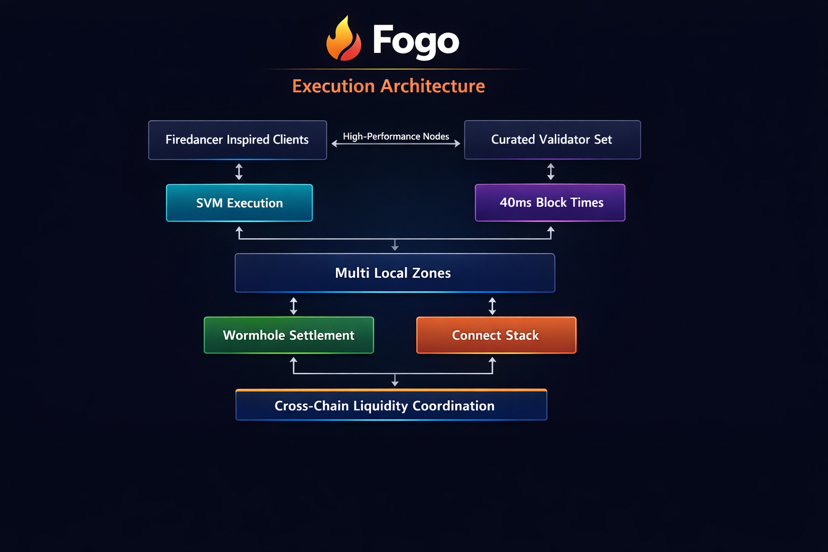
The goal is to create a real world execution layer where capital movement is reliable, predictable and extremely fast. Even though people compare it with Solana because it uses the Solana Virtual Machine, the mindset behind the design is different. Fogo wants to reduce coordination drag and remove unnecessary steps between user intention and final outcome.
What makes this approach unique is the focus on execution architecture. The network uses a Firedancer inspired client strategy where the validator set is highly curated. Instead of letting any random hardware join and create noise, it prioritizes performance grade infrastructure. This is not about limiting decentralization. It is about creating a clean environment where consensus does not wobble during load and where latency remains stable. The idea is simple. If you want markets to function, you need predictable timing. Variance kills outcomes.
The chain currently targets approximately 40 millisecond blocks and edge cached RPC reads. This means transactions feel instant even during peak hours. Builders also get a huge advantage because the SVM compatibility lets them deploy Solana apps without rewriting code. This is already attracting traders and developers who want high speed but with more controlled execution. On top of that, the multi local zone model reduces timing risk. Instead of forcing all validators to operate everywhere at once, Fogo aligns activity by geography and timing windows. This creates more consistent finality and lowers the probability of congestion spikes.
One of the biggest advantages of Fogo is how it handles capital flow. Right now most DeFi users repeat the same pattern. Bridge, wait, swap, bridge back, rebalance, hope everything works. Every extra step adds timing risk. Every delay introduces slippage or attack surface. Fogo reduces this multi step process to a single execution path because it is built on top of Wormhole settlement and the Connect stack. Instead of moving tokens, the system coordinates intents and final settlement across chains. This is where the chain feels different. It solves capital movement as a system level problem instead of pretending users enjoy managing bridges manually.
The token economy is also surprisingly mature for a young chain. The supply is not thrown into the market all at once. A significant part of tokens allocated to core contributors is locked with long cliffs. This prevents early supply shocks and keeps incentives aligned. There are clear distribution buckets for team, ecosystem, advisors, community, liquidity and a burn allocation. The important part is that the unlock timelines are designed around network growth instead of fast exits. Buyers, investors and traders can actually see the schedule and plan around it.
Incentives today are a huge challenge in crypto because most chains attract farmers that leave after rewards drop. Fogo seems aware of this problem. Their approach focuses on rewarding real behavior like bridging early, trading, interacting with apps, joining governance and participating in meaningful ways. They acknowledge Sybil attacks instead of acting surprised later. The network tries to balance fairness with growth. It is not perfect, but it is much more realistic than the usual airdrop meta.
Another major update that has boosted the visibility of Fogo is the listing momentum. Binance TH recently added FOGO trading pairs such as FOGO USDT and FOGO USDC. This created a wave of liquidity and pulled new traders into the ecosystem. Price action reacted immediately with strong weekly gains and higher trading volume across regions. Even during broader market fear, FOGO continued showing green days and stable interest. This is rare for a young chain and signals that builders and traders are actually paying attention.
What stands out the most is the real world alignment. Fogo is not designed as a speculative playground only. It is an attempt to build market grade infrastructure where execution quality matters more than slogans. The network treats performance, coordination and timing as first class design problems. The focus is not “fast blocks”. The focus is predictable blocks that behave the same during normal activity and during volatility spikes. That is the part that most L1 projects ignore.
There is also growing conversation around how Fogo could influence future DeFi models. If applications can rely on stable latency and cleaner coordination, liquidity strategies become more advanced. Market makers can operate efficiently. Automated strategies become easier to manage. The removal of timing uncertainty unlocks a new class of execution based products that were not possible on chains with high variance.
It is still early. Like any young ecosystem, Fogo will be tested under real load and market pressure. Bridges will always be a sensitive area even with trusted infrastructure. Multi local zone execution adds layers that need careful management. The curated validator set must maintain stability without becoming too closed. These are real trade offs and should not be ignored.
But what is clear today is that the direction of the project is intentional. It is not chasing decentralization theatre. It is not promising impossible throughput numbers. It is trying to build a system level foundation for capital movement, cross chain settlement and real world execution under predictable timing.
If this vision holds, Fogo could become one of the few chains where speed is not a marketing slogan but a structural advantage. As more builders experiment with SVM apps on Fogo and more liquidity enters through new listings, we might see the network evolve into a serious execution layer for the next cycle.
For now, Fogo stands out because it is not trying to be another fast chain. It is trying to be a coordinated chain where outcomes match user intention with minimal friction. And that is exactly the type of infrastructure the next generation of markets will need.