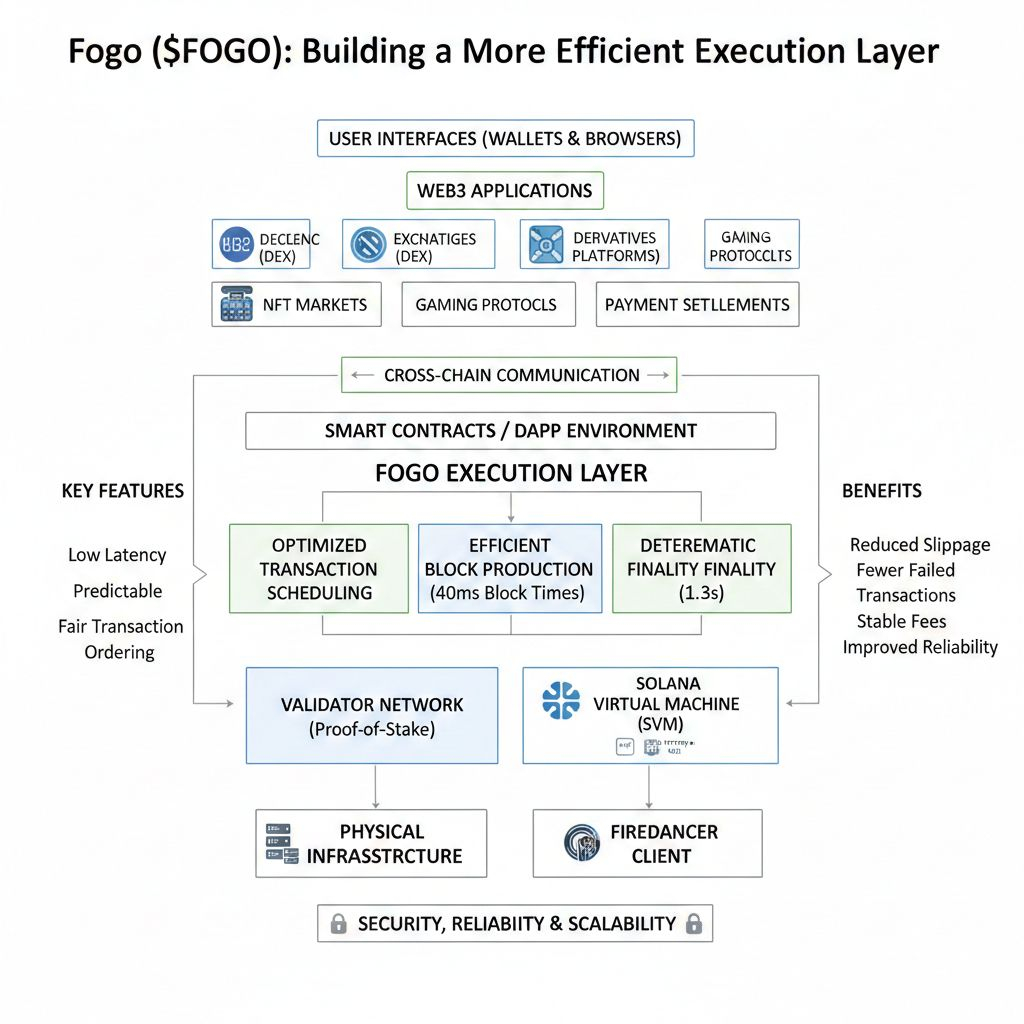
In blockchain systems, most users focus on tokens, applications, or price movement. Less attention is given to how transactions are actually processed and executed. Fogo ($FOGO) is built around a specific infrastructure problem: inefficient on-chain execution. In many networks, traders and decentralized applications face delays, high fees, unpredictable ordering of transactions, and congestion during volatile periods. These issues reduce reliability and increase hidden costs for users.
This problem matters because Web3 applications increasingly depend on real-time execution. Decentralized exchanges, derivatives platforms, NFT markets, and gaming protocols all require consistent and fair transaction processing. When blockspace becomes congested or ordering is manipulated by priority fees, users can experience slippage, failed transactions, and unfair advantages for sophisticated actors. Over time, this weakens trust in decentralized systems.
Fogo approaches this issue as an execution-focused infrastructure layer. Rather than competing purely as another general-purpose chain, it aims to optimize how transactions are sequenced, confirmed, and finalized. At a high level, Fogo introduces a specialized execution environment designed for high-throughput trading activity. The architecture emphasizes deterministic ordering, lower latency, and predictable performance under load.
Key features include optimized transaction scheduling, efficient block production, and mechanisms that reduce execution bottlenecks during market spikes. Instead of relying only on fee-based priority, Fogo’s design focuses on improving fairness and minimizing harmful congestion effects. The network is structured to support fast confirmation times while maintaining compatibility with existing decentralized finance standards.
From an architectural perspective, Fogo functions as an execution layer that can integrate with broader blockchain ecosystems. It is designed to support smart contracts while improving the infrastructure beneath them. The system prioritizes performance engineering, including throughput optimization and efficient state management. This makes it particularly suited for applications where milliseconds can affect outcomes, such as automated trading or liquidation engines.
Use cases extend beyond trading. Any application requiring reliable transaction ordering, such as prediction markets, real-time gaming, or payment settlement systems, can benefit from improved execution guarantees. Infrastructure improvements at the execution level also indirectly enhance user experience in wallets and decentralized applications.
For developers, Fogo provides an environment where applications can operate with more predictable performance. This reduces the need for complex workarounds to handle congestion or transaction reordering. For users, the benefits may be less visible but still important: fewer failed transactions, more stable fees, and improved reliability during periods of network stress.
Security and reliability remain critical considerations. Fogo’s design must ensure that performance optimizations do not compromise decentralization or validator integrity. Trust assumptions, validator incentives, and network resilience are central to long-term viability.
Scalability and compatibility are also essential. As Web3 ecosystems grow more interconnected, execution layers must support cross-chain communication and developer-friendly tooling. Fogo’s long-term relevance will depend on whether it can maintain performance advantages while integrating with broader networks.
In a competitive market of Layer 1 and Layer 2 solutions, Fogo’s focus on execution efficiency addresses a real structural problem. Its success will depend not on short-term attention, but on whether it can consistently deliver measurable improvements in how on-chain transactions are processed and experienced.