With $BTC still trapped in a range and lacking clear momentum, altcoins remain structurally fragile. When Bitcoin doesn’t provide direction, liquidity becomes selective — and alts typically feel that pressure first.
This week, $XRP saw a notable shift.
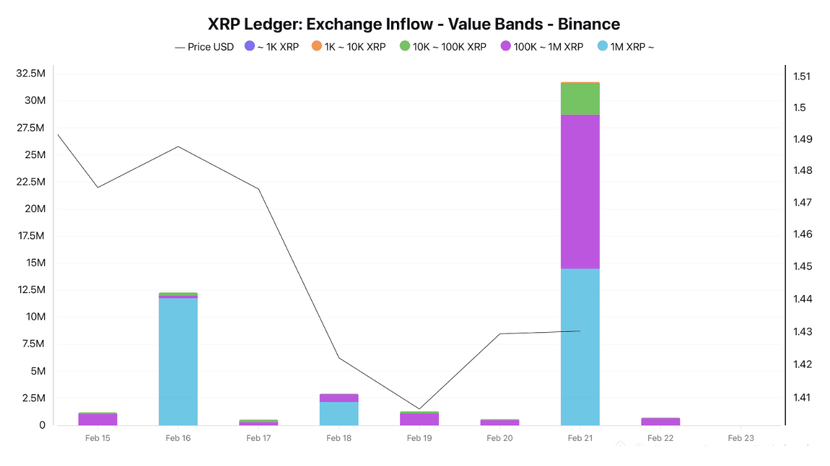
More than 31 million XRP moved into Binance in a single day — the exchange most preferred by large participants due to its depth and execution efficiency.
That kind of inflow isn’t random.
Breakdown of Holder Activity
The transfers were distributed across cohorts as follows:
• <1k: 6,543
• 1k–10k: 73,630
• 10k–100k: 2,938,809
• 100k–1M: 14,236,825
• >1M: 14,494,865
The majority came from wallets holding 100k+ XRP, indicating that larger players were behind the move.
In total, that represents nearly $45 million in potential sell-side liquidity entering the exchange environment.
Why This Matters
Exchange inflows don’t automatically equal selling — but they increase optional supply.
When large holders move assets to exchanges, they’re positioning for flexibility:
• Taking profit
• Reducing exposure
• Hedging
• Rebalancing
In a strong uptrend, markets can absorb that supply.
In a corrective or uncertain structure, absorption becomes harder.
Current Market Context
Right now:
• BTC lacks directional expansion
• Altcoin relative strength remains weak
• Liquidity is thinner than peak-cycle conditions
That makes XRP more vulnerable to sustained pressure if these flows convert into active selling.
What To Watch
The key isn’t the inflow itself — it’s follow-through.
• Does exchange balance continue rising?
• Does spot selling volume increase?
• Does price lose structural support?
If selling pressure persists, recovery attempts may stall.
If absorption appears and balances stabilize, the move could represent redistribution rather than distribution.
In this environment, structure matters more than sentiment.
And for XRP, large-holder behavior is now the variable to monitor closely.