Fogo’s crosschain strategy clicks into place when you stop thinking of it as a blockchain and start seeing it as a venue. Most chains still present themselves like jurisdictions: build here, keep assets here, stay here. Traders don’t behave that way. They route. Capital flows to wherever execution is clean, fast, and dependableand it leaves the moment those conditions slip.
That perspective reveals Fogo’s core bet. It isn’t trying to relocate markets. It’s trying to become the place traders naturally pass through when they want to put on riskquickly, repeatedly, and without friction.
Speed is the obvious headline, but the deeper objective is reducing uncertainty. The true cost of latency isn’t the wait; it’s the price movement during the wait. Traders commit, then watch the market drift while settlement catches up. That gap becomes slippage, missed hedges, and hesitation. If Fogo can compress the intenttosettlement window, onchain trading starts to resemble a realtime venue rather than a delayed one.
Once execution quality becomes the product, cross-chain design stops being a feature and becomes a requirement. A trading venue can’t demand that users migrate their entire balance sheet before they act. Liquidity has to arrive from wherever it lives, execute efficiently, and leave without friction. In that sense, “borderless” isn’t brandingit’s routing logic.
Interoperability, however, introduces dependency. Bridges, messaging layers, and source chains become part of the execution experience whether Fogo controls them or not. If upstream flows stall, traders don’t assign blamethey experience delay and risk. A venue built for traders has to treat cross-chain infrastructure as missioncritical, engineering for failure modes rather than assuming seamless connectivity.
Speed itself introduces structural challenges. In fast environments, tiny advantages compound. Participants who are fractionally quicker or better connected extract value from everyone else. In traditional markets this is latency arbitrage; onchain it manifests as MEV and toxic flow. A serious venue must design not only for speed, but for how competition unfolds within that speed.
That shifts attention to market microstructure. Trading isn’t just throughputit’s rules. Who sees orders first? How are they matched? How is value shared between makers, takers, and intermediaries? Mechanisms like batching, hybrid matching, or selective visibility acknowledge a crucial truth: fairness and efficiency are engineered outcomes, not automatic consequences of performance.
There’s also a behavioral dimension that often goes unnoticedrepetition fatigue. Most DeFi friction isn’t economic; it’s cognitive. Approvals, signatures, wallet prompts, gas choices, edge cases. Real trading is iterativeenter, adjust, hedge, rotate, exit. If each step feels heavy, traders don’t build habits. They visit, test, and move on.
Sessionstyle workflows and smoother interaction models matter because they reduce that mental overhead. They’re not cosmetic UX improvements; they’re retention infrastructure. Crosschain access may attract flow, but only reliable, low-friction repetition sustains it.
Ultimately, liquidity depth is the real test. Traders don’t commit to infrastructurethey commit to conditions: tight spreads, predictable fills, stable behavior during volatility. A venue becomes real when capital stays during stress rather than merely passing through.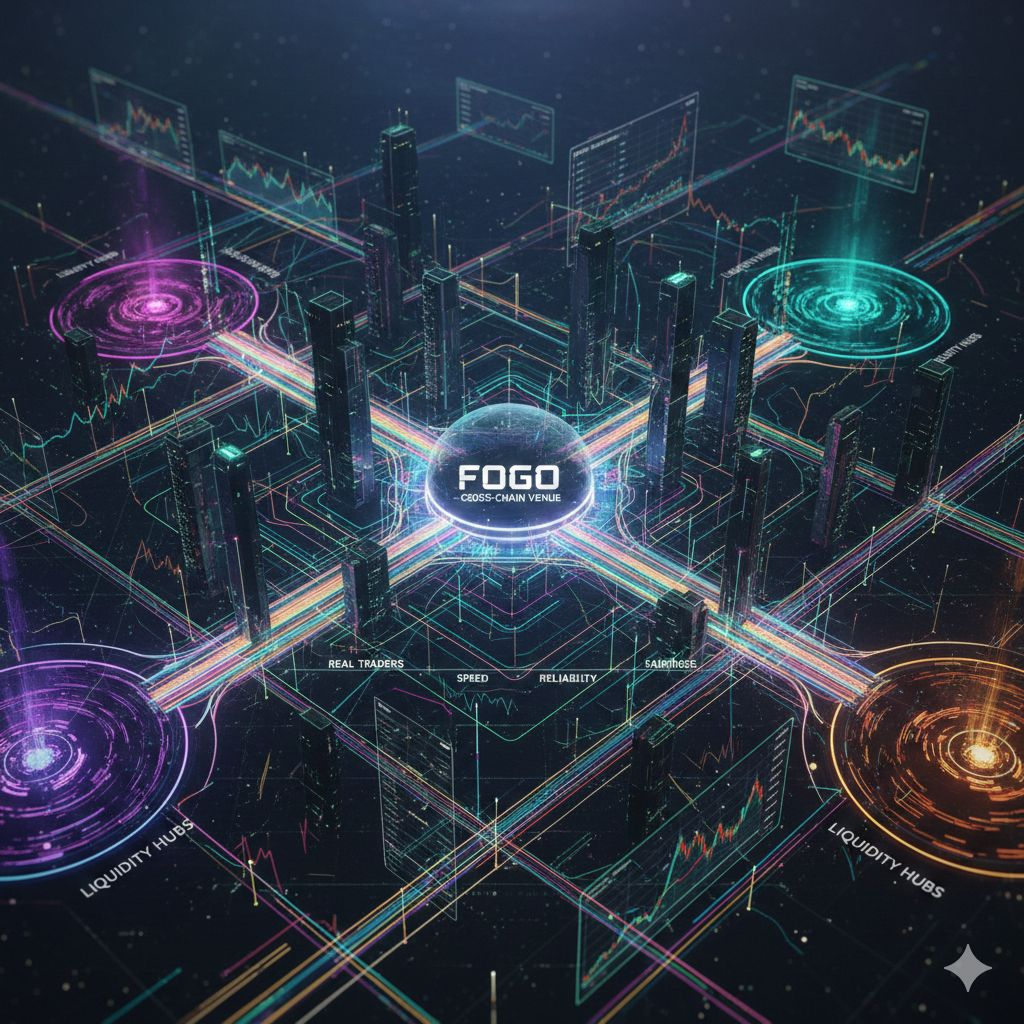
For Fogo, the decisive moments will occur under pressure. Quiet markets validate little. Stress reveals everythingbridge congestion, price acceleration, synchronized demand for execution. If the system maintains speed, fairness, and reliability when activity spikes, trust compounds. If it doesn’t, routing behavior adjusts immediately.
The broader trajectory of crypto supports this thesis. The ecosystem is shifting away from winnertakeall chains toward interconnected liquidity hubs. Capital increasingly behaves as it does in traditional financeit routes continuously. Interoperability accelerates this shift by making movement routine rather than disruptive.
In a landscape defined by connected financial districts rather than isolated ecosystems, the chains that matter most won’t necessarily be the loudest. They’ll be the ones that function as dependable execution layers within a broader network. Fogo’s ambition is to occupy that role.
Whether that ambition succeeds won’t be determined by narratives or architecture diagrams. Markets decide differently. The answer will be visible where it always iswhere liquidity chooses to remain when conditions are hardest.