Fogo Is About Moving Money, Not Just Speed
Most conversations around Fogo start and end with latency. Sub-40ms block times. Fast finality. Optimized execution. And yes, speed matters. But if we reduce Fogo to just another “fast chain,” we miss the bigger picture. It is about how quickly capital can move.
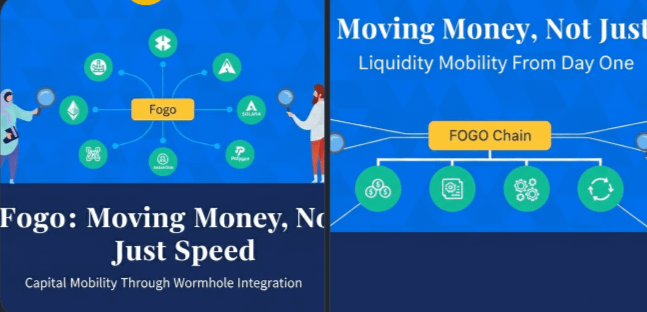
From day one, Fogo approached liquidity differently. Instead of waiting months or years to slowly accumulate TVL chain by chain, it connected through Wormhole. That decision changed the trajectory. Rather than growing in isolation, Fogo entered the ecosystem already linked to more than 40 chains.
That is not a minor technical detail. It is a structural advantage.
In markets, capital rarely sits still. It moves toward opportunity. It reacts to volatility. It rotates between ecosystems when yields shift, when narratives change, or when arbitrage windows open. If liquidity cannot move efficiently, it becomes trapped. And trapped liquidity is friction.
By integrating with Wormhole early, Fogo ensured that liquidity mobility was embedded from the start. Capital does not need to crawl through narrow pathways. It can flow. And when decisions are made in seconds, that difference matters.
Speed without liquidity is empty performance.
Liquidity without speed is congestion.
Fogo is aligning both.
For traders, especially those operating in high-frequency or institutional environments, predictability is as important as raw throughput. When block times are consistent and cross-chain capital can enter and exit efficiently, strategies become viable that would otherwise fail due to timing uncertainty or transfer delays.
This is where Fogo becomes more than just another Layer 1. It starts to resemble infrastructure for active markets.
A chain that is fast but disconnected becomes a silo.
A chain that is connected but slow becomes inefficient.
Fogo is attempting to eliminate both problems at once. Execution happens quickly, and capital mobility is not an afterthought. It is built into the foundation.
When liquidity can move without friction, trading environments mature faster. Arbitrage tightens spreads. Price discovery becomes cleaner. Opportunities are captured rather than missed because of bridging lag. In that context, Fogo is not simply competing on block times. It is competing on capital efficiency.
And capital efficiency is what defines serious financial infrastructure.
Being linked to over 40 ecosystems means Fogo did not have to wait for organic isolation growth. It positioned itself as a node within a larger liquidity network from the beginning. That accelerates network effects. It lowers the barrier for funds to participate. It reduces the psychological cost of entering a new chain.
In practical terms, that means traders can move funds where opportunity appears without feeling trapped by slow bridges or fragmented liquidity pools.
So while the conversation online may continue to focus on milliseconds and benchmarks, the deeper story is about movement. About flow. About reducing friction not only inside the chain, but between chains.
Fogo is not just trying to be fast.
It is trying to make money move like it is supposed to move.
And when capital moves freely, trading does not feel forced or scraped by inefficiencies. It feels fluid.
That is when a blockchain stops being a technical experiment and starts becoming a financial venue.
@Fogo Official
#fogo