 The first time I truly felt blockchain latency, it wasn’t on a chart. It was mid-trade, when a position that looked safe became fragile in the time it took my cancellation to “arrive.” Price moved, my risk view lagged by a heartbeat, and the market didn’t wait for my transaction to catch up. That moment taught me something simple: in trading, being correct is useless if you’re late.
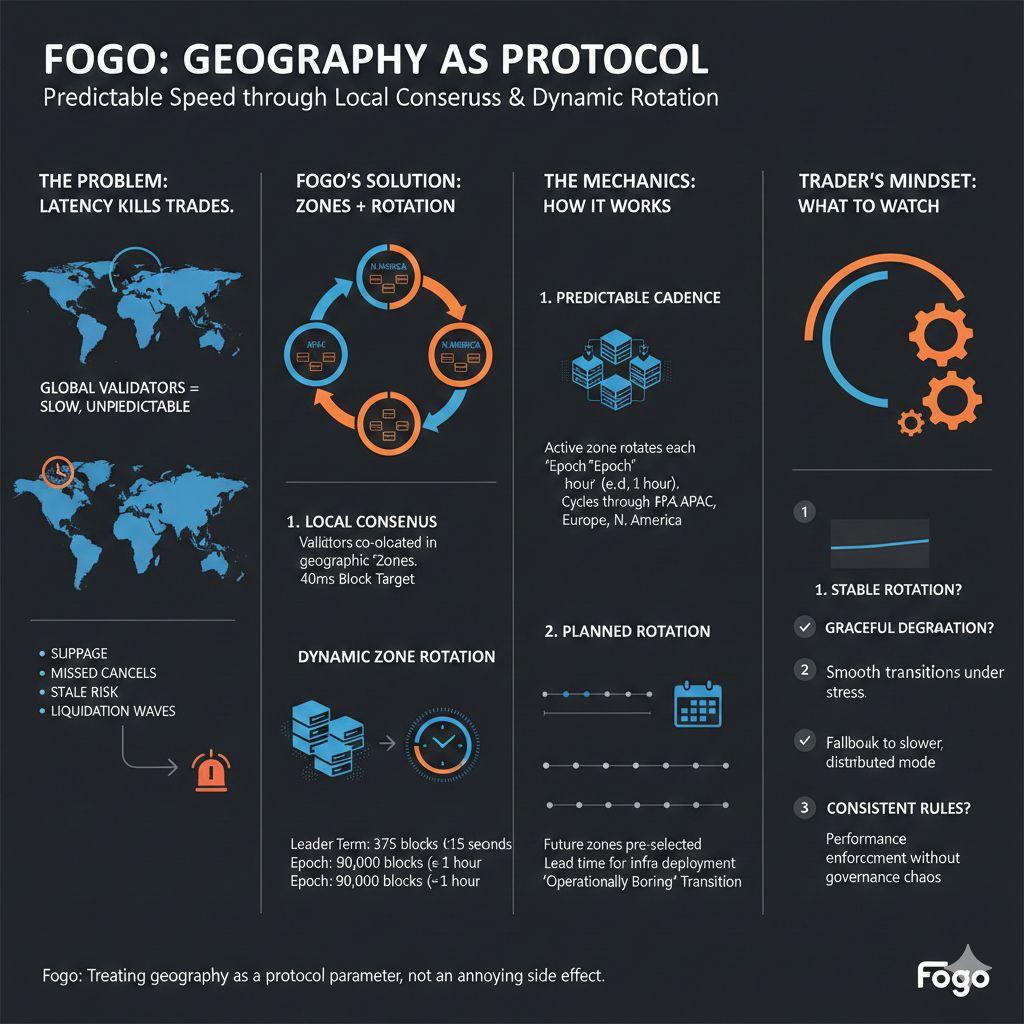
Fogo is built for that exact reality. Not the vague “fast L1” story everyone repeats, but a sharper premise: you can’t talk about real-time execution while ignoring physics. If validators are scattered across continents, every block is a conversation across oceans. No amount of software optimism beats packet travel time. Those milliseconds turn into a hidden tax: slippage, missed cancels, stale risk checks, and liquidation waves where timing decides who survives.
So Fogo does something most chains avoid because it forces uncomfortable tradeoffs. It intentionally makes consensus local.
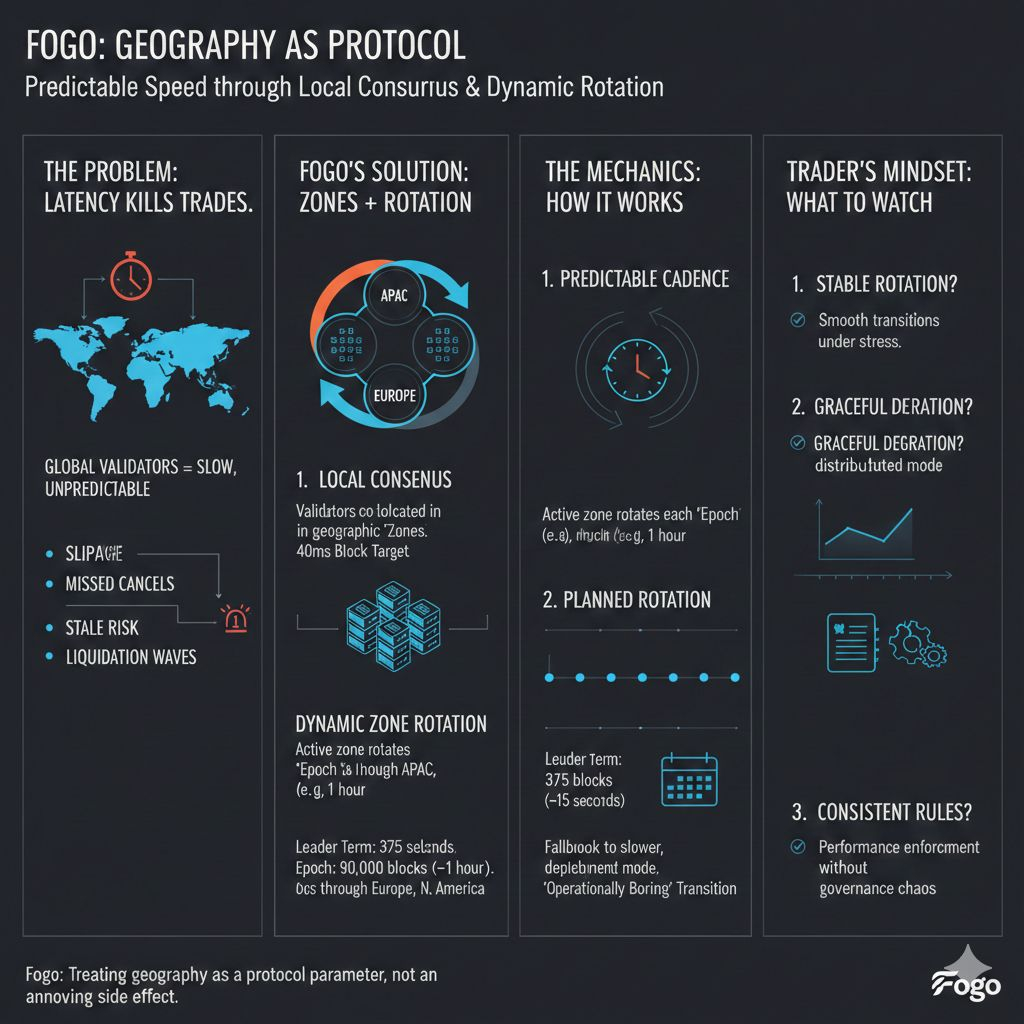
In Fogo’s design, validators operate in geographic “Zones,” where they co-locate so validator-to-validator latency is pushed down toward hardware limits. The point isn’t just raw speed once; it’s stable speed that doesn’t wobble every time the network has to coordinate across half the planet. If you’ve ever traded during a volatile minute, you know the real enemy isn’t only “slow.” It’s jitter. It’s not knowing whether your next action lands in 200ms or 2 seconds.
That’s why I pay attention when a chain publishes concrete timing parameters instead of adjectives. On Fogo’s testnet, the stated target is 40-millisecond blocks. Leadership rotation is also explicit: a leader term of 375 blocks, which is roughly 15 seconds of continuous block production before handing off. That cadence matters. A predictable beat is what strategy is built on—especially anything that relies on fast cancels, rapid re-quotes, or tight liquidation defense.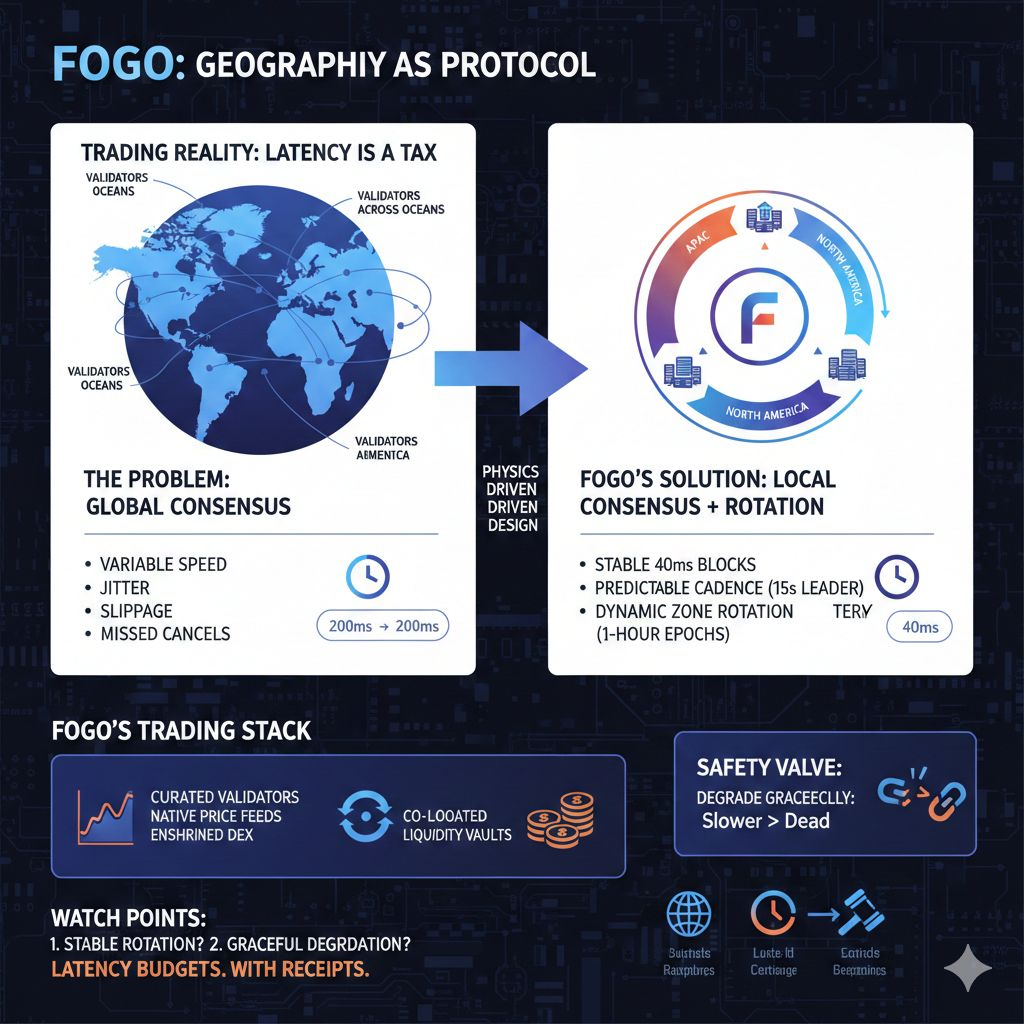
But local consensus raises the obvious criticism: if you compress the active validator set into one region, aren’t you just centralizing the network to buy speed?
This is where Fogo’s angle becomes more than a data-center flex. It pairs local consensus with Dynamic Zone Rotation.
Instead of keeping consensus “local” in the same place forever, Fogo rotates the active zone on a schedule. Testnet epochs are defined as 90,000 blocks—about one hour at the target block time—and each epoch moves consensus to a different zone. The zones are plainly framed across major regions (APAC, Europe, North America). In other words: inside the hour, the chain behaves like a low-latency local system; across hours, the chain aims to preserve decentralization by moving that locality across jurisdictions, infrastructure providers, and geographies.
That’s the core idea I can’t ignore: Fogo is treating geography like a protocol parameter, not an annoying side effect.
If you’ve spent time around real markets, this mindset feels familiar. Liquidity doesn’t “exist globally” in one uniform cloud. It has rhythms. Information arrives unevenly. Volatility clusters around waking hours, macro events, and regional flows. A chain that can intentionally position its consensus near where activity is concentrated is making a very specific bet: that latency budgets are the real product.
And Fogo doesn’t present rotation as a coin-flip. The design is meant to be planned and coordinated, not chaotic. The network pre-selects future zone locations with enough lead time for validators to deploy and harden infrastructure where consensus will move next. That matters, because a serious operator doesn’t spin up secure production posture in five minutes. Rotation only works if it’s operationally boring.
Still, the real test of any performance-first architecture is what happens when conditions aren’t ideal. Fast systems can be fragile if they don’t have an escape hatch. Public descriptions of Fogo’s approach point to a safety valve: if a zone can’t operate as intended (or if quorum/coordination fails), the network can fall back to a more globally distributed mode with more conservative settings so the chain stays alive. That’s not flashy, but it’s what I want to see. If you’re going to push the envelope, you need a “slower is better than dead” switch.
Now bring it back to the one scenario that decides whether this is meaningful: a liquidation wave.
In a liquidation wave, everyone is trying to do the same thing at once—reduce risk quickly. You place exits, cancel stale orders, replace quotes, move collateral, close leverage. On a chain with inconsistent latency, the sequence turns into a trap: your cancel lands late, your replacement lands even later, the price feed updates at a different cadence than the book, and by the time finality arrives, the trade you thought you executed no longer matches the market that existed when you acted. That’s the space where “decentralized” can feel like “unreliable.”
Fogo is trying to shrink that space by making the hardest part of coordination—the validator agreement loop—tight and predictable. And it’s not pretending consensus speed is the only bottleneck. The project’s own positioning leans into a trading-first stack: curated validators, native price feeds, an enshrined DEX, and even co-located liquidity vaults. You can disagree with vertical integration as a philosophy, but it’s coherent engineering: end-to-end latency is only as fast as the slowest link, and traders live in the end-to-end path.
The tradeoff is real, and it should be said plainly. A curated validator set with performance enforcement is not permissionless purity. Fogo is choosing quality control to chase physical limits, then trying to buy back decentralization across time through rotation. Some people will hate that. Others will say it’s the only honest way to build an on-chain venue that can compete with real-time expectations. Either way, it’s a testable thesis, not a vague promise.
So here’s my takeaway after reading the architecture with a trader’s mindset: the headline isn’t “40ms blocks.” The headline is that Fogo is turning the map into part of consensus—localizing agreement for predictable speed, then rotating that locality so no single geography owns the network forever.
If you want to judge Fogo like a market participant instead of a timeline scroller, watch three things: Does zone rotation stay boring at epoch boundaries, even under stress? When something breaks, does the chain degrade gracefully instead of freezing? Do the performance rules stay consistent without turning governance into a circus?
If those three hold, Fogo’s “Zones + Rotation” model becomes more than a speed demo. It becomes a new way to think about on-chain markets: not TPS first, but latency budgets—with receipts.