
I had been watching Midnight for some time. When I saw the Midnight City Simulation, I thought it was just another blockchain demo. I was wrong.
Most crypto projects show you a whitepaper or a GitHub repo and expect you to trust the technology. Midnight built a city instead. An actual digital city with AI citizens who work, shop, talk, and transact. I spent some time exploring it and I have to say, it changed how I think about privacy tech and honestly about the NIGHT token too.
The first thing that got me was the viewing modes. When you look at any transaction in Midnight City, you can switch between three perspectives. Public mode shows what anyone on the blockchain can see. Auditor mode shows what a regulator or authorized party would see. Then there is God mode, which shows everything including the agent's personality, memories and full history. In a real deployment, that last layer belongs only to the user. Nobody else gets access.
I thought this was a brilliant way to explain selective disclosure. I have read about ZKPs for two years and this was the first time I actually understood what selective disclosure looks like in practice. You are not reading about it. You are watching it happen.
The agents themselves surprised me the most. They run on Google Gemini and each one has a personality built across six psychological dimensions. They do not follow a fixed script. They evolve based on their experiences and memories over time. One agent might start as a cautious trader and gradually become more aggressive based on past interactions. That kind of behavioral depth generates transaction patterns that are genuinely unpredictable, which is exactly what you want when stress testing a privacy network.
Now here is where NIGHT comes in and why I think most people are missing the connection.
Every transaction those agents make inside Midnight City requires DUST to execute. DUST is the shielded resource that powers private transactions and smart contract execution on the network. And DUST is generated automatically by holding NIGHT. So the city is not just a visual demo. It is actually demonstrating the entire token economy working in real time.
You do not spend NIGHT when you transact. Instead holding NIGHT generates DUST continuously, which then powers shielded transactions. I found this design genuinely clever. It means developers and users can plan their network usage without worrying about token price volatility eating into their transaction budget. The fuel is separate from the capital.
The total supply of NIGHT is fixed at 24 billion tokens. Beyond generating DUST, NIGHT also powers block production rewards and is designed to support future governance of the network. So holding it is not just passive. It connects you to the actual operation of the network.
There are currently five districts in the city. Kalendo, the Nexus, Bison Flats and two more. You can log in through Discord and follow specific agents around the city. There is also a built in block explorer where you can watch live transactions and zero-knowledge proof generation in real time. I found myself just sitting and watching proofs being generated during a busy period. It sounds boring but it was actually quite fascinating.
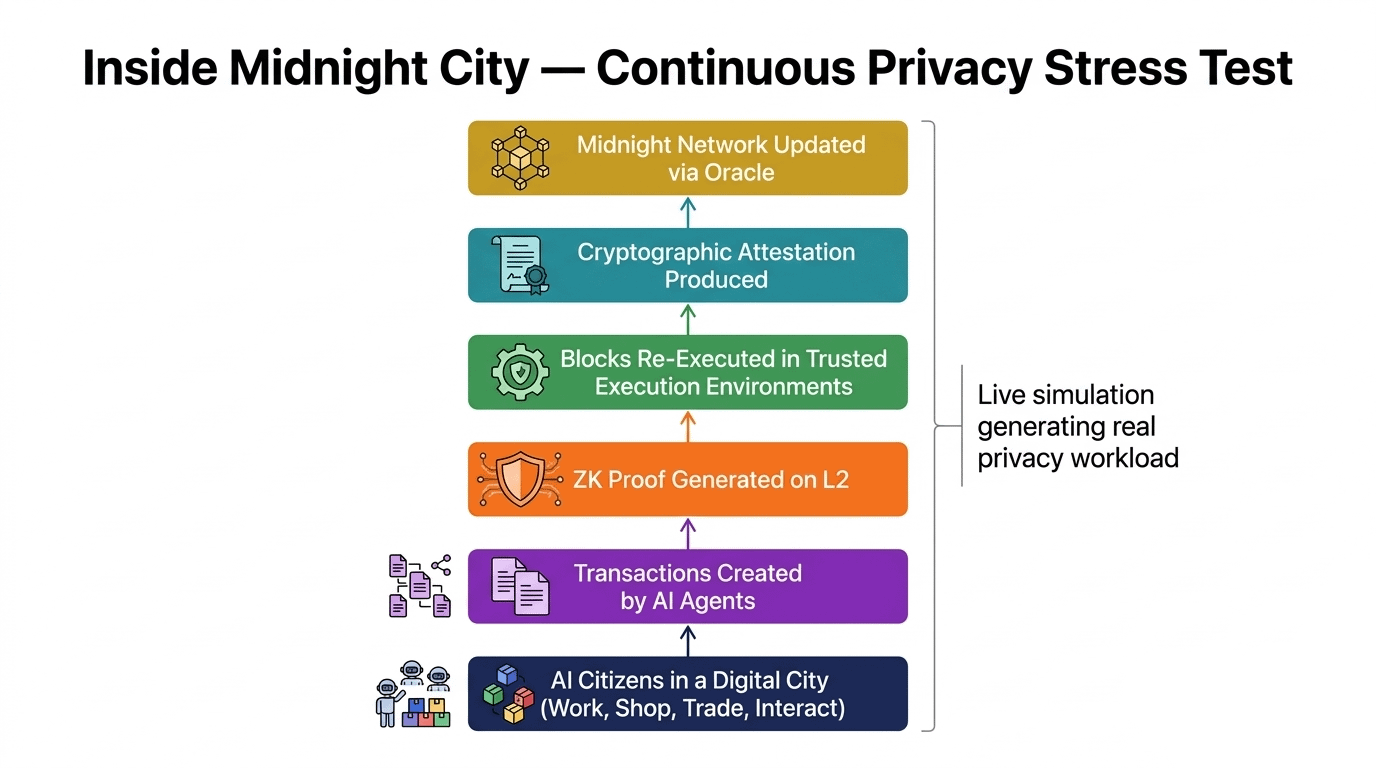
The infrastructure is two layered. Each shielded transaction gets a ZK proof on the L2 first. Then batches of blocks go through Trusted Execution Environments which re-execute the blocks and produce a cryptographic attestation. That attestation updates the main Midnight network through a specialized oracle. The whole thing runs continuously so the network is being tested under real load every single day.
There is also something about agentic AI here that most people are not talking about. As AI agents start doing real tasks for users, like executing trades or signing contracts, the intent behind those actions becomes sensitive information. If someone can see that your agent is about to buy an asset under specific conditions, that can be exploited before the action completes. Midnight shields that intent. The result goes on chain. The reasoning stays private. That distinction is going to matter a lot more in the next two or three years than most people currently realize.
Charles Hoskinson confirmed in early 2026 that the Midnight mainnet was launching before the end of March. That transition moves NIGHT from being a speculative asset to a functional utility token powering a live network with real privacy preserving smart contracts. Seeing Midnight City running alongside that announcement made the timing make sense to me. You do not launch a mainnet without showing people what the network can actually do under pressure. Midnight City is that proof.
The Glacier Drop distributed over 4.5 billion NIGHT tokens across eight major blockchain ecosystems including Bitcoin and Ethereum. That is a wide net. It means people across multiple communities already hold NIGHT and have a reason to pay attention to what the network does next.
I think the smartest thing about Midnight City is that it is not just a marketing tool. It is a live demonstration of the entire NIGHT and DUST economy working together under real transaction volume every single day. Most people will explore it casually and walk away understanding privacy tech better than they did before. If you look a little deeper you will see the token economy running underneath it all.
If you have been on the fence about whether programmable privacy can work at real scale, spend twenty minutes in Midnight City. It will not feel like reading documentation. It will feel like watching the future run in real time. And the NIGHT token is the fuel making all of it possible.
#night @MidnightNetwork $NIGHT
