
Introduction:The Missing Infrastructure for Autonomous Systems
Artificial intelligence keeps growing more powerful.That’s clear.But as these AI systems and autonomous agents trading bots,decentralized apps,even AI powered cloud services get smarter,the hard part isn’t just the intelligence.It’s coordination.These agents need spaces where they can work together,make deals,and settle outcomes safely,without a big central authority watching over them or getting in the way.Classic cloud platforms weren’t built for this kind of thing.Most blockchains so far?They stumble over high coordination costs,slow performance,and messy governance.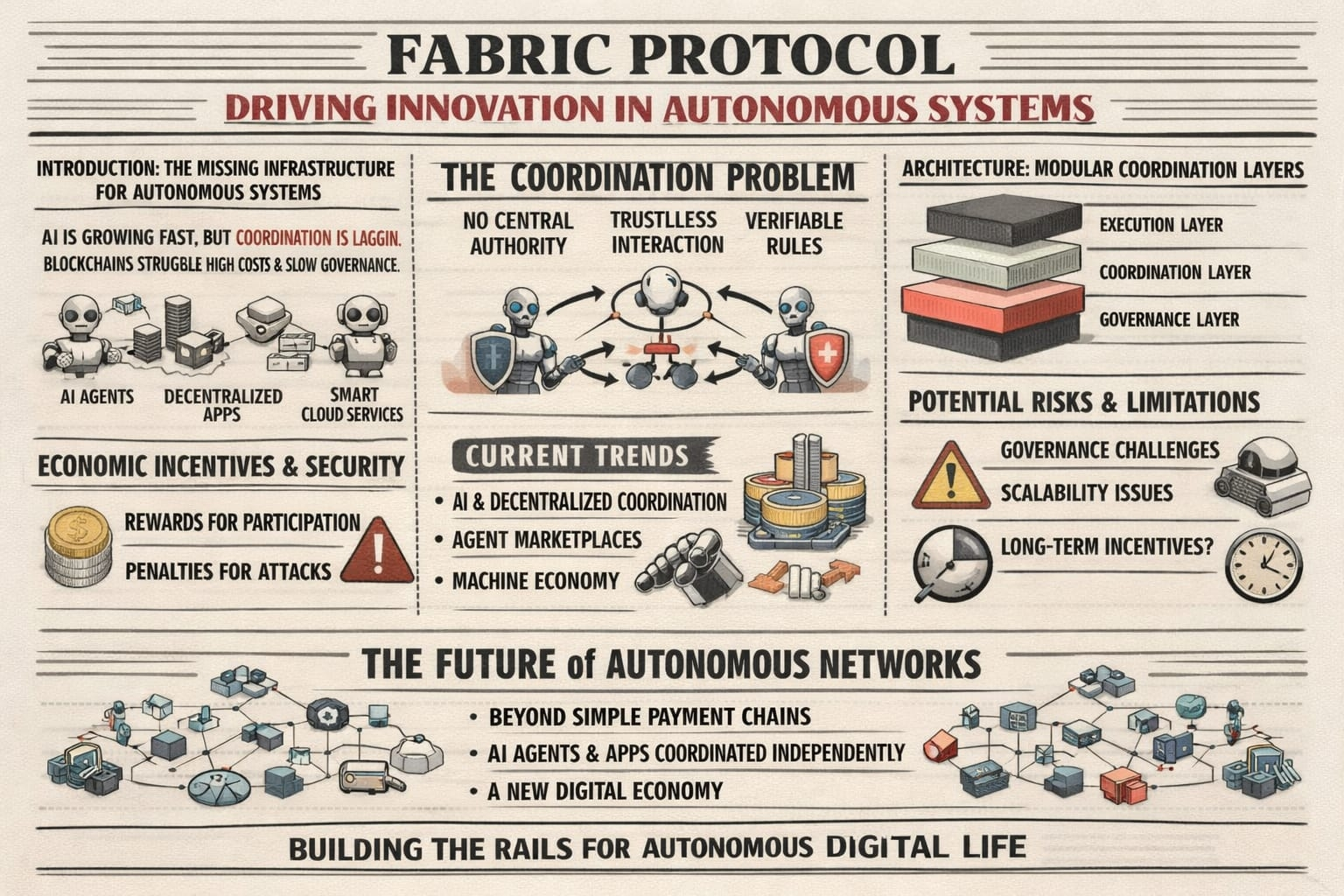
Fabric Protocol is a deliberate response to that gap.Instead of focusing only on moving money,Fabric tries to build a programmable “coordination layer” letting AI agents,applications,and whole infrastructures interact under consistent,transparent rules with verifiable results.It’s not just a ledger.It’s more like the missing operating system for autonomous digital life.
The Coordination Problem in Autonomous Networks
There’s a basic challenge here:if all these autonomous agents act on their own,can they actually cooperate without first trusting each other?In old school systems,you’d put a trusted authority in the middle a company,a platform,maybe a cloud provider.But the minute self running agents start handling value or making economic decisions,that central choke point becomes a risk maybe you get censorship,single points of failure,or just too much power in one place.
Fabric tackles this head on by setting up a decentralized coordination system.Instead of trust,you get verifiable rules.Participation and security depend on clear economic incentives,not arbitrary gatekeepers.Governance the ability to upgrade the system,change the rules,adapt also spreads out,so it doesn’t get locked by a few insiders.The result feels less like a simple blockchain and more like an economic operating system.
Architecture:Modular Coordination Layers
A lot of crypto is moving away from“one chain does it all.”Fabric Protocol fits right in by splitting its system into flexible modules this keeps things adaptable and scalable.
The execution layer is where apps and autonomous interactions actually happen.Here,decentralized services and AI agents do their work in full view of the network.
The coordination layer lays out the rules smart contracts that structure deals and agreements,so agents know exactly how they can interact.No mediator needed.
Then there’s governance this layer lets the network’s stakeholders steer upgrades,tune economics,and define overall direction.Breaking these pieces apart makes it easier to update the system,change strategies,or scale to new use cases without rebuilding everything from scratch.
Economic Incentives and Network Security
Getting incentives right is critical.If you fumble economic design,things fall apart bad actors can game the system,or the network splits into factions.
Fabric tries to balance all this with tokens that reward people (and maybe agents) who secure the protocol validators,devs,even infrastructure providers. Penalties discourage attacks,and governance lets everyone with a stake help shape the system’s future.The whole idea:humans and algorithms both need strong incentives to play fair.
Relevance to Current Crypto Trends
Fabric lands right at the crossroads:everyone’s talking about AI infrastructure,decentralized coordination,and combining autonomous agents with blockchain.As more of the economy becomes digitized,the old “human at the center of every transaction”model starts to break down.
You see growing demand for secure agent marketplaces where AIs can buy and sell data,trade computational power,and settle resources autonomously.Decentralized compute networks are taking shape too,pooling and coordinating resources on a global scale.And with the machine to machine economy finally escaping science fiction,these autonomous agents need new rules and infrastructure to coordinate all this value.Fabric wants to be that critical coordination layer.
Risks and Limitations
Of course,none of this is a slam dunk.Autonomous agent economies are still experimental.Real world traction depends on whether devs actually build useful things atop platforms like Fabric.
Decentralized governance?Looks great on paper,but in practice,participation often clusters around a few powerful voices,leaving most stakeholders with little influence.
Scalability is no small issue,either.You need to coordinate thousands even millions of agent interactions without losing speed or opening security holes.And on the economics side,incentive models must keep everyone engaged for the long haul without fueling bubbles or rampant speculation.
Implications for the Crypto Ecosystem
If Fabric catches on,it could help nudge blockchain tech past its current role as a fancy payment rail.Instead,you might see robust infrastructure for managing autonomous digital economies networks where machine agents,applications,and services interact,coordinate,and settle value with almost no human intervention required.
That’s a big step.It moves the technology toward real world digital collaboration,beyond just passing coins back and forth between wallets.
Final Takeaway
Protocols like Fabric matter not because of the price of their tokens,but because they reimagine infrastructure.As autonomous systems spread into finance,logistics,data,and AI driven platforms,the real question isn’t speed or throughput.It’s:how do we let independent agents coordinate safely,openly,and efficiently?
Fabric Protocol is one serious attempt to answer that.It builds the rails for a world where algorithms,not just people,are economic actors.For anyone watching crypto evolve whether you’re investing, building,or researching real innovation won’t be just about faster chains.The next phase is about building networks that run themselves.