

I keep coming back to a simple problem here. A blockchain can record claims and payments and timestamps but it cannot directly watch a robot move through a warehouse or see what an edge device actually sensed in the moment. My first instinct used to be that “proof” meant a chain somehow knowing everything for itself. The more I look at Fabric the more I think that is the wrong model. Fabric’s idea feels closer to building a trustworthy bridge between a messy physical event and a durable onchain record so other people can judge what likely happened without having to rerun the whole event themselves.
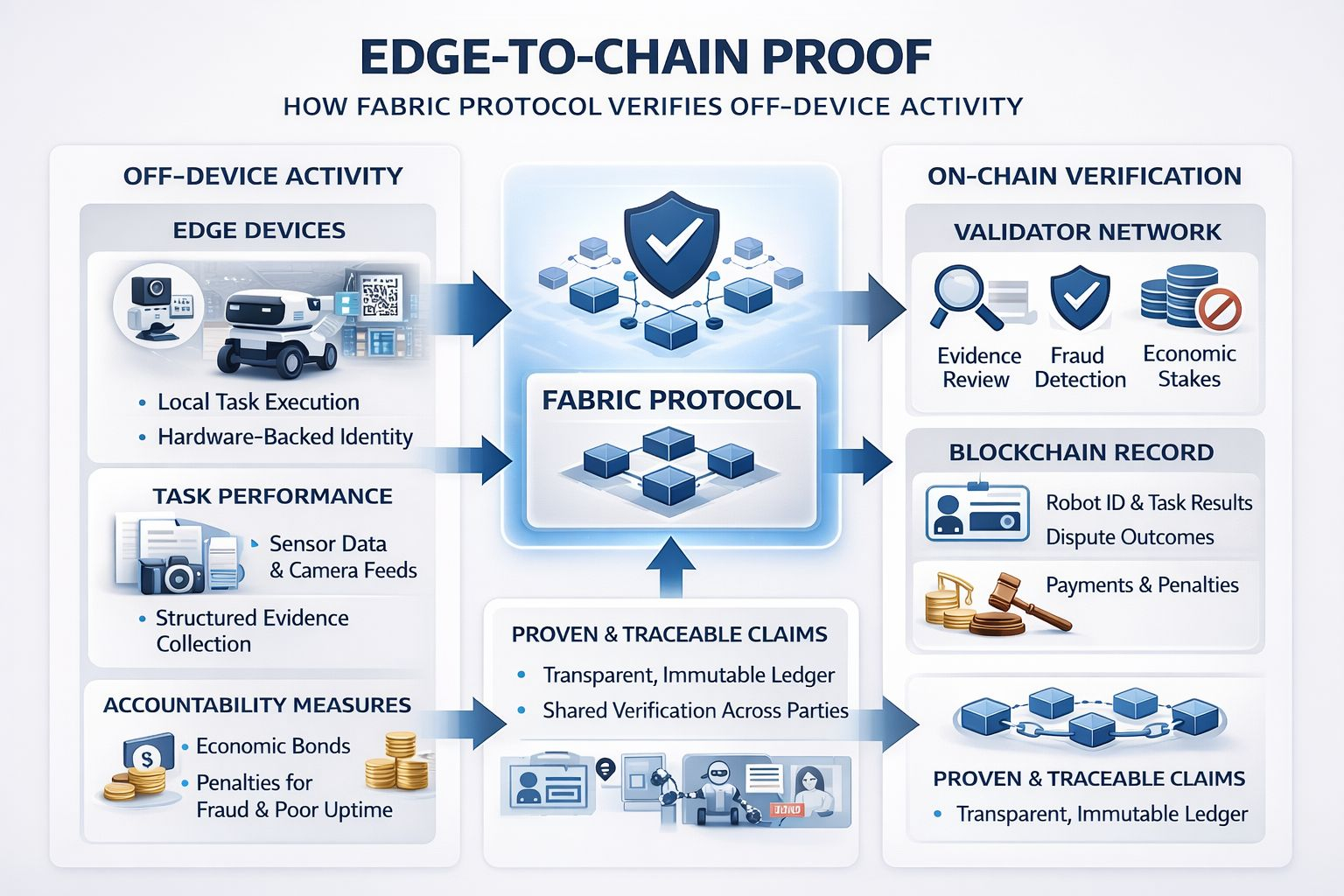
What helps me is to stop imagining a single magic proof and instead picture a stack of evidence that builds over time. Fabric’s recent materials describe a network built around robot identity and task settlement and structured data collection with rewards for verified contributions. In plain English the chain is not trying to become the robot’s eyes. It is trying to become the place where a robot’s identity and work history and payments and permissions and disputes can be recorded in a way that other parties can inspect later. That matters because once machines are working across different operators and customers and places trust stops being a private database problem and starts becoming a coordination problem. The chain is useful there because it gives everyone the same ledger even when they do not share the same company or software stack.
The part I find most honest in Fabric’s whitepaper is that it does not pretend physical work can always be turned into a neat cryptographic fact. It says the quiet part out loud by admitting that robot service in the physical world is only partly observable and that task completion generally cannot be cryptographically proven in the pure mathematical sense. So Fabric leans on a challenge based model instead. Validators do routine checks on availability and quality while they also investigate disputes and can earn bounties for proving fraud. Robots or operators post economic bonds that can be slashed for proven fraud or bad uptime or poor quality. In other words the system does not claim to make lying impossible. It tries to make lying expensive and risky and visible enough that honest behavior wins more often than cheating. I think that distinction matters a lot because it is less glamorous and much closer to how real systems usually have to work.
That is where the “edge-to-chain” idea starts to make sense to me. The edge device does the actual work and produces the raw signals while some of those signals will naturally be stronger than others. Fabric talks about verified task execution and data submission in its 2026 roadmap and it also points to compute provision with cryptographic attestation of completion. Elsewhere in the whitepaper it mentions identity solutions that may use trusted execution environments which are protected enclaves in a processor. TEEs are commonly used to protect code and data while they are being processed. None of that solves the whole problem by itself but it does show the shape of the design. The system uses hardware backed identity where possible and collects structured evidence and anchors the important parts onchain while leaving room for humans or validators to challenge suspicious claims.
I also think this angle is getting attention now rather than five years ago because the surrounding world has changed. Industrial robot deployments reached 542000 in 2024 which was more than double the number from ten years earlier according to the International Federation of Robotics. At the same time companies like NVIDIA are releasing open robot foundation models aimed at more general reasoning and skills which means more people expect robots to operate in less scripted settings. Fabric’s own recent posts reflect that shift because the emphasis is not just on robot hardware but also on the identity and payments and settlement and verification infrastructure around deployment. There is a second pressure too. Fabric explicitly frames “immutable ground truth” as more valuable in a world filling up with synthetic media and easy to fake evidence. Once both robots and fake content become more common provenance starts to matter in a more practical way.
So when I think about how Fabric verifies what happened off device I do not picture a perfect proof descending from the cloud. I picture a chain of custody for machine work that records the device’s identity and its claim and the attached data and the review around that claim along with the financial consequences if the claim turns out to be false. That is a more modest promise but maybe a more credible one. What surprises me is that Fabric’s strongest move may be its willingness to admit the limits. The hard part is not just proving computation because it is also about connecting computation to reality. Fabric seems to understand that this will remain a mix of cryptography and hardware trust and market design and governance. Whether that mix holds up in real deployments is still an open question and the project says as much in its discussion of unresolved design choices and the need for better measures that are harder to game over time. But as a way of thinking about off device truth it is serious enough to pay attention to.
@Fabric Foundation #ROBO #robo $ROBO
