One of the most common mistakes in crypto investing is judging a token purely by its total supply.
You’ll often hear things like:
“24 billion tokens? That’s too much.”
Or the opposite: “Low supply means it will pump.”
But experienced market participants know that supply alone rarely tells the real story.
The more important questions are:
How much is circulating?
What mechanisms control inflation?
And what actually drives demand for the token?
This is where the tokenomics of $NIGHT , the native asset of @MidnightNetwork , become more interesting than they might appear at first glance.
Looking Beyond the 24B Supply
At first glance, NIGHT’s numbers might raise eyebrows. The total supply is 24 billion tokens, with roughly 16.6 billion circulating at launch.
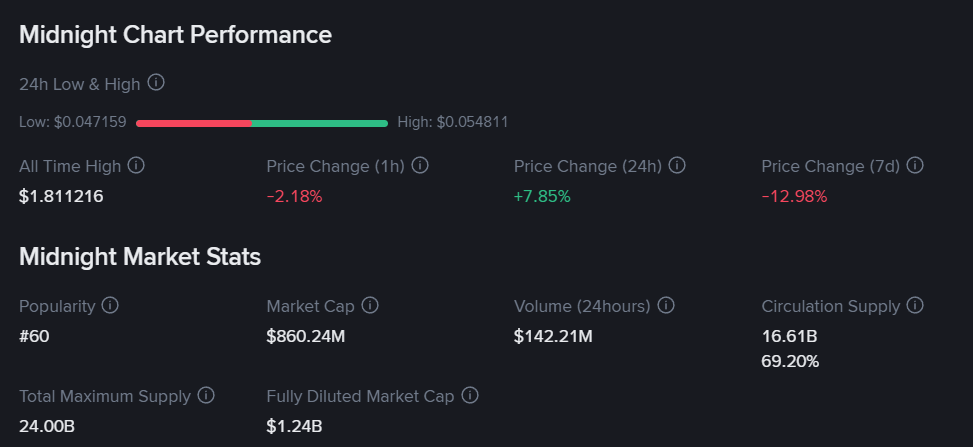
In other words, about 69% of the supply is already in circulation.
For context, that’s relatively high compared to many newer tokens that launch with extremely small floats. In practice, this changes the risk profile.
Tokens with tiny circulating supply often face severe dilution pressure when large unlocks occur later. When the majority of supply is already circulating, that future dilution risk tends to be lower.
This doesn’t eliminate volatility, but it does alter how investors should think about long-term supply expansion.
The Role of NIGHT in the Midnight Ecosystem
Token supply alone isn’t the full picture. #night is designed to serve as the economic backbone of the Midnight network.
Instead of being directly consumed for computation, NIGHT generates DUST, which is used for private transactions and confidential smart contract execution.
Two important dynamics come into play here:
DUST decays over time if NIGHT isn’t held
DUST is burned when used for private computation
This creates an interesting feedback loop.
Holding NIGHT effectively gives users access to the privacy infrastructure of the network, while the consumption of DUST introduces a mechanism that partially offsets inflationary pressure.
In other words, NIGHT isn’t just a governance token it acts as a gateway to the network’s privacy layer.
A Simple Numerical Example
Imagine an investor holding 10,000 NIGHT.
Over time, that balance generates a certain amount of DUST, which can be used to execute shielded transactions or private smart contracts.
Now imagine a developer building a privacy-enabled DeFi protocol. Each transaction consumes DUST, which is burned during execution.
If usage of private applications grows, the demand for DUST increases and by extension, holding NIGHT becomes more valuable because it is the source of that resource.
The key point is that network activity matters more than raw supply numbers.
Without real usage, even well-designed tokenomics struggle to create sustainable demand.
The Short-Term Risk: Post Listing Pressure
Of course, token design doesn’t remove market reality. After major exchange listings, many tokens face short-term sell pressure.
Early investors, airdrop recipients, and short-term traders often take profits once liquidity arrives. This can create volatility regardless of the long-term fundamentals.
However, the market also tends to respond strongly to major catalysts. For Midnight, one of the biggest potential catalysts is the mainnet launch and the expansion of privacy-focused applications within the ecosystem.