
That is the gap Fabric Protocol is trying to inhabit when people describe it as a new operating layer for machines.
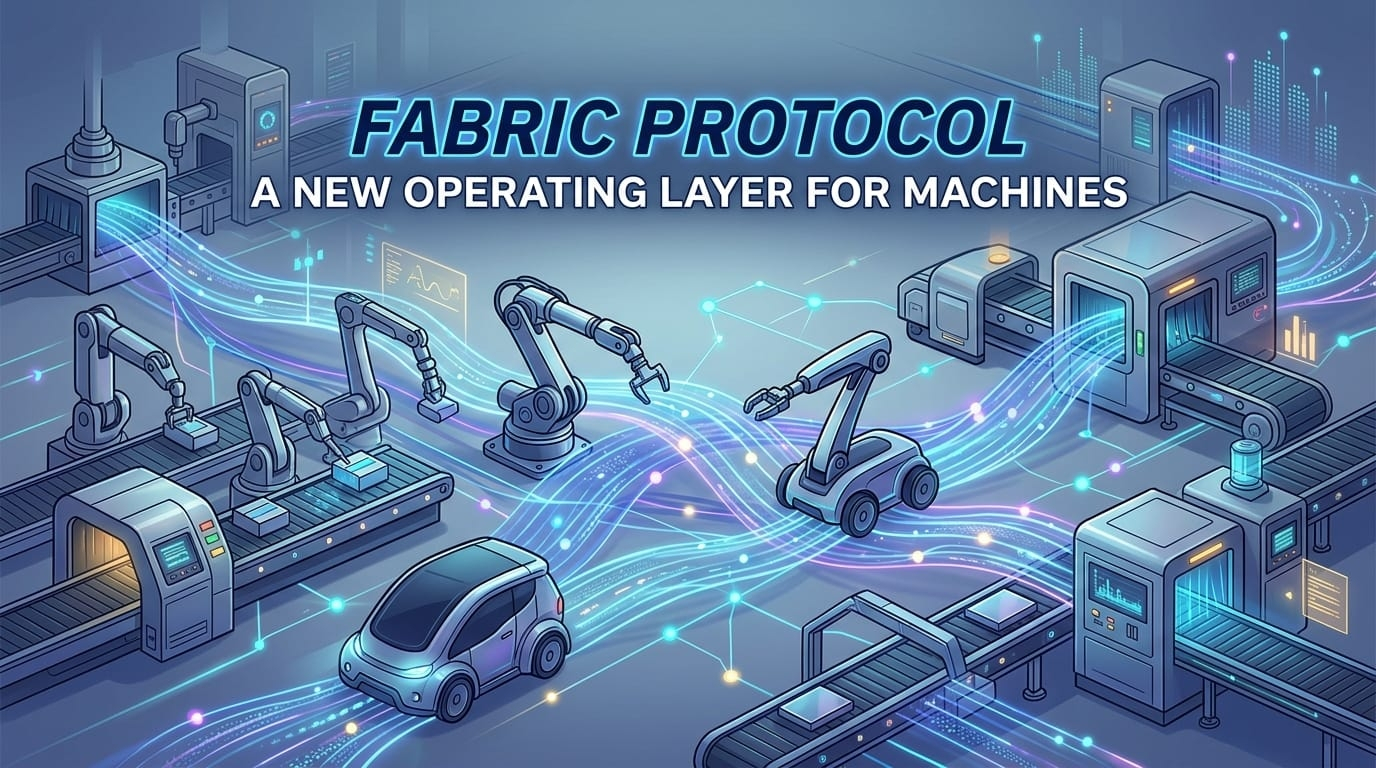
Robotics has always been more networked than the public imagines. Even a “standalone” machine depends on a web of components: sensors, controllers, safety systems, maintenance tools, identity keys, update pipelines, and the human decisions that shape how it’s allowed to behave. As fleets grow, those dependencies multiply. Different vendors show up. Different software stacks coexist. Someone adds a new camera. Someone delays an update because the floor is busy and downtime is expensive. The robots keep moving, but the system’s sense of truth starts to fragment.

An operating layer, if it’s worth the name, is supposed to reduce that fragmentation. It should make it easier to answer basic questions that become urgent the moment something goes wrong. Which machine executed the command? When a human overrode the system—because humans always do—did the record capture the intervention in a way that can be trusted later?

These questions aren’t philosophical. They’re the difference between a manageable incident and a spiraling argument. In a busy warehouse, a stalled robot isn’t just a stalled robot. It’s a delayed pallet, a missed cutoff time, overtime pay, and a customer service escalation that ends with someone saying, “We don’t know why it happened.” In a hospital, the cost can be sharper. A delivery unit that can’t prove its authorization to enter a controlled area creates a security issue. A unit that can prove it, but only by exposing sensitive operational details, creates a different kind of issue. Either way, trust becomes a daily operational concern, not a brand value.
Machines need shared identity. They need shared rules for permissions. They need shared ways to confirm that an action happened and to record it in a form that remains legible outside a single vendor’s toolchain. The moment you operate across multiple vendors, even in one building, the absence of a common layer becomes obvious. Everyone has their own logs. Everyone has their own timestamps. Everyone has their own “truth.”
A protocol layer can’t fix physics, of course. It can’t make batteries last longer or sensors stop drifting. But it can make the system more honest about itself. It can give machines a clearer way to authenticate and prove state. It can make handoffs between devices less dependent on brittle glue code that only one engineer understands. It can help an operations team reconcile events without spending hours correlating screenshots, export files, and support tickets.
The tradeoffs arrive immediately. Any coordination layer that adds verification also adds overhead. Robotics doesn’t have the luxury of endless overhead. Some machines operate on tight compute budgets. Some rely on networks that are unreliable by design: thick concrete walls, moving metal objects, dead zones in predictable corners. Latency isn’t an annoyance in many workflows; it’s a safety parameter. A machine that hesitates at the wrong moment because it’s waiting for a confirmation can become the hazard it was meant to prevent.
So the real test for something like Fabric Protocol is not whether it can describe a unified model. It’s whether it can do the work lightly enough to fit real environments. Can it operate when connectivity is intermittent? Can it degrade gracefully when a service is down? Can it keep identities and permissions stable across updates and repairs? If a technician swaps a sensor module at 7 a.m. before the first shift ramps up, can the system re-establish trust without turning a simple repair into a multi-hour credential ceremony?
There’s also governance, the word people reach for when they mean “who’s responsible.” In machine systems, governance isn’t a debate stage. It’s a practical rulebook. Who can issue a command to pause a fleet? Who can grant temporary access to a contractor? What’s the process for revoking a device identity after suspected compromise? How are exceptions handled when a nurse, a dock worker, or a safety officer makes a judgment call in the moment? If Fabric Protocol wants to be an operating layer, it has to acknowledge that human authority isn’t an edge case. It’s part of the system.
The best infrastructure tends to disappear into routine. You notice it only when it isn’t there, when things become strangely hard to explain. That’s the kind of usefulness an operating layer for machines should aim for. Not spectacle. Not a new vocabulary. Just fewer moments where a robot’s behavior can’t be accounted for across the full chain of systems that touched it.
It’s worth being careful, though. “Operating layer” can become a flattering phrase that covers over hard questions. Interoperability is difficult. Standards take time. Security isn’t a box you tick once. And any shared layer creates shared risk if it’s poorly designed or too centralized in practice. Robotics doesn’t need another dependency that fails in the most inconvenient way.
But the direction itself—treating coordination, identity, permissions, and verifiable records as first-order problems—matches what real deployments struggle with. If Fabric Protocol can help machines work together across messy conditions without asking operators to become part-time detectives, that would be a quiet kind of progress. The kind you don’t celebrate in a launch thread, but you feel on an ordinary Tuesday when the fleet keeps moving and, when it doesn’t, the system can finally tell the truth about why.