
One of the interesting contradictions in blockchain technology is that the systems designed to build trust often do so by making everything visible. Transactions are public, addresses can be traced, and activity can sometimes be analyzed in ways users did not initially anticipate. Transparency helps create security and accountability, but it can also expose more information than many people are comfortable sharing.
This tension is one of the reasons privacy has become an ongoing conversation in the blockchain world.
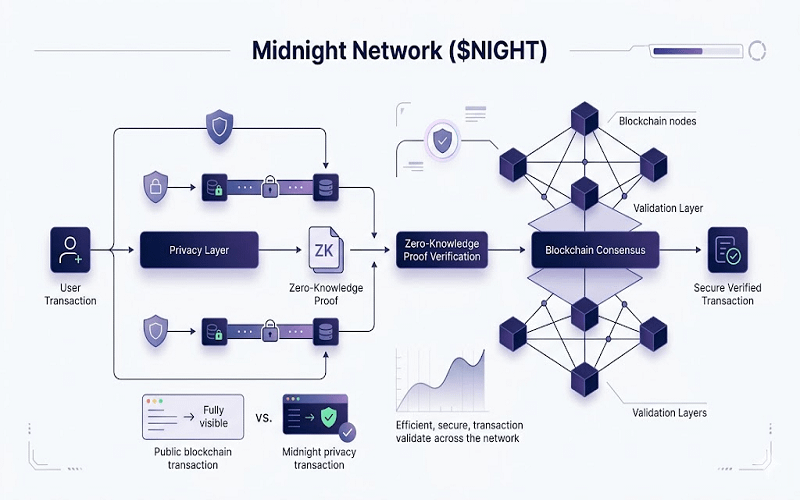
Projects like @MidnightNetwork are exploring what it might look like if decentralized systems could keep their security and openness while still protecting sensitive information. Instead of making every detail public, the idea is to allow certain pieces of data to remain private while still proving that a transaction or action is valid.
A large part of that exploration revolves around zero-knowledge proof technology.
Zero-knowledge proofs make it possible to verify that something is true without revealing the underlying data itself. In simple terms, a system can confirm that a rule has been followed without needing to show the full details behind it. This approach has started to attract attention because it offers a way to rethink how privacy could work within public networks.
Within the ecosystem being built around Midnight, this concept could support things like confidential transactions and private smart contracts. Instead of publishing every input and output on a public ledger, certain elements could remain hidden while the network still confirms that everything follows the protocol’s rules.
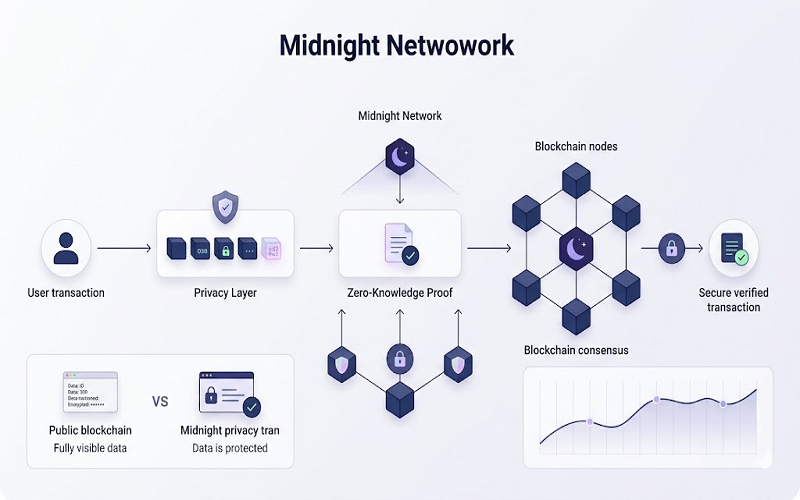
The token $NIGHT is connected to this broader environment, acting as part of how participation and activity might take place across the network. Like many emerging blockchain systems, the token sits alongside the technical infrastructure that aims to support decentralized applications built with privacy in mind.
Some observers see this kind of infrastructure as an attempt to address a growing concern in Web3: who actually controls the visibility of data. When everything on a blockchain is permanently visible, it raises questions about user ownership and long-term privacy. Networks experimenting with privacy layers are trying to give users more flexibility over what information is shared and what remains confidential.
Projects referenced through communities like #night often highlight this balancing act between transparency and discretion. It is not about removing openness entirely, but about deciding which information truly needs to be public.
For readers interested in how the project describes its work, the official Square profile at
https://www.binance.com/en/square/profile/midnightnetwork provides a closer look at how the team frames its approach to privacy-focused infrastructure.
Still, the broader field of privacy technology in blockchain is very much in development. Zero-knowledge systems can be technically complex, and many networks experimenting with them are still early in their ecosystem growth. There is also significant competition, as several projects are exploring similar ideas in different ways.
Because of that, the story of privacy in decentralized networks is still unfolding.
What projects like Midnight suggest is that the conversation may gradually shift from whether blockchains should be transparent to how transparency and privacy can coexist in a more balanced way.
