
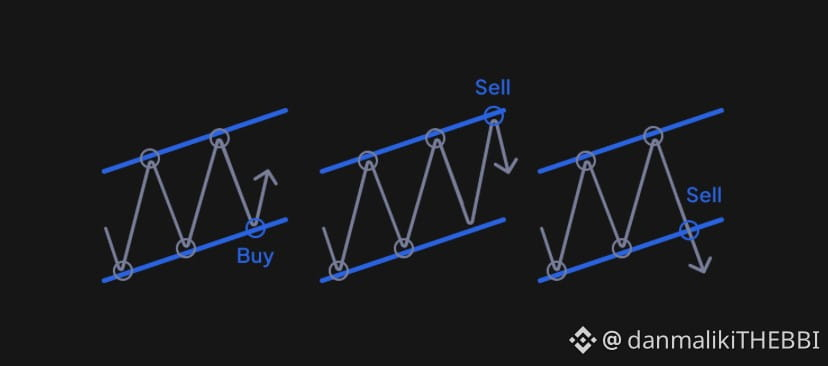
A price channel is a signal where prices move between two parallel lines on the trading chart. A price channel can be ascending or descending, depending on the direction of the trend. It is ascending within an upward trend and descending within a downward one.
This signal is similar to a trend line as it shows the price movement direction. The price channel also helps traders identify the range where the price moves up and down. When the price breaks out of this channel, it might significantly change the market direction.
How price channels work
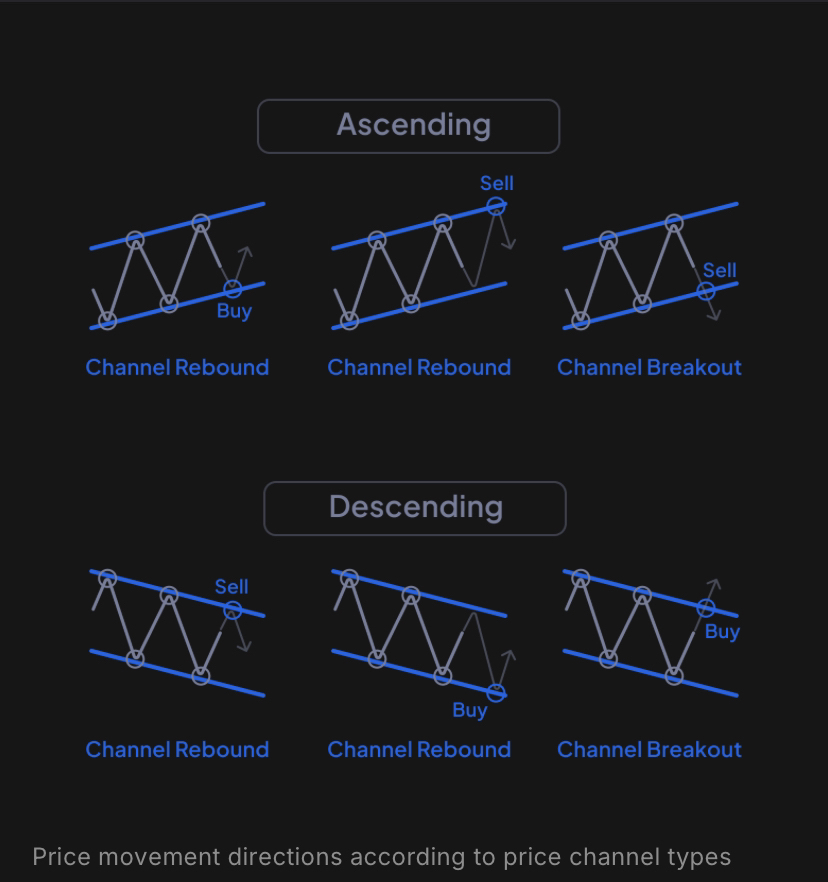
The lines of ascending and descending channels represent the highest and lowest points the price repeatedly hits. Essentially, they are the same as support and resistance levels but with an incline.
The more times the price touches these lines, and the longer these lines extend, the more traders will notice and trust this price channel.
Price channels represent a period of relative calmness in the market, often forming after a phase of sharp price movements. It is easier to trade within them, given the increased clarity about the direction of future movements.
However, price channels usually end with a sharp breakout in the opposite direction of the previous trend.
Identifying price channels
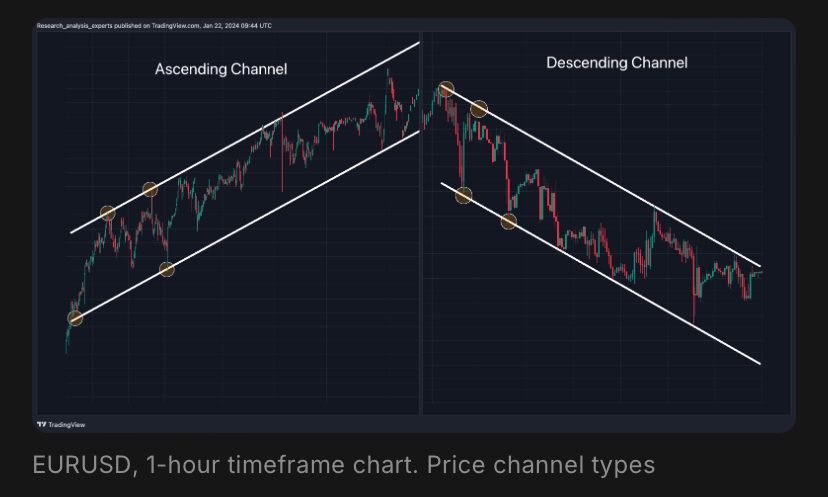
To correctly identify a price channel, you must connect at least two points on each side of a trading chart, creating two parallel lines.
Start by finding two points on each side of a chart. These points are usually located where a price has reversed or changed direction.
Draw two parallel lines connecting these points to form your price channel.
After you’ve managed to identify the price channel, there are three possible scenarios of the price behaviour.
If the price bounces off the channel's boundaries, it will likely move away from the edge towards the opposite boundary.
If the price breaks through the channel in the same direction as the channel's trend, there's a chance it might return to the same price channel.
A price breakout in the opposite direction indicates the end of this price channel and serves as a signal to enter a trade in the direction of the breakout.
Trading examples
Price channel rebound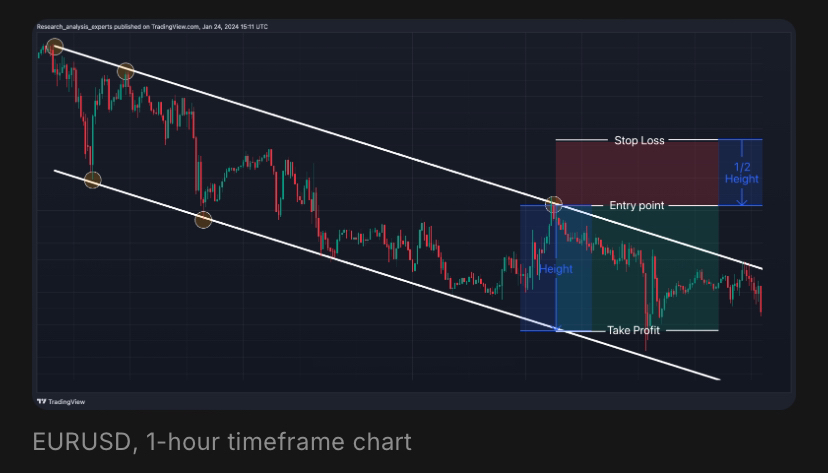
Open a Sell order after the price rebounds from the upper border of an ascending or a descending channel.
Open a Buy order if the price rebounds from the lower border of an ascending or a descending channel.
Place Stop Loss at a level equal to half the channel's initial height to limit potential losses.
Calculate your position size, ensuring the Stop Loss is no more than 5% of your total deposit.
Set the Take Profit at a level twice bigger than Stop Loss.
Price channel breakout
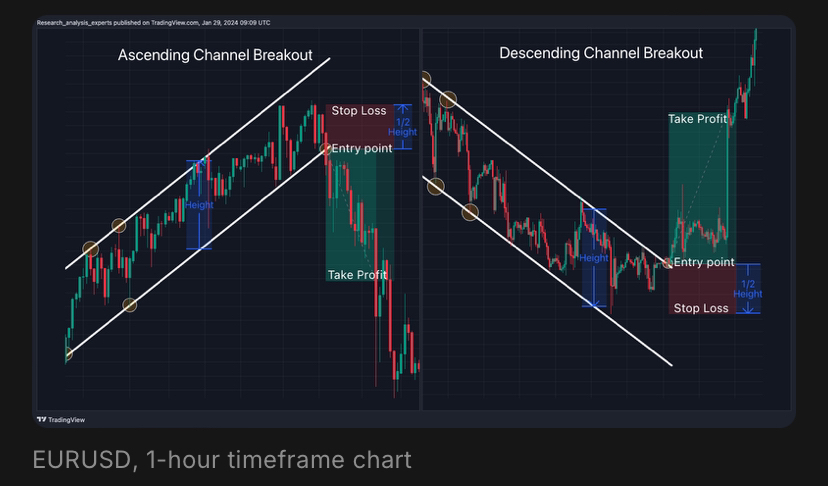
Open a Sell order once the price drops below the ascending channel's lower border. This action is based on the expectation that the ascending channel is broken.
Open a Buy order once the price rises above the descending channel’s upper border. This action is based on the expectation that the descending channel is broken.
Place Stop Loss at a level equal to half the channel's initial height to limit potential losses.
Calculate your position size, ensuring the Stop Loss is no more than 5% of your total deposit.
Place Take Profit at a level that exceeds Stop Loss three times. This allows you to profit more if the trend continues moving downwards in an ascending channel or upwards in a descending channel.
Leveraged trading involves risk. This content is not investment advice. Trade responsibly.$EUR
