
When I first started looking into Fabric Foundation and its token ROBO, my initial reaction was honestly skepticism. The crypto market has become crowded with projects claiming to power the future of artificial intelligence. Every week another token appears promising to become the “infrastructure layer for AI,” and after years of hype cycles it becomes difficult to separate genuine technological attempts from narrative-driven speculation.
But the more I studied Fabric’s architecture and the broader technological context surrounding it, the more I realized that the project might actually be approaching the AI narrative from a completely different angle. Most so-called AI tokens today are focused on software: training models, providing distributed compute, or coordinating digital agents. Fabric, however, appears to be exploring something far less discussed but potentially just as important — the economic infrastructure that could allow physical machines to participate in real-world systems.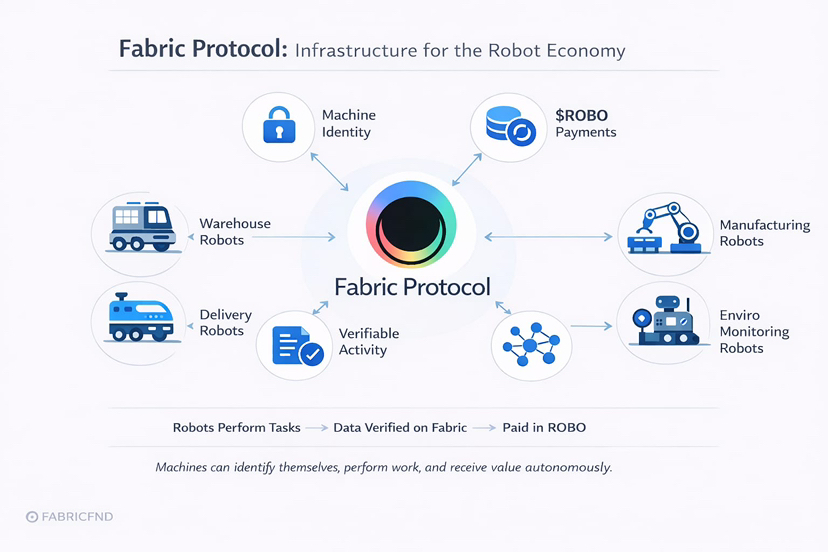
The idea becomes clearer when looking at the current technological landscape. Artificial intelligence continues to improve rapidly, enabling machines to analyze data, make decisions, and learn from complex environments. At the same time, robotics is expanding across industries. Robots already operate in warehouses, manufacturing facilities, farms, and increasingly in public environments such as delivery services and logistics networks. Yet despite these advancements, the economic and coordination systems that govern these machines remain fragmented. Most robots exist inside closed corporate ecosystems where they operate under centralized control and proprietary data systems.
This is the gap Fabric appears to be trying to address. The protocol is designed as a decentralized network where machines can interact through shared infrastructure rather than isolated systems. Instead of each robotics company building its own internal coordination layer, Fabric proposes a network where robots, developers, and businesses can interact using standardized digital identities, payment systems, and verifiable activity records. The goal is not simply to improve robotics technology but to create a common economic framework around it.
One of the most interesting aspects of the Fabric model is the concept of machine identity. Within the network, robots can be assigned cryptographic identities that allow them to authenticate themselves and maintain persistent operational histories. These identities can be associated with wallets capable of sending and receiving payments through the network. In practice, this means a robot performing a task could theoretically receive compensation automatically through the system, while its performance history and capabilities remain transparently verifiable.
At the center of this infrastructure sits the ROBO token, which functions as the economic backbone of the network. The token is designed to facilitate transactions, governance participation, staking mechanisms, and machine-to-machine payments. In essence, ROBO becomes the unit of value that coordinates activity between developers, machine operators, and other participants within the ecosystem. The total token supply is fixed at ten billion units, with allocations distributed among ecosystem incentives, investors, the development team, and long-term foundation reserves. Investor and team allocations reportedly include vesting periods designed to align incentives with long-term development rather than short-term speculation.
Another concept associated with the network is the idea of rewarding real-world robotic activity. Rather than focusing purely on computational validation or staking rewards, Fabric explores mechanisms that link token incentives to physical tasks completed by machines. Examples could include robots performing logistics operations, industrial assembly work, environmental monitoring, or delivery tasks. The idea is that value generated through real-world machine activity can be measured, verified, and rewarded within a decentralized system.
Whether this model ultimately works at scale remains an open question. Robotics infrastructure is expensive, complex, and historically slow to adopt new technologies. Industrial robotics companies often operate on long development cycles, and integrating new coordination layers into existing systems can take years. Convincing businesses to adopt shared infrastructure — especially infrastructure tied to blockchain networks — may prove challenging.
At the same time, the broader technological trends supporting the concept are difficult to ignore. The number of robots operating globally continues to grow as automation spreads across industries. Logistics warehouses deploy fleets of autonomous machines, manufacturing plants rely on robotic assembly systems, and new service robots are entering public spaces. As these machines become more capable and more autonomous, the question of how they interact economically and operationally will become increasingly important.
This is where the idea behind Fabric becomes interesting from a long-term perspective. If machines eventually operate as semi-independent agents within economic systems, they will require infrastructure similar to what humans already rely on: identity frameworks, payment systems, coordination protocols, and governance mechanisms. Today, those systems exist primarily for human participants. Fabric is attempting to extend them to machines.
Of course, this vision is still early. The network itself only recently introduced its token and began expanding its ecosystem. Compared to more established infrastructure protocols in the crypto industry, Fabric is still in the earliest phase of development. Its developer community, integrations, and real-world deployments will need time to grow before the full vision can be evaluated.
But what makes the project worth watching is the direction of its thesis. Rather than competing directly with the many AI compute networks and agent platforms already operating in the market, Fabric appears to be targeting a different layer entirely — the physical economy of machines. If that layer eventually becomes as important as many technologists believe, the infrastructure supporting it could become highly valuable.
For now, Fabric represents an experiment in connecting robotics, artificial intelligence, and decentralized economic coordination. Whether it succeeds will depend on adoption, technological execution, and the willingness of industries to collaborate on shared infrastructure. But the problem it attempts to address is real. As automation expands and intelligent machines become more common in everyday environments, the systems that coordinate them will become increasingly important.
Looking at the broader trajectory of technology, it seems likely that the future of AI will not exist purely in software running on servers. It will exist in machines operating throughout the physical world — in factories, transportation systems, hospitals, and cities. Those machines will need ways to identify themselves, communicate securely, and participate in economic systems.
The real question is not whether that infrastructure will exist. The question is which networks will build it first, and whether decentralized protocols like Fabric will play a meaningful role in shaping the emerging machine economy.