
When I first began examining the work being done by Fabric Foundation and its underlying infrastructure, Fabric Protocol, I expected to encounter something that felt familiar. The crypto industry has developed a pattern over the years. A new sector becomes fashionable—artificial intelligence, robotics, decentralized compute—and suddenly dozens of projects appear claiming to represent the future of that industry. Most of them wrap the same architecture in slightly different language. A token appears first, a story appears second, and the product is expected to arrive later.
But as I spent more time studying the ideas behind Fabric and its native token ROBO, I realized the project was approaching the problem from a slightly different angle. The story here is not really about robots. The machine itself is not the center of gravity. The more interesting idea is the layer underneath: the economic coordination of machine capabilities. Fabric is attempting to build a system where machines—robots, autonomous systems, and AI-driven agents—can operate inside verifiable economic frameworks rather than opaque corporate silos.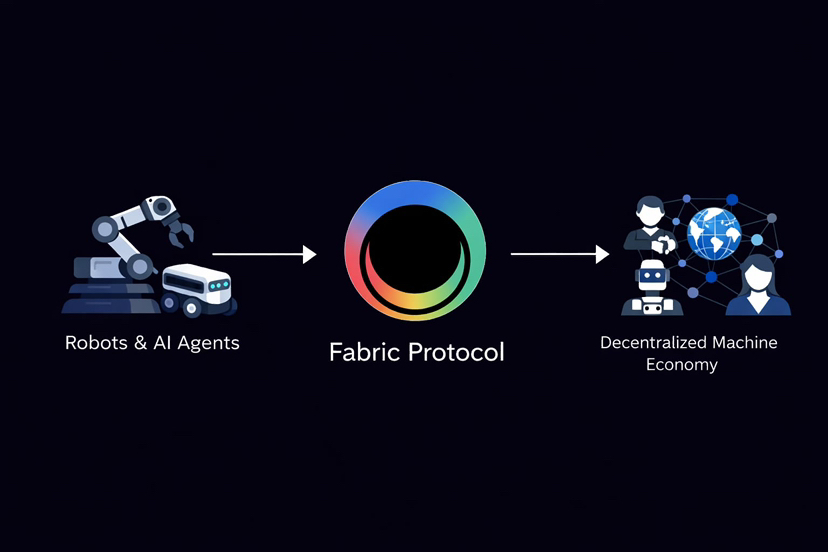
The concept sounds deceptively simple, but the deeper I looked the more I realized how complex the challenge actually is. Modern robots already perform valuable work in logistics warehouses, manufacturing lines, agricultural fields, and inspection facilities. Global robotics spending has been climbing rapidly, and the International Federation of Robotics estimates that millions of industrial robots are already operating worldwide. These machines move goods, assemble electronics, scan infrastructure, and assist in medical environments. Yet despite their economic importance, robots still exist in a strangely disconnected position within the digital economy. They generate value, but they do not directly participate in the economic systems that measure and distribute that value.
Fabric begins from the assumption that this gap will eventually become unsustainable. As automation spreads, more economic activity will originate from machines executing tasks autonomously. That raises a basic question: how do we verify, coordinate, and reward machine work across decentralized networks?
The proposed answer from Fabric is to create an infrastructure layer that records machine activity through cryptographic verification while enabling a marketplace for machine capabilities. Instead of treating robots as isolated products owned and controlled by a single company, Fabric imagines them as participants in an open ecosystem where tasks, skills, and verification systems circulate through a decentralized network.
What intrigued me most while reading through the architecture is that Fabric does not treat hardware as the final product. The more important layer is what the project describes as machine skills—specific capabilities that can be installed, upgraded, replaced, or monetized across robotic systems. When I think about the project through that lens, the analogy that keeps coming to mind is the early smartphone economy. A phone by itself is just hardware. What transformed smartphones into global platforms was the ability for developers to build applications that could be distributed, monetized, and improved over time.
Fabric appears to be exploring a similar concept for machines. Instead of an app store for phones, the network could eventually resemble a marketplace for robotic functions. A warehouse robot might run one set of navigation algorithms, while a delivery robot installs a completely different set of operational skills. Developers who design these capabilities could earn revenue whenever their skills are deployed on machines operating across the network.
If such a system worked in practice, it would fundamentally change how robotic ecosystems evolve. Instead of a closed model where each manufacturer develops its own internal software stack, capabilities could circulate more fluidly between developers, operators, and users.
But as interesting as this concept is, the deeper I examined it the more questions emerged.
One of the central promises of Fabric is verifiability. The protocol proposes using blockchain infrastructure to verify that robotic tasks were executed correctly before payments are distributed. This approach aligns with broader trends in decentralized artificial intelligence, where developers are attempting to create systems that reduce blind trust in centralized providers. Cryptographic proofs and decentralized validation mechanisms can confirm that certain computations occurred or that specific data was recorded at a given time.
However, verification has limits.
A blockchain can verify that data was submitted. It can confirm that validators approved a transaction. It can prove that certain information was processed through a cryptographic system. What it cannot do easily is determine whether the underlying activity was meaningful, ethical, or even real.
This is where the architecture becomes particularly interesting to me. Fabric is not simply solving a technical challenge. It is attempting to solve a coordination challenge that sits at the intersection of robotics, artificial intelligence, and decentralized governance.
If machines are completing tasks on behalf of users, someone must determine whether those tasks were performed correctly. If developers are building machine skills, someone must evaluate whether those skills produce useful outcomes. If validators are responsible for verifying activity across the network, the system must ensure that verification itself remains trustworthy.
This introduces one of the most delicate aspects of the entire design: incentives.
In decentralized systems, incentives determine whether a network remains honest or gradually becomes distorted by opportunistic behavior. Validators may be rewarded for confirming tasks. Operators may earn tokens for running machines. Developers may receive payments when their skills are used. All of these participants interact through economic signals, and those signals must be carefully balanced.
If rewards are too generous, participants may begin farming incentives rather than producing real value. If rewards are too small, participants may abandon the network altogether. Achieving equilibrium between these forces is one of the most difficult problems in decentralized system design.
The presence of the ROBO token introduces another layer to this economic structure. Tokens in decentralized networks typically serve multiple roles at once: they can function as governance instruments, coordination tools, and incentive mechanisms. In Fabric’s case, the token appears to be designed to facilitate payments for machine work, staking mechanisms for validators and operators, and governance participation for protocol upgrades.
Token systems can be powerful coordination tools, but they also introduce sustainability questions. If too many tokens are issued too quickly, inflation can undermine long-term incentives. If too few tokens circulate within the ecosystem, participation may stagnate. The balance between growth and sustainability will likely determine whether the network develops a stable economy or struggles with the same volatility that has affected many crypto experiments.
Beyond the economic questions, governance remains one of the most important factors shaping the long-term success of any decentralized network. Fabric proposes a system where participants can collectively influence protocol parameters, validation rules, and future upgrades. In theory, decentralized governance distributes power across the community rather than concentrating it in a single organization.
In practice, governance often becomes more complicated.
Large token holders may accumulate disproportionate influence. Early participants may dominate decision-making processes. Validators may coordinate strategies that favor their own economic interests. These dynamics have appeared in many blockchain networks, and they represent real challenges for any protocol attempting to maintain decentralization at scale.
Despite these uncertainties, the broader ambition behind Fabric is undeniably compelling. The project is exploring a world where machine capabilities become economic assets that can circulate through open networks rather than remaining locked inside proprietary platforms.
If that vision materializes, it could create entirely new forms of digital marketplaces. Instead of simply trading data or computation, networks might facilitate the exchange of physical capabilities—navigation algorithms, inspection routines, robotic manipulation systems, and other machine behaviors that produce real-world outcomes.
In such an environment, robots would gradually evolve from isolated tools into participants within larger economic ecosystems. Developers could specialize in creating machine skills. Operators could deploy fleets of machines optimized for specific tasks. Validators could verify activity across networks. Users could request services without needing to own the underlying infrastructure themselves.
What fascinates me most about this possibility is that it reframes robotics not as a hardware industry but as a coordination problem. The challenge is not just building better machines. The challenge is building systems that allow those machines to interact, transact, and evolve collectively.
That is the deeper layer of Fabric’s ambition.
The project is attempting to create the rails that allow machine capabilities to circulate with rules, incentives, and verification mechanisms attached to them. Whether that experiment ultimately succeeds will depend less on marketing narratives and more on the network’s ability to maintain integrity as it grows.
Because the real test of any decentralized infrastructure is not how innovative its initial design appears. The real test is whether the system can remain open, resilient, and economically coherent once thousands—or potentially millions—of participants begin interacting with it.
Fabric is still early in its development. The robot economy it imagines may take years to fully emerge. But the questions it raises about machine identity, verifiable activity, and decentralized coordination are likely to become increasingly important as artificial intelligence and robotics continue to reshape global industries.
For me, that is what makes the project worth studying. Not because it promises a futuristic vision of machines taking over economic systems, but because it is attempting to build the infrastructure that might allow those systems to function responsibly.
If the next technological era truly belongs to autonomous machines and intelligent software, then the networks that coordinate those systems will matter just as much as the machines themselves.
And Fabric, quietly and methodically, appears to be positioning itself right at that intersection.