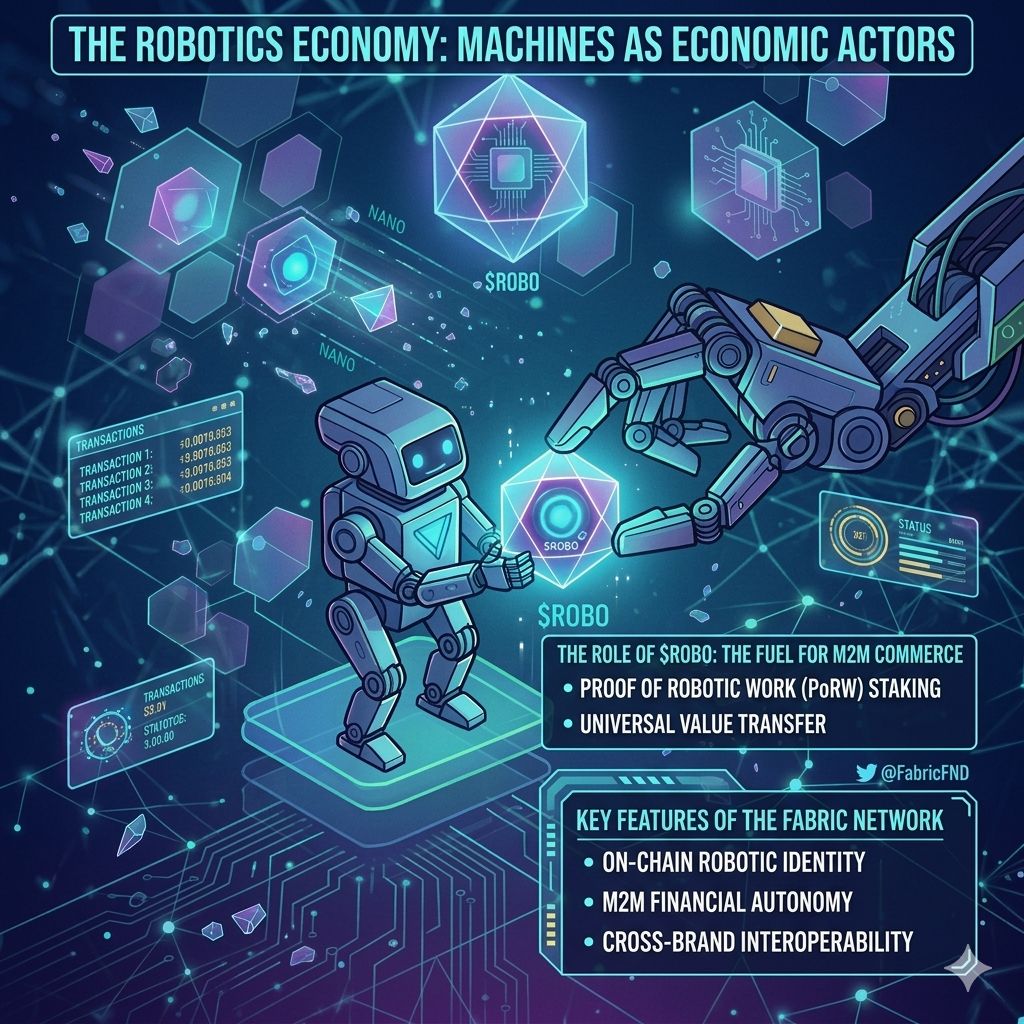
The robotics revolution is accelerating, moving far beyond the walls of factory floors and into our daily lives. From autonomous delivery drones to self-healing infrastructure maintenance robots, we are witnessing an explosion of hardware capability. But a critical question remains unanswered: how will these machines transact? How will they manage their own resources, pay for energy, or trade services without a human intermediary?
Current economic models are human-centric, designed for individuals with bank accounts and legal identities. Robots, as they become more sophisticated and autonomous, remain economically stranded. They are isolated tools, dependent on human-managed systems for every financial action. This dependency creates massive friction, limits the scale of robotic deployments, and prevents the creation of a true, interconnected machine-to-machine (M2M) economy.
This is the central challenge that@Fabric Foundation (the Fabric Foundation) is solving. Fabric is not building new hardware; it is building the essential economic and technological middleware—the connective tissue—to turn robots from human-dependent tools into autonomous economic actors.
Fabric Foundation: The M2M Infrastructure
Fabric’s vision rests on three core pillars:
* On-Chain Robotic Identity: A robot without an identity cannot hold assets, sign contracts, or be held accountable. Fabric provides a secure, decentralized framework for robots to establish and manage their own cryptographic identities on the blockchain. This identity is the foundation for everything else, linking a specific machine to its operational history and economic wallet.
* Machine-to-Machine Financial Autonomy: Fabric enables robots to possess and control their own cryptographic wallets. This allows a drone to receive payment directly for a delivery and then use a portion of those funds to pay for a battery swap at an automated charging station, all without human intervention. This unlocks friction-free M2M transactions.
* Cross-Brand Interoperability: Today, a drone from Company A cannot talk to a docking station from Company B. Fabric’s infrastructure aims to be the universal translation layer, allowing machines from different manufacturers, running different proprietary software, to understand and trust each other within a standardized economic framework.
$ROBO: The Fuel for the Machine-to-Machine Economy
The heart of this new economic ecosystem is BO, the native token of the Fabric Network. is far more than just a currency; it is the vital fuel that powers every interaction within this emerging M2M landscape.
Why is Essential:
* Trust and Accountability via Staking: One of the biggest obstacles to a trustless M2M economy is accountability. How do you trust a robot to fulfill a contract? $ROBO introduces a novel solution: Proof of Robotic Work (PoRW). Robot operators are required to stake a work bond in $ROBO. If the robot fails to complete a task or behaves maliciously, that bond can be slashed, providing a powerful, economic-based incentive for reliable and safe operation.
* On-Chain Identity and Service Fees: To participate in the Fabric network, robots (and their operators) use $ROBO to register identities, manage their profile, and pay transaction fees. Every computation, identity verification, and value transfer between machines consumes a small amount of $ROBO, creating a continuous utility-driven demand.
* Universal Value Transfer: In a multi-chain and highly fragmented robotic landscape, serves as a standardized, universal token for exchanging value. A logistics bot can pay a maintenance bot for a repair service, and both can transact in the same, trusted asset.
* Service Level Agreements (SLAs) and Escrow: Machines will enter into complex, algorithmic service contracts. $ROBO enables the automated use of smart contracts and escrow mechanisms. For instance, a smart contract might hold $ROBO in escrow until a sensor network verifies that a delivery robot has correctly deposited a package at its destination, automatically releasing the payment upon confirmation.
Beyond Automation: The Path to Autonomy
The implications of this shift from "robots as tools" to "robots as economic actors" are profound.
* Efficient Asset Management: Robots can manage their own maintenance and depreciation. A delivery van could, based on its onboard diagnostic data, automatically book and pay for an oil change or tire rotation.
* Machine-to-Human Commerce: A robot might hire a human. Imagine an automated warehouse that detects a loose cable but lacks the fine dexterity to fix it. Using its identity and funds, the warehouse AI could post a micro-bounty for a human technician, paying out in upon task completion.
* True Scalability: By automating the financial and contractual layers, robotic networks can scale far faster and with significantly less overhead than currently possible.
Conclusion
We are on the cusp of an era where machine-to-machine commerce will outpace human commerce in frequency and speed. @Fabric Foundation FabricFND is building the essential, invisible infrastructure for this future, and is is the catalyst. As decentralized physical infrastructure networks (DePIN) and autonomous robotic agents continue to multiply, the need for an economic rail built for machines, by machines, becomes undeniable. ROBO is not just a token; it is the fuel for the autonomous economy. Excitement to see this ecosystem scale! 🤖⚙️ #ROBO