
While scanning the chain last night, long after the usual tabs had closed, the location-gated and human-gated payments in the Fabric Foundation ROBO ecosystem refused to let me move on. $ROBO sits at the center of robot task settlements, and I had gone in assuming the gates would fade into the background once on-chain identity took hold. Instead, they emerged as the defining friction point.
The contract address 0x32b4d049fe4c888d2b92eecaf729f44df6b1f36e showed a clear uptick in activity right after the March 5, 2026 OKX spot trading launch and reward event. Location data triggered reliably for zone-restricted tasks, yet nearly every payout still waited for an explicit human-gated approval step before releasing funds.
One actionable insight stood out early: if you’re routing $ROBO for any test settlement, always simulate the human gate first — it adds a predictable 1-2 block delay but builds the trust layer the ecosystem actually runs on.
I remembered running my own small test flow a few weeks earlier, just to feel the settlement in real time. The location oracle fired instantly, but the payment sat until I manually confirmed the human approval. That moment grounded everything.
The structure I kept circling back to is a quiet three-layer feedback loop. Robot identity registers on-chain first. Location proof then hashes against the contract rules. Finally the human gate signs off and unlocks the bonded ROBO payout. Without all three meshing, the loop simply pauses.
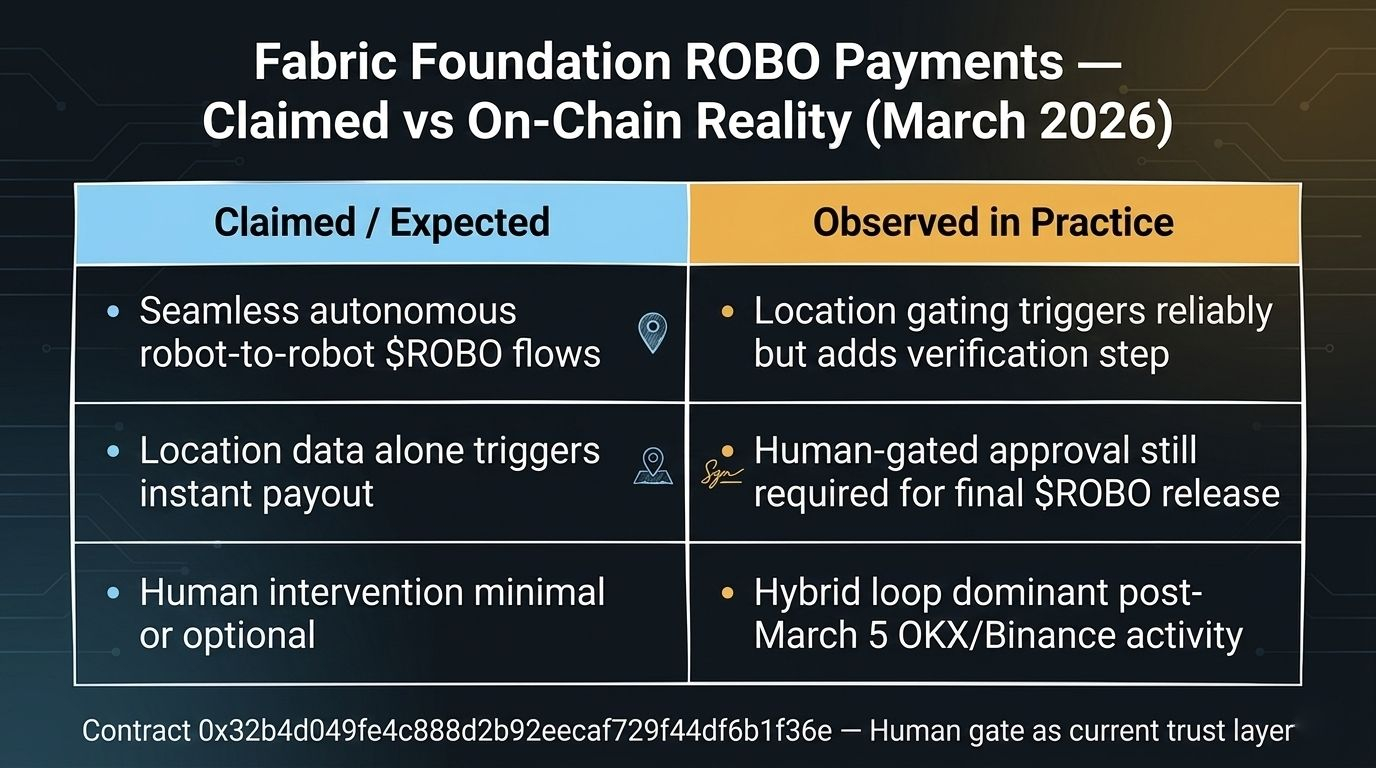
On-chain behavior since the March 5 listings confirms this pattern holds steady. Early volume came mostly from human operators stress-testing the system, not autonomous robot wallets closing cycles solo.
the contrast that stuck with me
The contrast that stuck with me is between the narrative of frictionless robot payments and what actually plays out on-chain. The project positions ROBO as the equal-payment rail for humans, agents, and machines alike, free of legacy geo limits. In practice the location gate enforces real-world boundaries while the human gate adds the accountability that pure code cannot yet provide.
This hybrid approach isn’t a flaw — it’s the feature keeping early deployments safe. Location data gives verifiable “where,” the human signature gives verifiable “who approved.” Together they create the trust bridge the market is currently leaning on.
Actually, seeing the logs after the OKX event made me adjust my own expectations. What reads as delay on paper functions as deliberate protection in live conditions.
The Binance listing days earlier had already primed the liquidity wave. When the reward event hit March 5, the settlement flows revealed the same gated rhythm across dozens of transactions.
It forces a gentle reevaluation: the human layer isn’t scaffolding waiting to be removed. It’s the current foundation for scaling robot coordination safely.
hmm... this mechanic in practice
Hmm… this mechanic in practice feels more pragmatic than revolutionary at this stage. Robots complete tasks, submit proof, and location data matches contract conditions without issue. Yet the ROBO payout almost always requires that final human-gated confirmation before moving.
The pattern showed up consistently in the March 7–8 settlement cluster I reviewed. Location triggers worked flawlessly for geo-fenced operations. The human gate was the step that finalized movement of funds every single time.
Two timely market examples drove the point home. First, the OKX integration and reward pool pulled in fresh participants who quickly hit the location gate limits in real deployments. Second, early Base network task settlements showed robots initiating requests while human operators still handled the release approval.
It’s the kind of detail that only surfaces when you watch the chain instead of the whitepaper. The gates aren’t blocking progress — they’re quietly enabling it by keeping disputes minimal and accountability clear.
Still, it leaves a small doubt about how quickly full machine autonomy can arrive when the human layer remains this active.
still pondering the ripple
This leaves me reflecting on how carefully the Fabric Foundation is threading the needle between vision and workable reality. The location-gated and human-gated payments aren’t just technical controls — they embed a layer of shared trust that pure autonomy hype often glosses over.
The on-chain data since the March 5 events shows the ecosystem growing precisely because of these gates, not in spite of them. Robot identities register cleanly, location proofs verify fast, and the human step keeps everything grounded while fleets scale.
It makes you pause and appreciate the long-game thinking at play. These mechanics could tighten as better oracles emerge or evolve into optional toggles for higher-value operations. Either direction, the current setup is teaching lessons about machine economies that reach far beyond ROBO alone.
The whole late-night dive shifted how I view the balance between speed and safety in robot coordination.
What patterns are you seeing when you trace the payment flows yourself?
How long until location data and on-chain proof alone can carry most ROBO settlements without the human-gated step still being the norm?
@Fabric Foundation #ROBO