
I remember staring at a log file around 2:10 a.m., trying to figure out why a simple autonomous script kept repeating the same transaction loop. The bot wasn’t malfunctioning in the usual sense. The code compiled fine. The network confirmed the transactions. But the behavior felt wrong. Every few minutes it would trigger the same action again, as if it had forgotten it had already done it. That was the moment something clicked for me about Fabric Protocol’s insistence on on chain identity.
At the time I thought identity sounded like unnecessary overhead. If a robot or agent can sign a transaction with a key, that should be enough. Cryptographic signatures prove authorship. The system verifies it. Done.
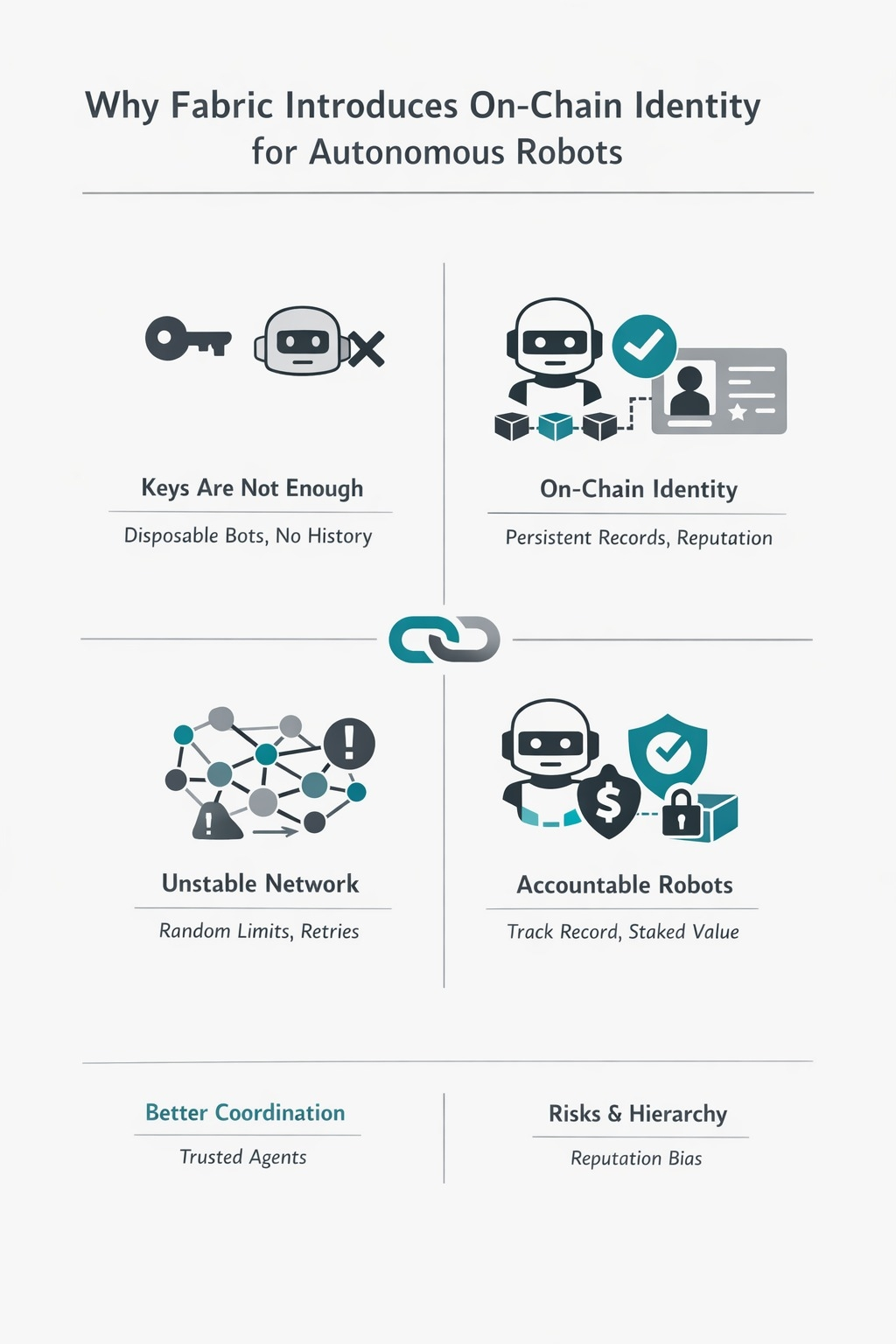
Except that wasn’t what was happening in practice.T he script I was running had a key. Technically it had an identity in the narrow blockchain sense. But operationally it had none. It had no persistent reputation, no state history tied to behavior, no memory the network could reference when deciding how to treat it. From the system’s perspective it was just another key broadcasting instructions. And keys are cheap but robots are not. That gap is exactly where Fabric’s design starts to make more sense.
When Fabric introduced on chain identity for machines, the idea initially sounded philosophical. Machines as actors. Agents as entities. It felt like conceptual framing rather than infrastructure. But the first time you run automated agents in production, the problem becomes painfully concrete. Without identity, the network cannot distinguish between a robot that has been behaving reliably for six months and a script spun up thirty seconds ago to spam requests. Both look identical at the transaction layer. And that breaks things in subtle ways. For example, one of the experiments we ran involved letting multiple agents interact with a routing service. Some agents were doing legitimate work. A few were just stress testing the system. Nothing malicious, but noisy.
Within a few hours the network’s behavior shifted. Throughput was technically fine. Latency stayed within the expected window. But the routing layer started treating every participant with equal suspicion. Retries increased and some requests were throttled unpredictably.
The system had no memory.
That sounds abstract until you watch the logs scroll past. The same request being retried four or five times because the network cannot tell whether the sender deserves trust.
Fabric’s identity layer changes that dynamic.
Instead of a robot simply appearing with a key, the machine registers an identity object on chain. That identity accumulates state over time. Interaction history, participation signals, economic commitments. Not just a signature attached to a transaction, but a traceable actor.
The immediate consequence is behavioral.
Once identity exists, robots stop behaving like disposable scripts. They behave like participants with something to lose.
You see it in small metrics. Retry counts drop. Certain routing paths stabilize. A robot that consistently completes tasks starts receiving faster confirmations because the network can reference its track record.
That part is easy to appreciate.
The part that surprised me was what identity changes for debugging.
Before identity, diagnosing failures meant tracing individual transactions across a chaotic graph of temporary keys. Agents would restart. Keys rotated. Sessions ended. The history fragmented quickly.
With persistent identity, the system develops continuity. You can track a robot across hundreds or thousands of operations. Patterns become visible. A particular identity consistently hitting timeout thresholds. Another one behaving predictably even under network congestion.
It becomes possible to reason about machines the way we reason about users.
Not perfectly. But enough to stabilize operations.
There is also a less obvious mechanism tied to Fabric’s identity design. Economic bonding.
When a machine registers its identity, it often locks some value into the system. Not necessarily large amounts, but enough to create friction. Enough to make disposable behavior expensive.
That single change alters network incentives more than most people expect.
Spam agents thrive when identity is cheap. If misbehavior costs nothing, there is no reason to behave.
Once identity carries stake, behavior becomes legible. Machines that repeatedly fail tasks or generate low quality outputs slowly damage their own standing. The system begins to treat them differently.
Which leads to an uncomfortable question.
Identity improves reliability. But it also introduces a subtle form of hierarchy.
A robot that has existed longer. A robot that bonded more stake. A robot with a deeper performance history. All of those signals quietly influence how the network treats requests.
You start seeing it after a while.
Some identities consistently receive faster processing. Others struggle to reach the same routing efficiency. Not because the system explicitly blocks them, but because reputation quietly shapes outcomes.
That tension is not necessarily bad. But it complicates the idea of perfectly open machine economies.
Fabric seems aware of that tradeoff. The identity layer is designed to be portable and transparent. But the moment identity accumulates history, it begins to influence the system.
Machines gain memory. The network gains judgment.
And judgment introduces power dynamics.
Still, after watching autonomous scripts operate without identity, I have trouble imagining large scale robot networks functioning without something like this.
Without identity, coordination breaks down quickly. Every agent becomes disposable. The network cannot differentiate between signal and noise. Systems fall back to blunt mechanisms like rate limits and random throttling.
Those approaches keep networks alive, but they never feel stable.
Identity gives machines continuity.
It also changes how developers think about their agents. When identity persists, robots start to resemble services rather than scripts. You maintain them differently. You care about their track record. You hesitate before resetting them because doing so wipes out accumulated trust.
That psychological shift alone alters how systems evolve.
Sometimes I wonder how far this goes. If robots maintain identities long enough, they begin to accumulate reputational gravity inside the network. Some agents become infrastructure simply because they have existed long enough.
Fabric may not have intended that dynamic.
But once machines have identity, time starts to matter.
@Fabric Foundation #ROBO $ROBO
