
In crypto, narratives move fast — but infrastructure compounds quietly.
While most of the market chases short-term AI headlines, I’ve been paying closer attention to protocols that are building coordination layers for real-world machine intelligence. One project I’m actively tracking is Fabric Protocol — not because of short-term volatility, but because of what it represents structurally.
Fabric Protocol, supported by the @Fabric Foundation , is positioning itself as a global open network for the construction, governance, and collaborative evolution of general-purpose robots. At its core, it’s not just about AI models — it’s about verifiable computing, agent-native infrastructure, and public-ledger coordination of data, computation, and regulation.
That framing matters.
Because in my view, the next wave of AI value will not be purely digital. It will involve physical systems — robots, autonomous agents, industrial automation — that require verifiable identity, secure coordination, and programmable governance. That’s where Fabric’s thesis starts to become interesting.
At the same time, I don’t ignore price structure. For CreatorPad, the combination of fundamentals and technical positioning is critical. So I’m analyzing both.
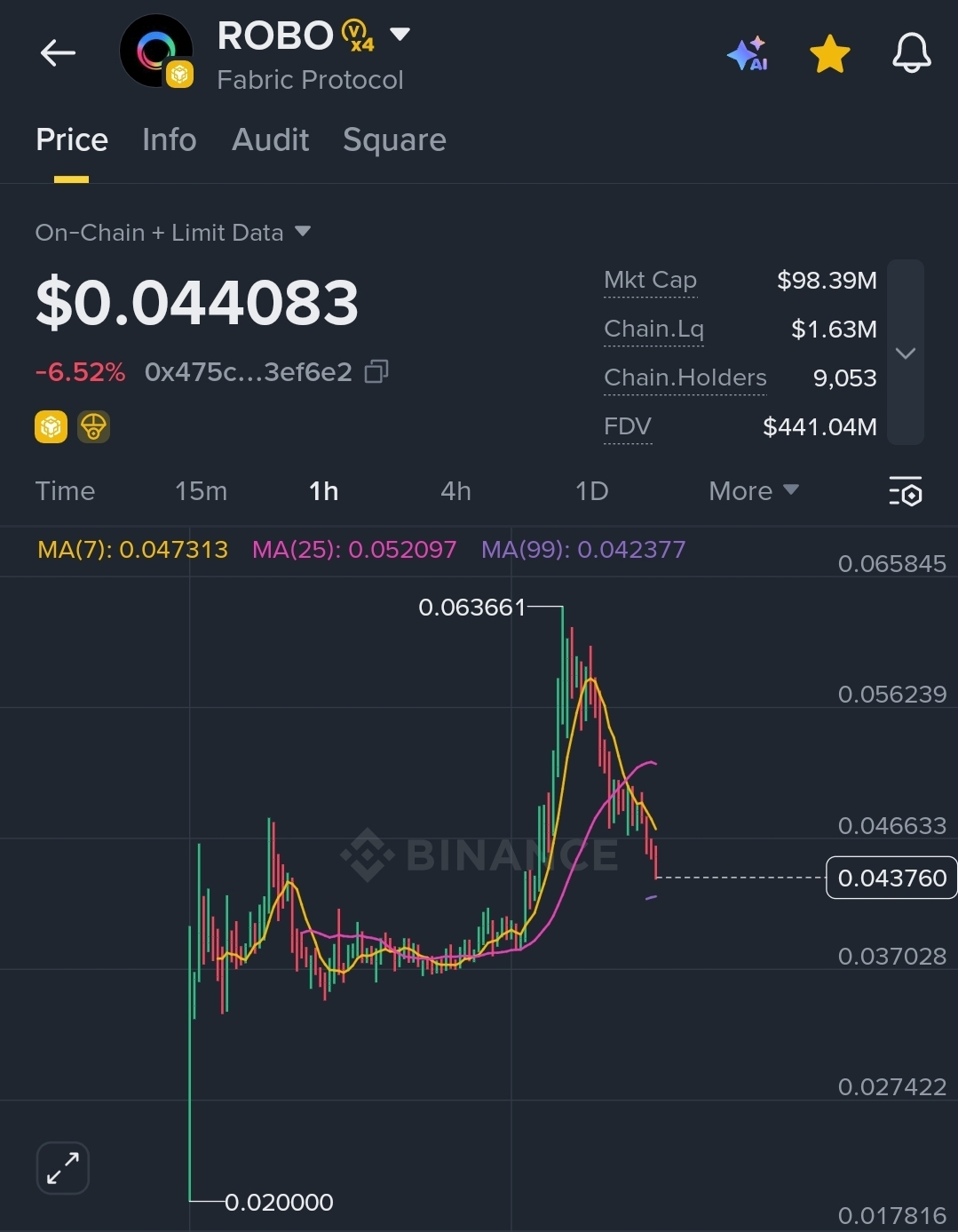
The Current Market Structure: What the Chart Is Saying
Looking at the 1-hour timeframe:
Current price: $0.04408
Recent local high: $0.06366
MA(7): ~0.0473
MA(25): ~0.0520
MA(99): ~0.0423
Market Cap: ~$98M
FDV: ~$441M
On-chain holders: ~9,000+
After pushing aggressively toward the 0.0636 zone, price rejected and entered a controlled pullback phase.
What stands out to me:
Price is now trading below MA(7) and MA(25), confirming short-term bearish momentum.
The pullback is approaching MA(99) around 0.042–0.043, which is acting as dynamic higher timeframe support.
The structure still maintains a higher low relative to the broader base formed around the 0.037–0.038 range.
This is not a collapse. It’s a correction within an expansion cycle.
In momentum-driven markets, the real question isn’t whether a pullback happens — it’s whether support holds and resets structure for continuation.
Right now, the 0.042–0.043 region is technically decisive.
If this level holds:
We could see consolidation.
A volatility compression phase.
A potential higher low formation.
And a reclaim attempt of the 0.052 (MA25) region.
If it fails:
0.037 becomes the next key liquidity zone.
The prior base would be retested.
Sentiment would likely weaken short term.
I’m watching how price behaves at MA(99). Not emotionally — structurally.
Why Fabric’s Model Is Structurally Different
Many AI tokens are narrative-first.
Fabric Protocol feels infrastructure-first.
The protocol coordinates:
Data
Computation
Regulation
Identity
Governance
All through a public ledger architecture that supports verifiable computing and agent-native systems.
That phrase — “agent-native infrastructure” — is key.
Most blockchain systems were designed for:
Financial transfers
Smart contracts
Tokenized assets
Fabric’s design thesis appears to move toward:
Machine coordination
Robotic governance
Collaborative evolution of general-purpose robotics
This is fundamentally different from meme AI tokens that rely on hype cycles.
If robots and autonomous agents are to operate safely in real-world environments, they require:
Verified identity
Tamper-proof audit trails
Programmable compliance
Data integrity
Transparent coordination
A public ledger layer that integrates these primitives is not a trivial concept.
It’s foundational.
Verifiable Computing: The Quiet Backbone
One of the strongest conceptual pillars here is verifiable computing.
As machine systems become autonomous, trust boundaries shift. You’re no longer verifying just transactions — you’re verifying behavior.
Verifiable computation allows:
Proof that a machine executed a task correctly
Proof of state transitions
Proof of model outputs or agent actions
Auditable collaboration between machines and humans
If Fabric can operationalize this at scale, the demand side for token utility becomes structurally embedded — not speculative.
Token flow then connects to:
Network usage
Compute coordination
Governance participation
Staking security
Identity validation
That’s a different demand curve than purely exchange-driven speculation.

On-Chain Metrics and What I Care About
I don’t just watch price.
I look at:
Holder growth
Liquidity stability
Market cap vs FDV gap
Transaction velocity
Volume behavior during pullbacks
With ~9,000+ holders, we’re in early-to-mid distribution phase territory. That’s not mass adoption, but it’s beyond ultra-early stealth phase.
The FDV (~$441M) vs market cap (~$98M) tells me there’s unlock structure to monitor. Token emission schedules always matter.
What I want to see:
Stable holder growth during consolidation
Reduced volatility during pullbacks
Increasing on-chain activity not tied purely to price spikes
Higher lows forming on both price and network metrics
Narratives spike fast. Infrastructure grows slower.
I’m positioning my attention accordingly.
The Psychology of the Pullback
The move from 0.02 to 0.06366 was aggressive. That’s a 3x+ expansion.
Markets do not move in straight lines.
When I see a vertical impulse:
I expect profit-taking.
I expect emotional sellers.
I expect MA compression.
The key is whether this pullback:
Breaks structure
orResets momentum
So far, the structure remains intact unless 0.042 decisively fails.
MA alignment currently:
MA(7) < MA(25)
Price < MA(25)
Short-term bearish.
But MA(99) is still trending upward.
Higher timeframe bias remains constructive until invalidated.
That distinction is critical.
Infrastructure vs Speculation
Crypto historically overvalues:
Speed
Narratives
Influencer attention
Short-term pumps
It undervalues:
Protocol design
Governance mechanisms
Modular scalability
Safety frameworks
Fabric’s focus on safe human-machine collaboration signals long-term orientation.
If robots become integrated into:
Manufacturing
Logistics
Defense
Healthcare
Smart cities
Then governance and coordination layers will matter more than speculative meme velocity.
I’m not saying Fabric has already captured that future.
I’m saying it’s aiming at the right problem space.
And problem selection often determines long-term viability.
Risk Assessment
No analysis is complete without risk framing.
Execution risk:
Building verifiable robotics infrastructure is complex. Delays are possible.
Adoption risk:
Developers must build on it. Enterprises must trust it.
Tokenomics risk:
Unlock schedules and emission pressure could suppress price if demand doesn’t match supply.
Narrative risk:
AI hype cycles rotate quickly. Attention can shift.
Market risk:
Macro volatility affects everything.
I don’t ignore these. I price them mentally.
But I balance them against structural thesis strength.
What I’m Watching Next
Technically:
Reaction at 0.042–0.043
Reclaim of 0.047 (MA7)
Break above 0.052 (MA25)
Volume expansion on green candles
Fundamentally:
Ecosystem integrations
Developer traction
Governance activity
Foundation transparency
Real robotics collaboration pilots
If price consolidates while fundamentals expand, that’s accumulation behavior.
If price pumps without ecosystem growth, that’s narrative behavior.
I prefer the first scenario.
Infrastructure narratives don’t need exaggeration.
They need clarity.
And clarity compounds trust.
My Strategic Outlook
At ~$0.044, we are mid-correction within a broader expansion.
This is not a euphoric breakout zone.
This is a decision zone.
If support holds:
Upside retest of 0.052
Then 0.063 liquidity region
Possible continuation into new discovery
If support breaks:
Reset toward 0.037 base
Longer consolidation
Sentiment cooling phase
Both scenarios are tradable.
Only one maintains bullish structure.
I am not reacting emotionally to red candles.
I am observing structure.
Because infrastructure assets reward patience more than impulse.
The Bigger Picture
We are entering an era where:
AI agents will transact.
Robots will coordinate.
Machines will negotiate.
Systems will require programmable governance.
Public ledgers may become machine-native coordination layers.
If that thesis plays out, protocols that integrate:
Verifiable computing
Modular infrastructure
Agent identity
Governance primitives
will sit at a strategic junction.
Fabric Protocol is positioning itself at that junction.
That doesn’t guarantee dominance.
But it makes it worth studying.

Final Thoughts
Most people chase volatility.
I track structure.
Most people follow headlines.
I follow coordination layers.
Right now, $ROBO is at a technical inflection point near MA(99).
Fundamentally, it’s targeting one of the most complex but high-impact intersections in crypto: robotics + blockchain + verifiable computation.
That combination is not trivial.
It’s ambitious.
And ambitious infrastructure — when executed well — can outlast cycles.
My focus remains:
Data over emotion
Adoption over hype
Structure over noise
I’m watching how support behaves.
I’m watching how the ecosystem evolves.
I’m watching how network metrics expand.
Because in the long run, real value forms quietly — inside infrastructure.
And the market eventually catches up.