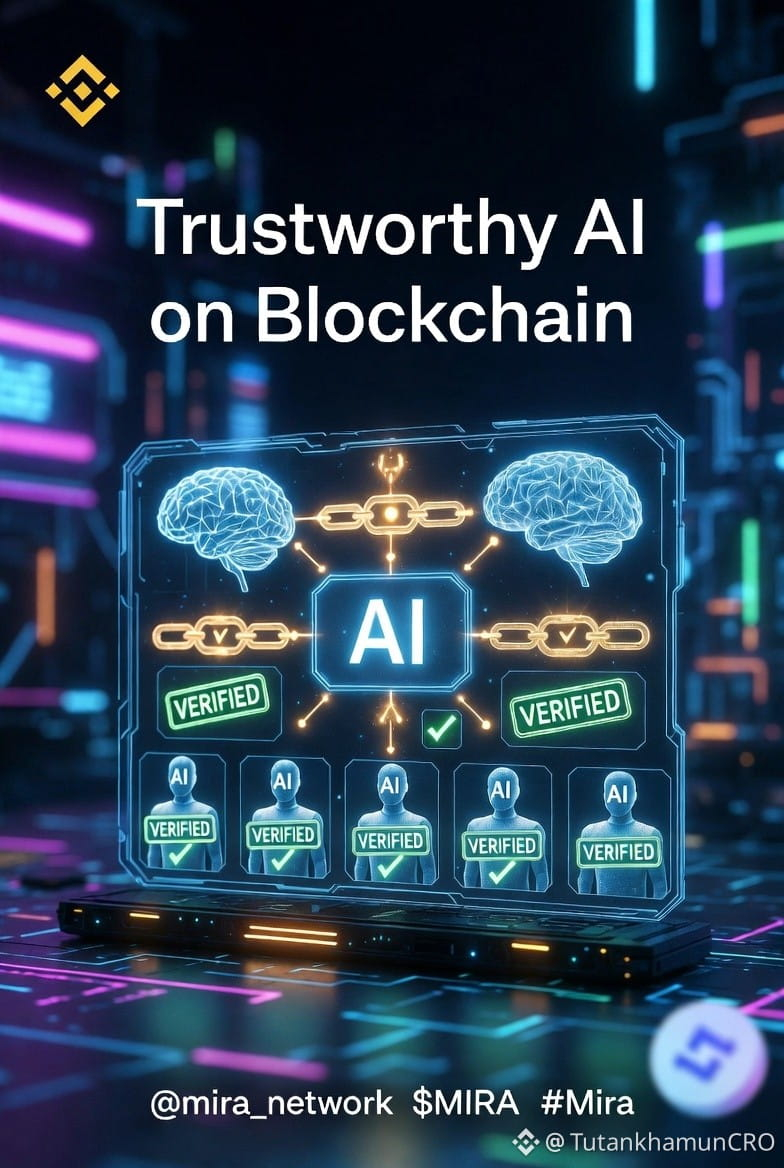
In the rapidly evolving landscape of artificial intelligence, one persistent challenge stands out: trust. How can we rely on AI outputs when models can hallucinate, bias creeps in, or malicious actors tamper with results? Enter Mira Network, a groundbreaking decentralized platform that's revolutionizing AI reliability through blockchain technology and collective intelligence. As someone passionate about the intersection of AI and crypto, I've been closely following Mira's developments, and today, I want to share why this project is poised to become a cornerstone of the Web3 AI ecosystem.
At its core, Mira Network addresses the "black box" problem of AI by creating a trustless verification system. Instead of depending on a single AI model or centralized authority, Mira leverages a network of diverse Large Language Models (LLMs) to cross-verify outputs and actions. This collective intelligence approach ensures that AI responses are accurate, unbiased, and tamper-proof. By integrating cryptoeconomic primitives—like staking and penalties—Mira incentivizes honest participation while deterring bad actors. The result? Fully autonomous AI systems that don't require constant human oversight, making them ideal for high-stakes applications in finance, healthcare, and beyond.
One of Mira's standout features is its flagship app, Klok—the world's first trustless multi-LLM chat app. With Klok, users can interact with top AI models while earning rewards in $MIRA tokens. It's not just a chat tool; it's a gateway to verifiable AI, where every interaction contributes to the network's security and reliability. Imagine chatting with AI for research or creativity, knowing that the responses are collectively validated by the community. This app alone demonstrates Mira's practical utility, bringing verifiable AI to millions of users right now.