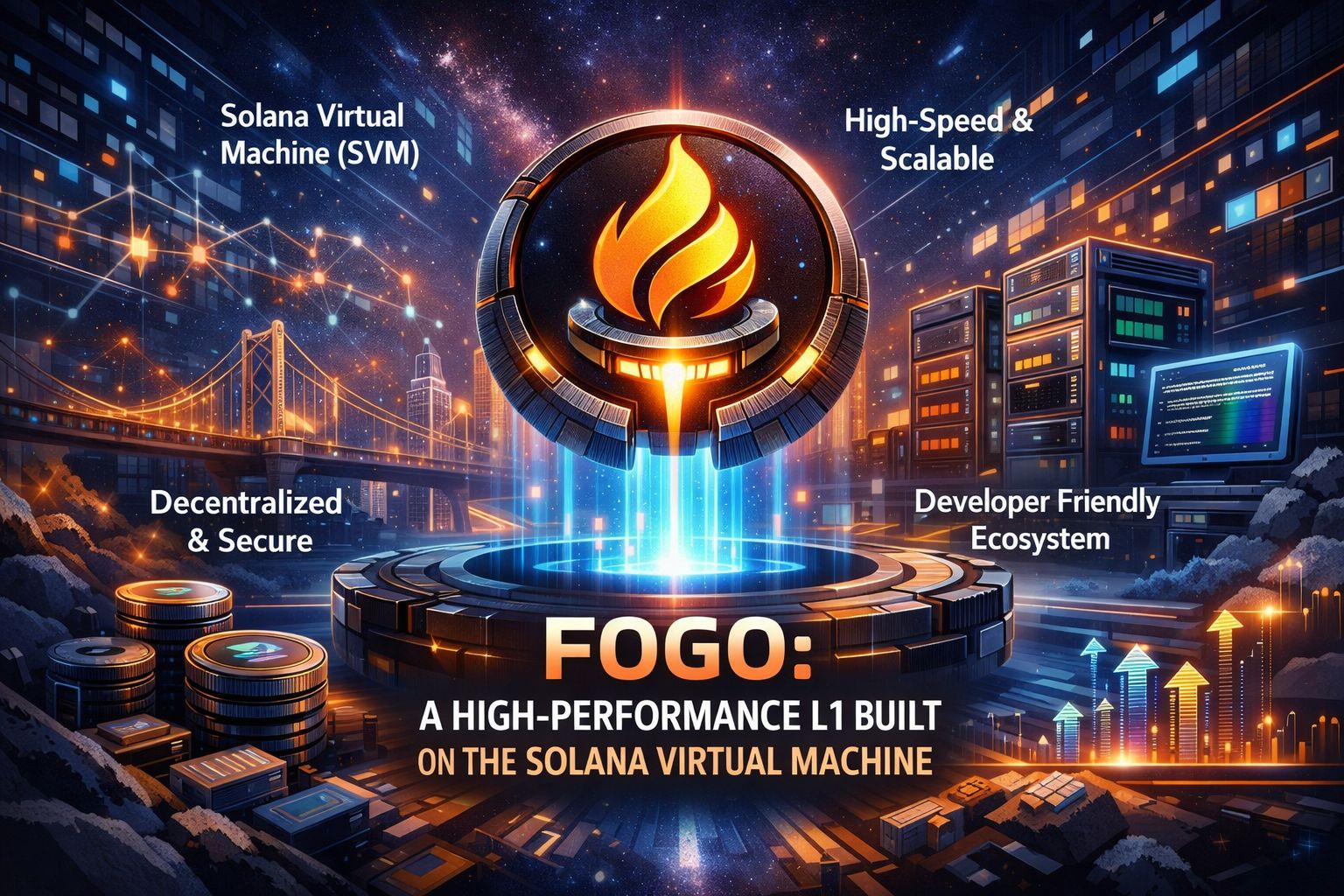
In the world of blockchain, every new Layer 1 seems to arrive with a familiar promise: faster speed, lower cost, and better scalability. But behind those promises, the real question is always deeper — can a network actually support real applications, real users, and real economic activity without breaking down? This is where Fogo becomes interesting, because it approaches performance not as a marketing claim, but as an architectural decision through the use of the Solana Virtual Machine.
At a high level, Fogo is a high-performance Layer 1 blockchain designed to run applications efficiently while maintaining the openness and decentralization that public networks aim for. Its defining feature is that it utilizes the Solana Virtual Machine (SVM), which is known for its parallel execution model and strong throughput capabilities. Instead of reinventing everything from scratch, Fogo builds on an execution environment that has already proven itself under heavy load.
To understand why this matters, it helps to step back and look at the broader problem blockchains still face. Many networks struggle with the same core tension: decentralization, security, and scalability are difficult to optimize at the same time. When usage grows, transaction fees rise, confirmation slows, and the user experience becomes frustrating. This has limited blockchain adoption beyond niche communities, especially in areas like gaming, payments, and real-time digital services.
Fogo’s design seems rooted in the idea that performance is not optional anymore. Modern applications require blockchains that can behave more like traditional infrastructure — responsive, predictable, and capable of handling large bursts of activity. If a chain cannot support thousands of users interacting simultaneously, developers will simply choose other platforms, even if they believe in decentralization philosophically.
This is where the Solana Virtual Machine plays an important role. The SVM differs from environments like the Ethereum Virtual Machine by allowing parallel transaction execution. Instead of processing transactions one by one in strict order, the SVM can run multiple non-conflicting transactions at the same time. This architectural difference is subtle, but it changes the scalability ceiling significantly.
By adopting the SVM, Fogo inherits a model that is naturally optimized for throughput. This could make it suitable for applications that need speed — such as decentralized exchanges, high-frequency NFT activity, consumer apps, or blockchain-based games. In these contexts, even small delays or high fees can ruin the experience, so execution efficiency becomes central.
Beyond execution, a Layer 1 must also think carefully about its broader architecture. Performance chains often rely on optimized validator communication, fast block production, and efficient state management. While technical specifics may evolve, the guiding principle is clear: reducing unnecessary bottlenecks while still keeping the network verifiable and open.
Another important layer is developer experience. One advantage of using the SVM is compatibility with an existing ecosystem of tools, programming models, and developer knowledge. Builders who are already familiar with Solana-based development may find it easier to deploy or experiment on Fogo. In blockchain, reducing friction for developers is often just as important as improving raw speed.
Interoperability is also becoming increasingly necessary. No blockchain exists in isolation anymore. Users hold assets across multiple chains, and applications often require cross-chain liquidity and messaging. If Fogo is able to integrate smoothly with bridges, cross-chain standards, or multi-chain tooling, it could strengthen its role as part of a broader interconnected ecosystem rather than a standalone competitor.
Token economics, if applicable within Fogo’s model, will also matter deeply. A Layer 1 token typically plays multiple roles: paying transaction fees, securing the network through staking, and aligning incentives between validators and users. The challenge is always balance — fees must remain low enough for usability, but rewards must be sufficient to maintain decentralization and validator participation.
One of Fogo’s strengths is its clear positioning: it does not attempt to be everything at once, but instead focuses on performance through an established execution framework. This kind of clarity can help ecosystems grow faster, because developers and users understand what the chain is optimized for.
However, it is also important to remain realistic. High-performance chains often face challenges around decentralization, hardware requirements, and long-term resilience. Faster execution can sometimes mean validators need stronger infrastructure, which may reduce accessibility. Networks like Fogo will need to show that performance does not come at the cost of openness.
There is also the broader question of differentiation. Many Layer 1s are competing in the same space, and technical strength alone does not guarantee adoption. Ecosystem growth depends on developer communities, application traction, and trust built over time. Fogo’s future will depend not only on architecture, but on whether meaningful applications choose to live there.
Still, the direction is thoughtful. Building with the Solana Virtual Machine suggests a willingness to learn from what already works, rather than endlessly reinventing execution environments. If Fogo can combine speed, usability, and sustainable decentralization, it could become a meaningful platform for the next generation of blockchain applications.
In the end, what makes projects like Fogo worth watching is not just the promise of faster transactions, but the deeper question they represent: can blockchain finally feel normal for everyday users? Not perfect, not magical — just reliable, accessible, and real. And perhaps that is the quiet goal behind performance-focused Layer 1s: not to impress, but to finally support the kind of simple experiences that make adoption possible.
@Fogo Official #fogo $FOGO #Fogo