

She wakes to a curated reality. The headlines she sees have been selected by an algorithm trained on millions of clicks, optimized not for truth but for outrage. The music recommended to her arrives via a model that learned her preferences by ingesting her private listening history, then selling those insights to advertisers. The map directing her commute displays routes influenced by sponsored locations she will never identify. She does not pay for these services with currency. She pays with something far more precious: her autonomy.
This is the hidden architecture of the modern internet. We have surrendered the very infrastructure of thought and discovery to a handful of corporations whose primary innovation has been the extraction of human attention and its repackaging as prediction. Artificial intelligence, the most transformative technology of our era, has become a private monopoly. Its models are trained on our collective expression, our photographs, our conversations, our creative works, yet the resulting intelligence remains locked behind corporate firewalls, accessible only on terms designed to maximize shareholder returns. We have collectively built the library of Alexandria and handed the keys to a landlord.
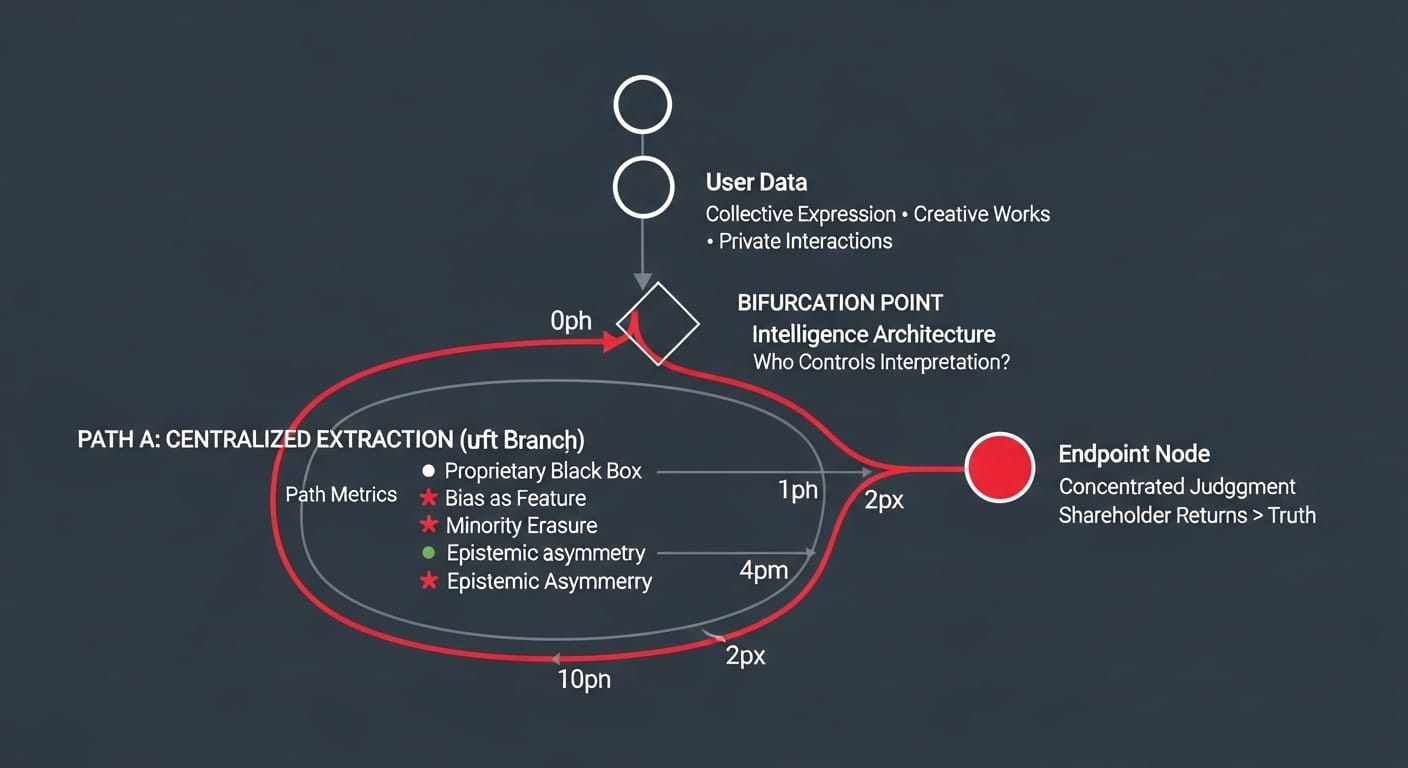
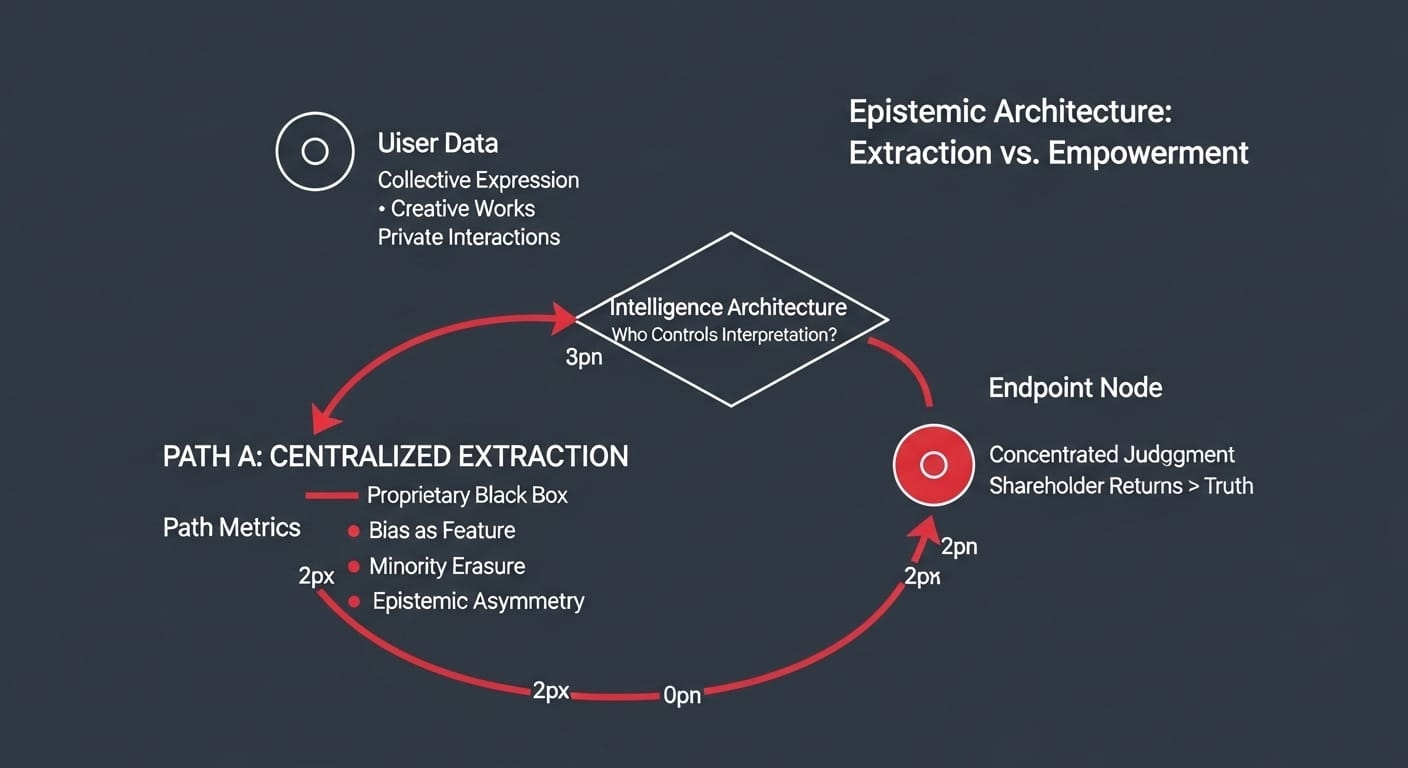
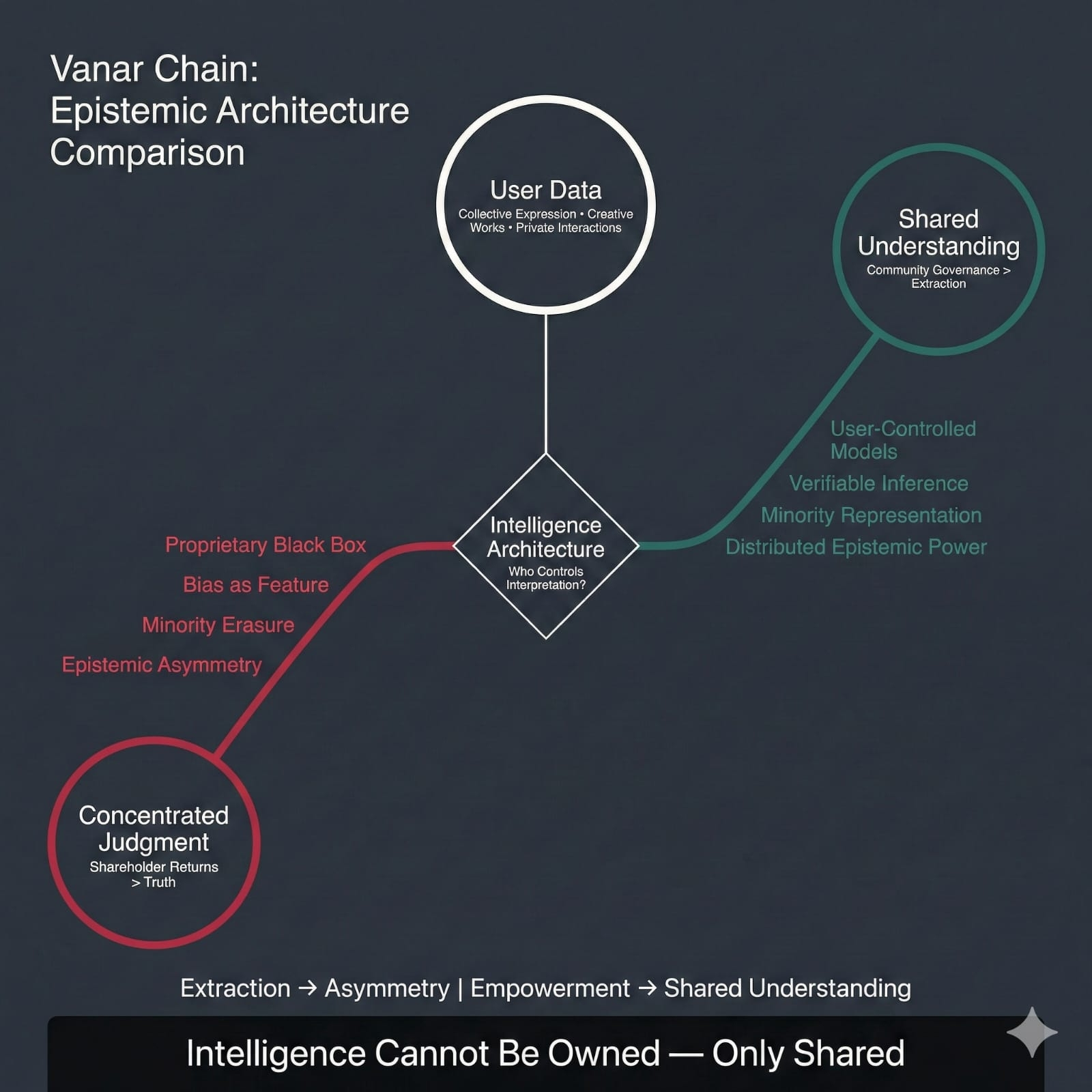
The tragedy is not merely economic, though the concentration of wealth this enables is staggering. The deeper wound is epistemic. When a small group determines what knowledge is surfaced and what is suppressed, which voices are amplified and which are silenced, we have not simply outsourced computation. We have outsourced judgment. The algorithms that now mediate our access to information, opportunity, and each other operate as black boxes, their criteria proprietary, their failures unaccountable. Bias is not a bug in these systems; it is a feature of their ownership.
Consider the translator who relies on automated tools to communicate with clients abroad. The model she uses was trained predominantly on English and Mandarin text, rendering her native language an afterthought. When she translates technical documents, the terminology distorts. When she conveys emotion, the nuance vanishes. She is told this is the cost of progress. In truth, it is the cost of centralization. An intelligence designed for the majority will always fail the minority. A model optimized for profit will never prioritize preservation.
Consider the smallholder farmer in a developing nation seeking access to agricultural credit. The lending algorithms that might evaluate his eligibility are trained on data from vastly different contexts, rendering his operation invisible. He does not appear in the datasets, so he does not exist to the models. His potential is not assessed; it is erased. He is told the future is automated. He is not told that automation without representation is merely exclusion at scale.
Consider the community historian archiving oral traditions in a region without reliable electricity. She has heard that blockchain can preserve her work against the erosion of time and political instability. But the tools she encounters demand connectivity she cannot guarantee, fees she cannot afford, and technical literacy her elders do not possess. The promise of permanence is conditional upon participation in a system designed for wealthier, better-resourced users. Her culture will be remembered only if it first adapts to someone else's infrastructure.
These are not separate problems. They are symptoms of a single failure: the belief that intelligence can be owned. We have accepted a model in which the means of understanding are concentrated in the same hands that have historically concentrated wealth and power. We have mistaken corporate efficiency for technological inevitability. We have forgotten that every algorithm encodes the values of its creators and that those values, when unchallenged, become invisible ceilings on human possibility.
This is why the emergence of decentralized, user-owned intelligence infrastructure is not merely a technical alternative but a moral imperative. A blockchain designed with native semantic capabilities offers something unprecedented: the ability to distribute not only data but the capacity to interpret it. When intelligence is embedded at the protocol level, it becomes a public utility rather than a private commodity. When models are trained on verifiable, user-controlled data, they reflect the diversity of human experience rather than the priorities of advertisers. When inference occurs on open networks, accountability is encoded rather than evaded.
This shift reimagines the relationship between individuals and the systems that serve them. Your digital footprint ceases to be raw material for someone else's product and becomes the foundation for your own personalized, private intelligence. Your creative works contribute to models you collectively govern, their outputs benefiting the communities that produced them rather than distant shareholders. Your identity remains under your control, verified cryptographically rather than surveilled behaviorally.
The implications extend far beyond technical efficiency. They touch the core of what it means to participate in a digital society. When intelligence is decentralized, the barriers to entry for innovation collapse. A developer in Lagos can build a weather prediction model trained on local sensor data without seeking permission from a Silicon Valley platform. A cooperative of artists can train a style transfer model on their collective portfolio, licensing its use to fund their community studio. A indigenous language preservation project can create a translation model that actually understands the grammatical structures of their tongue, not merely approximating them through statistical pattern matching.
This is not utopian speculation. The foundational infrastructure for this future is already operational, its capabilities expanding with each protocol upgrade. The chain designed for semantic understanding was never merely about optimizing financial transactions. It was always, at its deepest level, about rebalancing the epistemic asymmetry that has defined the internet era. It was about ensuring that the capacity to know, to predict, to create, and to decide is not hoarded but shared.
We stand at a crossroads not unlike the early days of the printing press. That technology, too, was initially captured by established powers who recognized its potential to disrupt their monopoly on knowledge. But the press ultimately prevailed as a democratizing force because its fundamental architecture was decentralized. Anyone with access to the machine could become a publisher. The liberation of intelligence requires the same condition: not merely access to the outputs of centralized models but ownership of the means of understanding.
The choice before us is stark. We can continue down the path of convenience purchased with autonomy, our collective intelligence enclosed within corporate walls. Or we can build a different path, one where the power to understand is distributed as widely as the power to transact. One where the blockchain that thinks is owned by the billions who contribute to its knowledge. One where the future of intelligence is not a luxury for the few but a birthright for all.
This is the promise carried forward by those who refused to accept that centralization was inevitable. This is the infrastructure being laid, block by block, by a team that understood that the most revolutionary application of blockchain was not faster settlement but broader enlightenment. This is the invitation extended to every builder, creator, and dreamer who has looked at the current internet and asked not "How do I succeed within it?" but "How do I transcend it?"
