
If you’ve spent any time around L1 marketing, you start to hear the same promises on repeat: faster blocks, cheaper gas, “built for mass adoption.” Vanar feels different when you look at what they’re actually pushing right now, because the story isn’t really “we’re a faster chain.” It’s more like: we want the chain to behave like a brain that can remember and reason so real products don’t collapse under their own complexity.
That shift shows up in the way Vanar describes its stack today: a base L1 plus Neutron (semantic memory), Kayon (reasoning), and then Axon/Flows as the automation + application layers. In plain terms, they’re trying to move from “a place to settle transactions” to “a place where apps can store meaning and make decisions without rebuilding half the world off chain.” 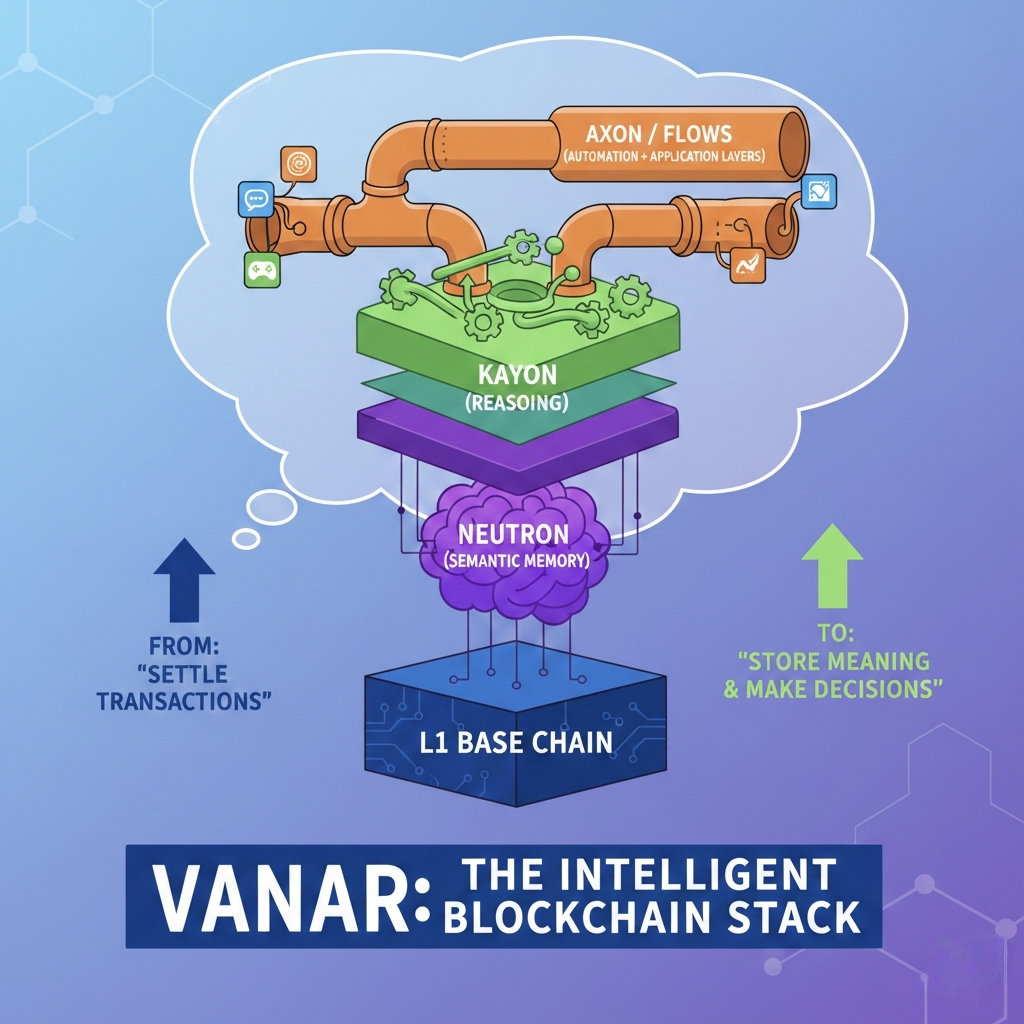
The part that makes this feel more than branding is the latest push around Neutron as an actual developer-facing memory API not just a concept. In the last few days, Vanar’s Neutron console has been positioning itself as “AI ready memory for OpenClaw agents,” with details that sound like someone sat with builders and asked what breaks in real agent products: persistent memory across channels, semantic search in sub-200ms, multimodal embeddings, multi tenant isolation, and an API that stores and queries “Seeds” like a memory store rather than a traditional file system.
This matters because agents without memory are basically goldfish with a to-do list. They can be impressive for a single session, but they don’t compound. The moment an agent restarts, gets redeployed, or has to operate across WhatsApp + Discord + Slack, it starts asking the same questions again, and users bounce. Vanar’s angle here is simple (and honestly pretty human): let the agent be disposable; let the memory survive the agent. That’s a cleaner mental model than “pin files and pray your pointers never die.”
Zooming out, Neutron’s bigger promise is that data isn’t just stored it’s made “active.” Vanar describes Neutron as compressing and restructuring data into programmable, verifiable “Seeds,” meant for agents, apps, and AI. That’s a very specific bet: most chains are great at proving “something happened,” but weak at proving “what this means” without relying on off-chain databases and middleware. If Neutron really becomes the default place where “meaningful objects” live (invoices, receipts, identity proofs, game state, compliance docs), Kayon becomes the natural next step: logic that can query and reason over those objects inside the stack.
Now, because you asked for on-chain relevance not just narrative here are two “reality checks” that I think keep the discussion honest:
On Ethereum, the ERC-20 VANRY token contract shows a capped max total supply of 2,261,316,616 VANRY, around 7,481 holders, and 107 transfers in the last 24 hours (at the time of capture), with Etherscan also displaying an on chain market cap figure around $14.18M.
That footprint says “still early distribution” more than “fully matured consumer network,” which is fine but it also means the ecosystem story has to be earned through usage, not vibes.
On Vanar’s own mainnet explorer, the network is showing 193,823,272 total transactions and 28,634,064 wallet addresses (plus network utilization displayed at 22.56% on the landing view).
Even if you treat any single metric cautiously, that’s the kind of scale signal you look for when a chain claims it’s built for consumer-like throughput.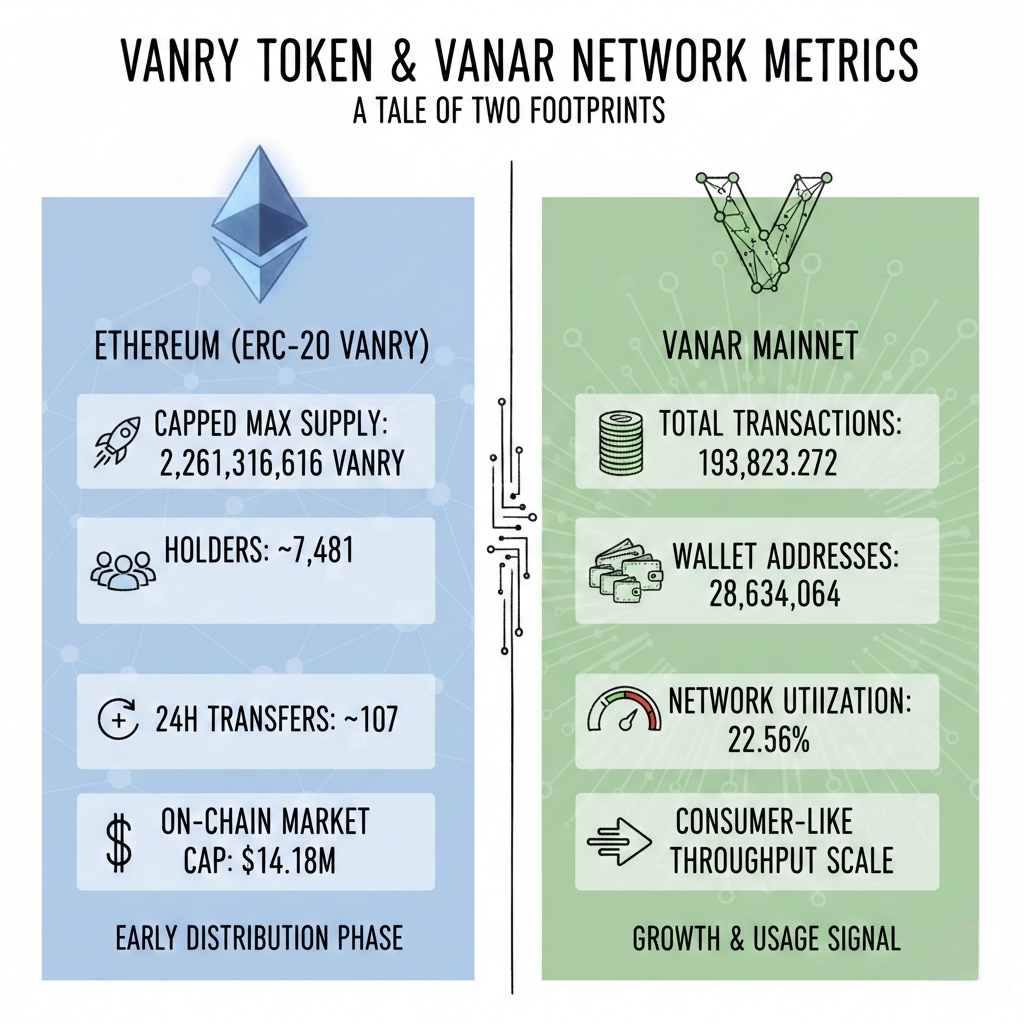
Where does VANRY fit into all of this in a way that doesn’t sound like a brochure? I think it becomes easiest to understand VANRY as “the resource that keeps the machine running” rather than “the thing you speculate on.” Gas and staking are the baseline (obviously), but the more interesting angle is what happens if Neutron/Kayon-style features become genuinely used infrastructure: you don’t just pay for blockspace, you pay for state that stays useful memory that can be searched, reused, and built on. That’s the difference between paying for a receipt printer and paying for an accounting system.
Vanar Neutron is trying to turn blockchain storage from “proof that something existed” into “memory you can actually use.” Instead of leaving apps with a hash and a hope, Neutron’s “Seed” approach is positioned as compact, verifiable, AI readable data that agents and applications can store, search, and build on without constantly bouncing off-chain for context. That’s why the Neutron push feels like a real update rather than another AI tagline it’s aimed at the unglamorous pain point builders hit every day: keeping context alive across users, sessions, and products in a way that stays auditable.
Vanar is betting that the next wave of adoption won’t come from louder narratives, but from infrastructure that quietly makes real products feel effortless.
