
I still remember the moment it hit me not during some flashy demo or whitepaper scroll, but while watching a routine USDT transfer on a "fast" chain crawl through congestion. The sender had to bridge, swap for native gas, approve, wait for confirmations, and pray no sandwich bot ate the edge. By the time it landed, the price had moved enough to make the whole thing feel pointless. I closed the tab and thought: we're building rockets, but still forcing people to carry their own fuel cans.

That small friction isn't just annoying it's structural. In 2026, when everyone talks about on-chain everything (DeFi settlements, RWAs tokenization, automated treasuries), the quiet killer isn't throughput numbers or TPS leaderboards. It's who actually ends up deciding what gets to move freely. Speed is table stakes now. Neutrality in how fees get handled? That's the real power shift hiding in plain sight.
Look at what happens when blockspace starts feeling "free." Automation floods in first bots, keepers, high-frequency strategies because humans tolerate pain longer. We've seen it on testnets: millions of transactions while fees stay noise-level. But free doesn't stay free forever. Someone sponsors that gas. Someone chooses which flows are worth subsidizing. And once sponsorship becomes curated by issuers, apps, or institutions neutrality quietly erodes. Not through overt censorship, but through selective absorption. Some traffic gets the red-carpet treatment. Others wait in the cold.
That's the fork in the road that keeps me up at night. If gas sponsorship collapses into a handful of default gatekeepers deciding what's "valuable" enough to settle, we don't get crypto-fast money anymore. We get card rails on-chain: convenient, fast, but ultimately permissioned under the hood. The dream of open, neutral settlement layers dies not with a bang, but with a sponsored whitelist.
I won't lie when I initially saw Fogo being compared to Solana and similar fast L1 chains, my first instinct was eye-roll. Another SVM contender chasing sub-second blocks? We've heard that song before. But the more I dug, the more Plasma-like echoes stuck with me. It's not really about raw speed, or EVM compatibility, or even stablecoins per se. It's about who quietly ends up in charge of the rails.
Fogo isn't screaming grand visions of AGI or infinite scalability. It's quietly engineering survival-level neutrality into the base layer. Gasless USDT transfers? Gas paid in stablecoins? That's not UX polish it's removing the user from the fee equation entirely. Fees don't vanish; they get absorbed. And by making sponsorship protocol-level and open (dApps can underwrite, compete on price, fail openly), Fogo pushes toward a genuinely market-driven settlement layer rather than curated benevolence.
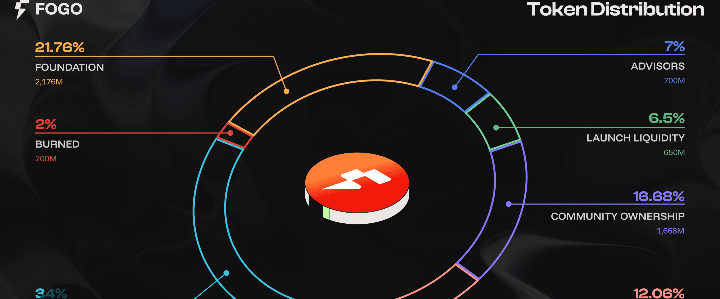
Recent mechanics show it in action. Mainnet live since January, consistently hitting 40ms block times, sub-second finality, and real throughput that tops independent trackers. Testnet already pushed millions of tx while fees stayed negligible automation rushed in, as expected. Bitcoin anchoring adds hard guarantees on finality and reorg resistance. But the softer, more dangerous problem curated sponsorship eroding neutrality is addressed head-on by design choices: curated-but-permissionless validator set for performance, gas sponsorship via dApps and ecosystem mechanisms, enshrined tools like native price feeds and colocated liquidity to reduce hidden taxes.
In my eyes, this isn't another "faster Solana." It's an anti-narrative play: tool-first, governance-minimal, focused on keeping the fork toward open markets rather than default sponsors. If sponsorship stays competitive anyone underwrites, competes, fails Fogo becomes the settlement layer crypto was supposed to deliver. If it collapses? We get prettier TradFi.
Philosophically, this resonates deeper. Human progress has always depended on neutral infrastructure that doesn't pick winners in advance open roads, public libraries, permissionless protocols. When fees become absorbed but not neutrally, we lose that. Every subsidized flow adds dignity to the system only if the absorption mechanism respects openness. Otherwise, cracks form, and gold isn't poured in; it's gatekept.
The market realism is brutal right now. $FOGO sits in the $0.02 range, volume respectable but not explosive, price action "lying flat" after the post-mainnet hype fade. Retail confidence worn thin no narrative fireworks, no meme momentum, no get-rich-quick bait. It's physiological torture for short-term holders: punishment for lacking storytelling in a market that still rewards it. Bear phases expose who built for endurance.
But here's the contrarian flip I can't shake: this is classic infra-phase pain. Deep refinement under low attention. Developer stickiness comes from path dependency once apps build for 40ms determinism, migrating away hurts. Usage-burn mechanics (if sponsorship scales via ecosystem underwriting) compound quietly. No reliance on hype cycles means resilience when others crack. Long-term bet isn't on narrative; it's on who captures real economic flows when automation dominates.
In 2026, whoever can make settlement layers truly neutral absorbing fees without picking winners will hold the ticket to the future. Not the fastest toy chain, but the one where open markets still decide value.
What part of this neutrality bet resonates most with you? Are you seeing the same fork in other chains?
