When people hear “SVM Layer 1,” they usually assume the same template. High throughput. Big TPS numbers. Bold marketing aimed at traders.
Fogo does sit in that category on the surface. It builds on Solana’s architecture and talks openly about performance. But if you look closely, the real story is not about raw speed. It is about designing a blockchain the way you would design a professional trading venue.
That is a different mindset entirely.
Fogo starts with a blunt question: if on-chain finance wants to compete with real markets, why do we tolerate loose timing, unpredictable latency, and uneven validator performance? In traditional trading infrastructure, geography, clock synchronization, and network jitter are not footnotes. They are the foundation.
Fogo treats them that way.
The new narrative is not speed. It is coordination. Time, place, clients, and validators aligned so that markets behave like markets instead of noisy experiments.
Latency Is Not a Feature. It Is a System Constraint.
In crypto, latency is often marketed as a competitive edge. A chain shaves off milliseconds and presents it as a headline number.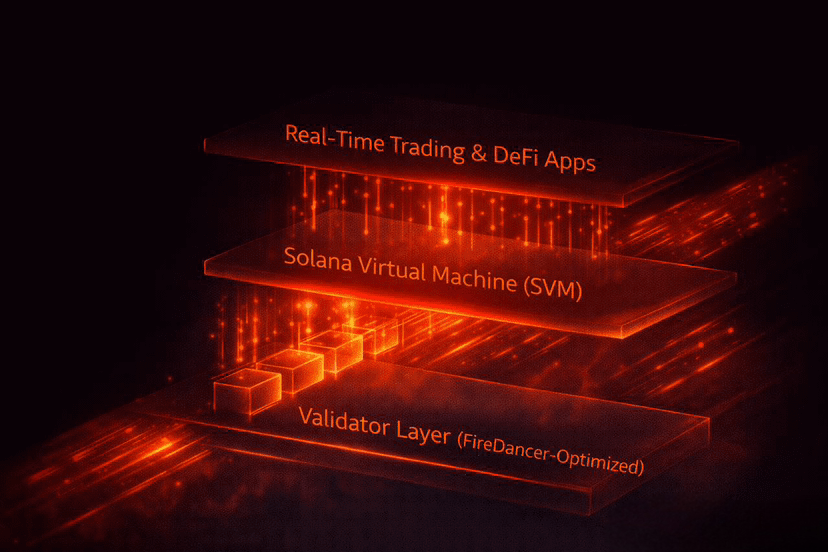
Fogo approaches latency differently. It treats it as a structural constraint that must be managed across the entire system.
If you want on-chain order books, real time auctions, tight liquidation windows, and reduced MEV extraction, you cannot simply optimize execution. You must optimize the entire pipeline.
That includes clock synchronization, block propagation, consensus messaging, and validator coordination. The execution engine alone is not enough.
Fogo’s thesis is that real time finance requires system level latency control. It does not build a generic chain and hope markets adapt. It designs the chain so that markets can function cleanly from the start.
That is the shift. Instead of asking how fast the chain is, Fogo asks how well the whole system coordinates.
Built on Solana, Interpreted Through a Market Lens
Fogo does not reinvent everything. It builds on the Solana stack and keeps core architectural elements that already work.
It inherits Proof of History for time synchronization, Tower BFT for fast finality, Turbine for block propagation, the Solana Virtual Machine for execution, and deterministic leader rotation.
That matters because these components address common pain points in high performance networks. Clock drift, propagation delays, and unstable leader transitions are not theoretical issues. They create real distortions in markets.
Fogo’s message is not “we are Solana.” It is “we start with a time synchronized, high performance foundation and then optimize the rest around real time finance.”
This reduces the need to solve already solved problems. It allows Fogo to focus on refining the parts that directly affect trading behavior.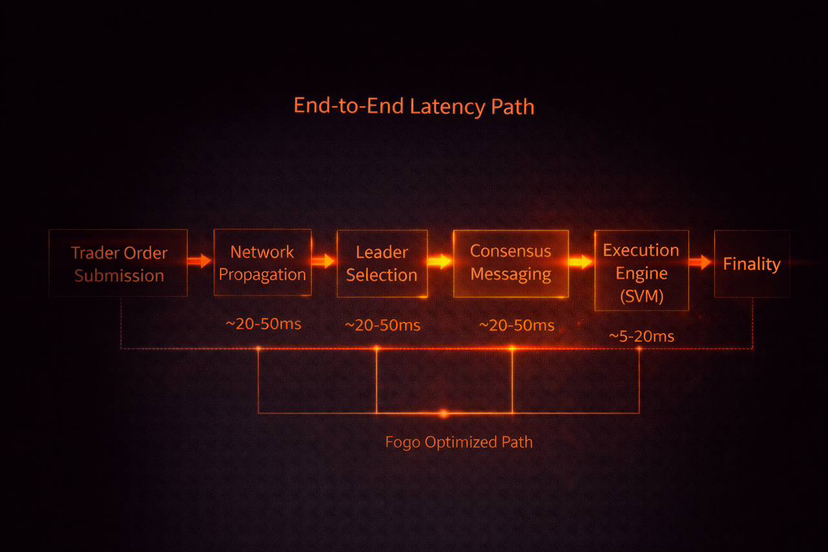
A Radical Decision: One Canonical Client
One of Fogo’s most controversial design choices is its preference for a single canonical validator client, based on Firedancer, rather than maintaining multiple equally valid client implementations.
In theory, client diversity reduces systemic risk. In practice, it can reduce performance to the speed of the slowest implementation.
Fogo argues that if half the network runs a slower client, the entire chain inherits that ceiling. For a general purpose network, that tradeoff might be acceptable. For a market oriented chain, it becomes a bottleneck.
The exchange analogy is obvious. A professional trading venue does not run five matching engines with different performance characteristics for philosophical balance. It runs the fastest and most reliable one.
Fogo takes a similar stance. Standardize on the most performant path. Treat underperformance as an economic cost, not as an abstract diversity benefit.
The roadmap acknowledges practical migration. It starts with hybrid approaches and gradually transitions toward a pure high performance client. That suggests operational realism rather than theoretical purity.
Multi Local Consensus: Geography as a First Class Variable
Perhaps the most distinctive architectural concept in Fogo is its multi local consensus model.
Instead of assuming validators are randomly scattered across the globe, Fogo embraces physical proximity as a performance tool. Validators can be co located in a defined geographic zone to reduce inter machine latency to near hardware limits.
This has direct market implications. Faster consensus messaging reduces block time. Shorter block times reduce the window for strategic gaming, latency arbitrage, and certain forms of MEV exploitation.
But co location introduces another risk: jurisdictional capture and geographic centralization.
Fogo’s response is dynamic zone rotation. Validator zones can rotate between epochs, with the location agreed upon in advance through governance. This allows the network to capture the performance benefits of proximity while preserving geographic diversity over time.
In simple terms, co locate to win milliseconds. Rotate to preserve decentralization.
That is not a generic L1 narrative. It reads more like infrastructure planning for a global exchange.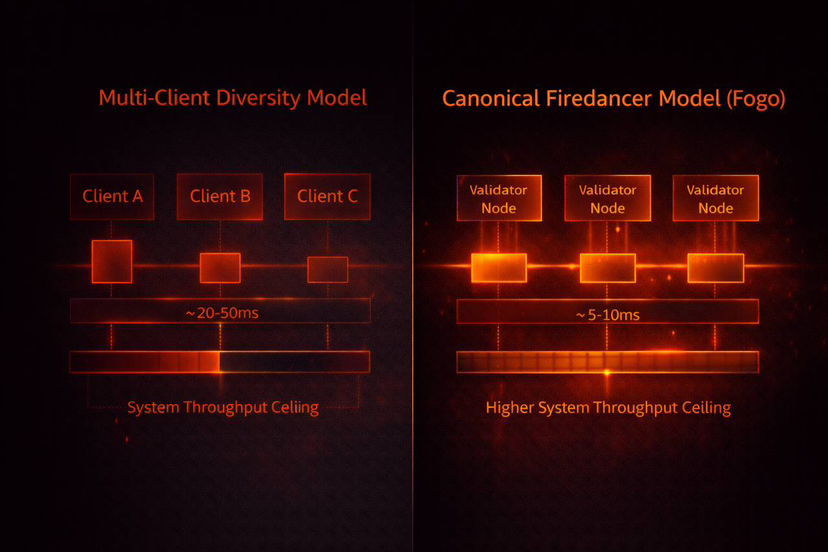
Curated Validators: Performance as a Requirement
Another non standard decision is the use of a curated validator set.
In fully permissionless systems, anyone can join as a validator with minimal barriers. While this maximizes openness, it can also degrade performance if underprovisioned or poorly managed nodes participate in consensus.
Fogo introduces stake thresholds and operational approval processes to ensure validators meet performance standards.
This challenges crypto culture. Permissionless participation is often treated as sacred.
Fogo’s counterargument is straightforward. If the network is intended to support market grade applications, operational capability cannot be optional. Poorly configured hardware or unstable infrastructure affects everyone.
The documentation also references social layer enforcement for behavior that is hard to encode in protocol rules. That includes removing consistently underperforming nodes or addressing malicious MEV practices.
This is an adult admission. Not every problem in market infrastructure is purely technical. Some require governance and human judgment.
Traders Care About Consistency, Not Slogans
Engineers may debate architecture. Traders care about three simpler things.
Consistency.
Predictability.
Fairness.
Consistency means the chain behaves the same under load as it does in quiet periods.
Predictability means your order execution is not randomly altered by network instability.
Fairness means you are not constantly paying hidden taxes to bots exploiting latency gaps.
Fogo’s architectural decisions map directly onto these concerns.
Co location reduces latency windows.
A canonical high performance client reduces uneven execution.
Curated validators reduce operational drag.
The marketing language about friction tax and bot tax aligns with the technical choices. That coherence is rare in crypto, where narratives and infrastructure often diverge.
Fogo’s Larger Bet: Markets First, Blockchain Second
At its core, Fogo is not trying to be another general purpose smart contract platform. It is positioning itself as market infrastructure.
That distinction matters.
A general chain optimizes for broad compatibility, experimentation, and decentralization as an end in itself. A market oriented chain optimizes for time synchronization, deterministic behavior, and predictable coordination.
Fogo’s worldview can be summarized simply.
A blockchain meant for real time markets must act like a coordinated system, not a loose bulletin board.
It needs synchronized clocks.
It needs fast and stable propagation.
It needs predictable leader behavior.
It needs performance oriented clients.
It needs validator standards that protect user experience.
You may disagree with some of these tradeoffs. But they form a coherent thesis.
If Fogo succeeds, the measure of success will not be a TPS number. It will be that developers stop designing around chain weakness.
Order books will feel tighter.
Liquidation engines will feel precise.
Auctions will behave predictably.
And users will not talk about the chain. They will talk about execution quality.
In markets, that is the only metric that ultimately matters.