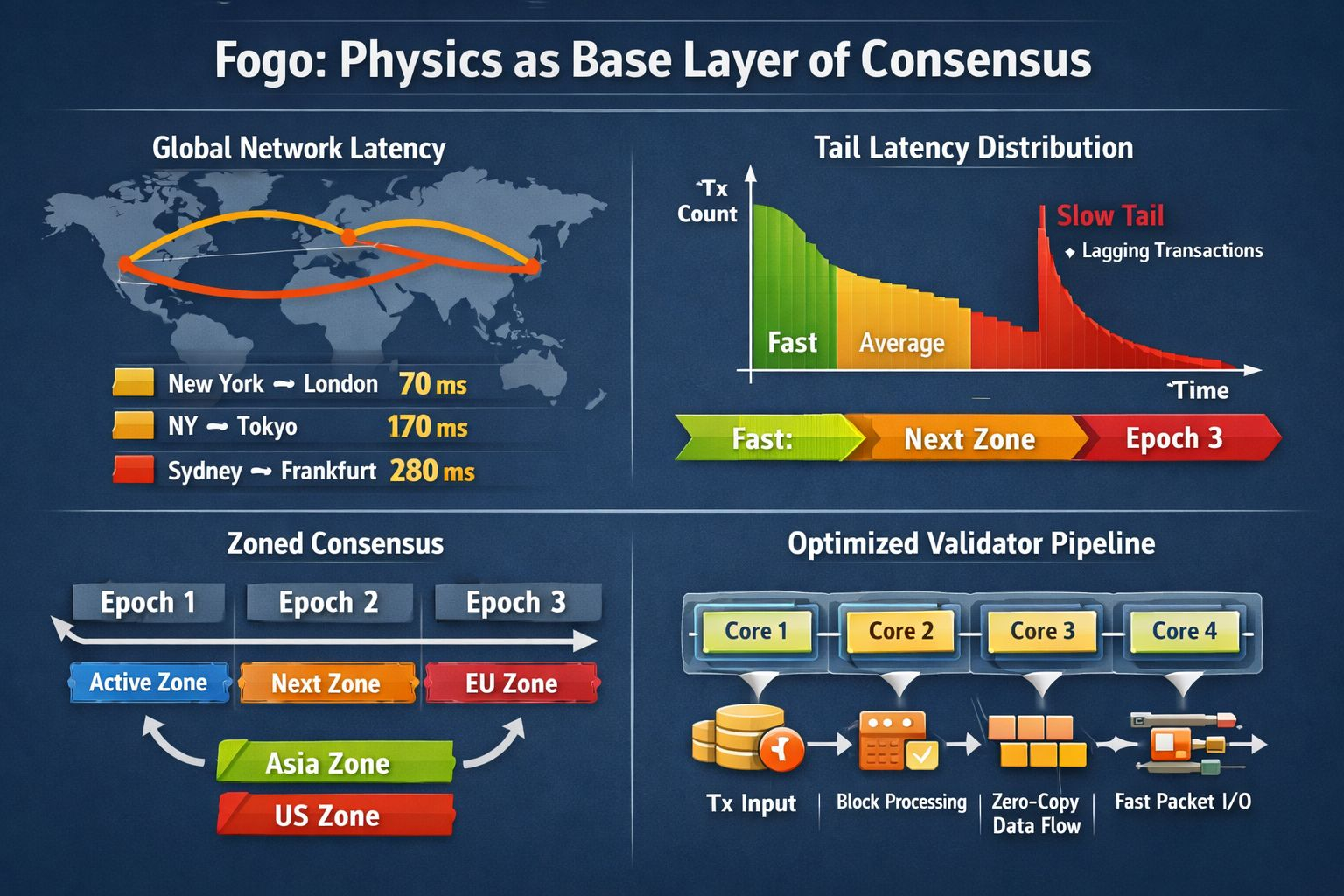
I tried to “feel” chain speed, I did a dumb test. I sent the same tiny swap on two networks while sitting in a noisy cafe, phone on weak Wi-Fi, and I counted in my head. One… two… three… The trade was “done,” but my screen still looked unsure. That gap between done on paper and known in the real world is where most consensus talk gets weird. Fogo (FOGO) starts from a blunt idea: you can’t vote your way around physics. Light in fiber is fast, sure, but not magic-fast. Signals move around ~200,000 km per second in fiber, and real routes bend with cables, peers, and traffic. That’s why cross-ocean round trips can sit around ~70–90 ms, and New York to Tokyo can be ~170 ms on a good day. And most consensus needs more than one message hop. So the “speed” you feel is mostly distance and delay, not some clever math trick. Fogo’s litepaper even says it straight: latency isn’t a nuisance. It’s the base layer. Here’s the part people miss. It’s not just average delay. It’s the slow tail. In plain terms, the whole group moves at the pace of the slowest kid in the line. Fogo calls this out: in big systems, tail latency is the enemy, and the critical path is set by the slowest parts you must wait for. If your validator set is spread all over the world, you’re not building “global speed.” You’re building a global waiting room. That’s why Fogo frames a kind of thesis: a chain that is aware of physical space can be faster than one that pretends space doesn’t matter. So what do you do if you accept the planet as a design rule, not a footnote? Fogo’s answer is zoned, localized consensus. Think of it like running a relay race, but you pick a stadium for each lap. Validators are organized into zones, and only one zone is active in consensus for a given epoch. That sounds like “less decentral,” and yeah, it’s a trade. But it’s a very specific trade: shrink the distance on the critical path, so the quorum can talk fast enough to feel real-time. The inactive zones don’t vanish; they stay connected and keep syncing blocks, but they don’t propose blocks or vote in that epoch. It’s like having a full crew on the ship, but only one shift is steering at a time everyone else is still on deck, watching the map. Zone choice is not hand-wavy either. The litepaper describes different rotation styles. One is epoch-based rotation. Another is “follow-the-sun,” where zones can activate by UTC time, shifting consensus across regions through a 24-hour cycle. If you’ve ever watched how big markets hand off from Asia to Europe to the US, you get the vibe. The point isn’t romance. It’s reducing user-to-quorum distance when it matters. Now, if you only optimize distance, you still lose to the second killer: uneven validator quality. A network can have a fancy protocol, but if half the machines run like old laptops, the chain will act like old laptops. Fogo leans into “performance enforcement,” meaning it tries to cut variance by standardizing on a high-speed validator build and clear ops needs. Again, trade-offs. But it’s honest about what sets real final time: not just what the leader does, but how fast the quorum can receive, check, and respond. This is where Firedancer comes in. Binance Academy notes Fogo integrates Firedancer to push throughput and cut latency. In the litepaper, the mainnet validator is described as “Frankendancer,” a hybrid where Firedancer parts (like networking and block making while leader) run alongside Agave code. If “validator client” sounds abstract, picture it as the engine block of the chain. You can keep the same road rules, but if one car has a lawnmower engine, the traffic flow still suffers. Fogo goes even more “hardware-minded” in how that engine is built. The validator work is split into “tiles,” each pinned to its own CPU core, running tight loops to cut jitter and keep timing steady under load. It’s like a kitchen where every cook has one station and never shares knives. Less bumping, fewer mistakes, faster plates. They also describe tricks like zero-copy flow passing pointers instead of copying data so blocks and tx move through the pipeline without extra lift. And they mention kernel-bypass paths like AF_XDP for fast packet I/O. If you’re not a Linux person, just hear it as: “stop taking the long hallway when there’s a side door.” I like the honesty of starting with physics. Most chains sell you a story about fairness, or purity, or some new vote trick. Fogo is basically saying, “Look, the earth is round, fiber is finite, and slow tails are real. Design from that.” That’s a real frame. But the same frame cuts both ways. Zoned consensus and enforced performance can improve feel and speed, yet they also narrow who can realistically run at the top tier. That’s not evil. It’s just a choice, and choices have edges. If Fogo keeps those edges visible who’s in zones, how rotation works, what the ops bar is then the model is at least legible. And in crypto, legible beats mystical every time.
@Fogo Official #fogo $FOGO #Layer1