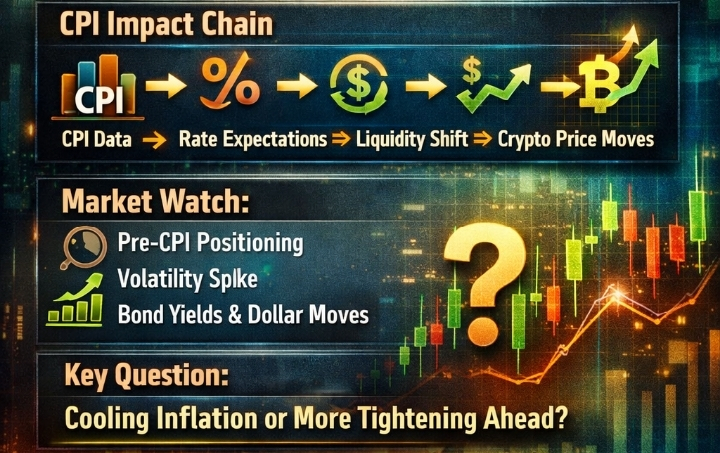
The crypto market is once again turning its attention to U.S. inflation data, as the latest Consumer Price Index (CPI) release shapes expectations around monetary policy and liquidity conditions. For digital assets like Bitcoin, CPI is no longer just a macro statistic — it’s a volatility trigger.
Why CPI Matters for Crypto
CPI measures inflation at the consumer level, and inflation directly influences decisions by the Federal Reserve.
Here’s the macro chain reaction:
CPI Print → Rate Expectations → Liquidity Conditions → Crypto Price Action
Lower-than-expected CPI → Increased probability of rate cuts → More liquidity → Bullish momentum for crypto.
Higher-than-expected CPI → Hawkish rate outlook → Stronger dollar → Pressure on risk assets like crypto.
In recent cycles, softer inflation data has often triggered sharp upside moves in Bitcoin and major altcoins, as traders price in easing financial conditions.
Market Positioning Ahead of the Print
Ahead of CPI releases, leverage typically remains cautious while spot activity increases. This signals that traders are positioning strategically rather than aggressively speculating. Volatility spikes are common within minutes of the data release, as algorithmic trading systems react instantly to deviations from forecasts.
The Bigger Picture
Crypto has evolved into a macro-sensitive asset class. Unlike early cycles driven purely by retail momentum, today’s market responds heavily to liquidity dynamics and institutional flows. CPI now acts as a key sentiment reset — either reinforcing confidence or injecting caution.
What to Watch
Core CPI vs headline CPI deviation
Bond yield reactions
Dollar index movement
Immediate response from Bitcoin and large-cap altcoins
In this phase of the market, CPI isn’t just economic data — it’s a directional catalyst.
The question now:
Is inflation cooling enough to unlock the next liquidity wave, or will persistent pressure keep crypto consolidating?