

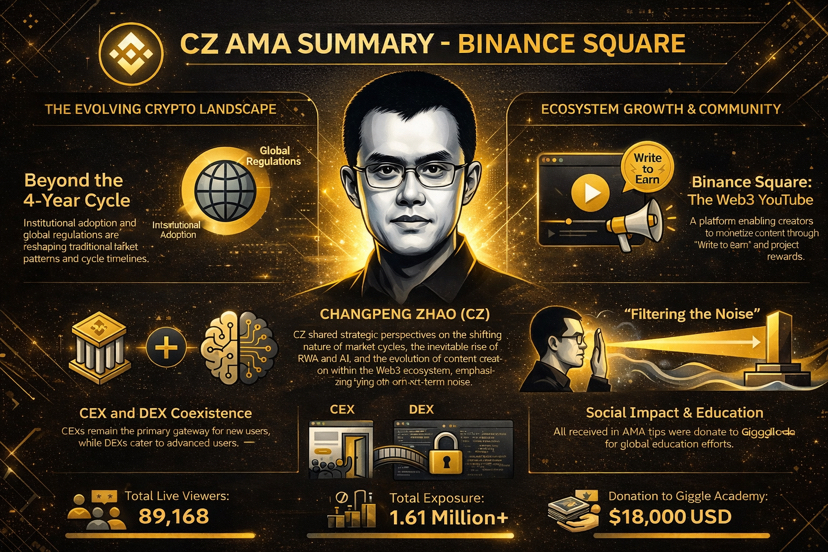
I sat through this AMA and one thing was obvious right away: this wasn’t about exchange features or short-term trades. The conversation went deeper—market psychology, big industry shifts, and how to stay steady when FUD starts flying.
Here’s the breakdown, in plain terms.
⸻
The Market Cycle Is Changing—And the U.S. Matters More Than Ever
CZ was straightforward about one thing: nobody can predict bull or bear markets with precision. Anyone claiming they can is guessing.
The old four-year cycle still exists in people’s minds, but today there are new forces shaping the market. The biggest one? The United States.
For the first time, there are clearer signals that U.S. policymakers are starting to recognize crypto instead of just pushing against it. Regulations are slowly taking shape, and if the U.S. moves toward a supportive framework, other countries won’t want to be left behind in what could become the backbone of a new financial system.
But don’t confuse long-term optimism with short-term calm. Volatility isn’t going anywhere. Risk management is still a personal responsibility—always has been.
CEX vs DEX Isn’t a War
There’s a narrative floating around that centralized exchanges and decentralized exchanges are fighting for survival. CZ doesn’t see it that way at all.
Most everyday users simply aren’t ready to manage private keys and security on their own. That reality alone keeps CEX platforms relevant.
At the same time, experienced users often prefer DEXs because they value full control and transparency.
Both models solve different problems. The market is big enough for both to grow.
This isn’t competition—it’s coexistence.
RWA Might Be One of the Biggest Narratives of the Decade
Tokenized real-world assets came up as a major theme, and it’s easy to see why.
Governments and institutions are already exploring ways to tokenize things like gold, commodities, and even natural resources. Once assets move on-chain, a lot of barriers start to disappear.
Liquidity improves.
Capital can be raised before physical delivery.
Investors from anywhere can participate.
It’s not hard to imagine this sector reaching a trillion-dollar scale if adoption keeps accelerating.
And right now, we’re still early.
AI + Crypto: A Combination That Actually Makes Sense
This part of the discussion was especially interesting.
CZ talked about a future where thousands—maybe millions—of autonomous AI agents operate online, interacting and transacting with each other.
Think about that for a second.
These agents will need to send tiny payments, constantly, across borders, instantly. Traditional banking systems weren’t designed for that kind of activity. Crypto was.
This isn’t science fiction anymore. It’s early, but it’s moving fast, and it could become one of the clearest real-world use cases for blockchain.
Don’t Obsess Over Short-Term Prices
When the topic shifted to Aster and market volatility, CZ’s response was simple: price comparisons in the short term don’t mean much.
Strong products take time to build. Teams that stay focused on fundamentals usually outlast the noise.
Short-term charts can distract you from long-term reality.
How to Deal With FUD Without Losing Focus
His take on FUD was refreshingly practical.
Not every attack deserves a response.
Not every rumor needs to be debated.
Sometimes the smartest move is to ignore the noise, mute the negativity, and keep building.
Markets have a way of filtering out misinformation on their own—but only if teams stay focused instead of reacting emotionally.
Ending on the Right Note
One detail that stood out: about 18,000 USD in tips from the livestream were donated to Giggle Academy.
That says a lot about priorities.
In an industry obsessed with price action, putting money into education is a reminder that the real value of crypto isn’t just speculation—it’s building tools, knowledge, and systems that last longer than any market cycle.

