

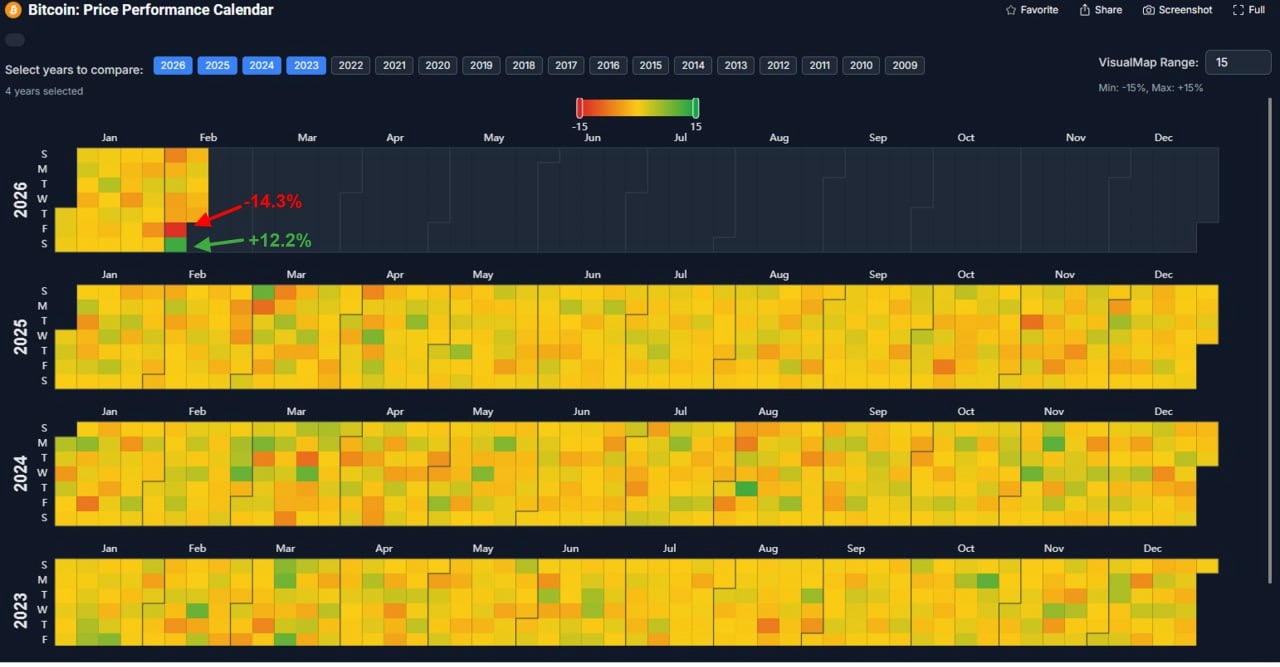
For the past few months, $BTC moved in a relatively tight range. Price was drifting sideways, daily candles were smaller, and volatility compressed. Many traders started to feel comfortable again.
That phase is clearly over.
If you look at the recent price performance, February 5–6 stands out. In a very short window, $BTC dropped -14.3%, then snapped back +12.2% almost immediately. That kind of two-way move is not random noise — it’s a volatility expansion event.
After that shakeout, both 30-day and 180-day volatility metrics turned higher. This signals a structural shift: the market is transitioning from compression to expansion.
When volatility is low, price action feels slow and manageable. But when volatility expands, $BTC can move thousands of dollars within hours. Markets rarely stay quiet for long. When movement is suppressed for weeks or months, energy builds — and eventually releases violently.
So why is volatility rising now?
First: leverage buildup.
During extended sideways conditions, traders accumulate leveraged positions on both sides. Longs build below support. Shorts stack above resistance. The longer price stays inside a range, the more crowded positioning becomes.
Once price breaks that range, liquidation engines activate. A sharp drop forces long liquidations, creating additional sell pressure. Then a strong bounce wipes out shorts, triggering forced buying. This chain reaction rapidly widens price swings.
Second: liquidity conditions.
Early 2026 has been influenced by macro uncertainty, shifting rate expectations, ETF outflows, and broader risk-off sentiment. When liquidity thins, markets become more fragile. It takes less capital to move price aggressively compared to high-liquidity periods.
Thin books + large orders = exaggerated moves.
Third: psychology.
Low-volatility environments breed overconfidence. Traders increase leverage because “nothing is happening.” When real movement begins, the reaction becomes amplified. Volatility doesn’t just reflect supply and demand — it reflects trapped positioning and emotional overreaction.
The key thing to understand:
Markets do not stay compressed forever.
Extended calm periods often precede violent expansion phases. And during volatility expansion, both longs and shorts can get damaged quickly.
This is not the phase to trade emotionally.
This is the phase to trade with discipline — or step aside and wait for structure to rebuild.
Volatility is not the enemy.
Lack of preparation is.
